QUESTION IMAGE
Question
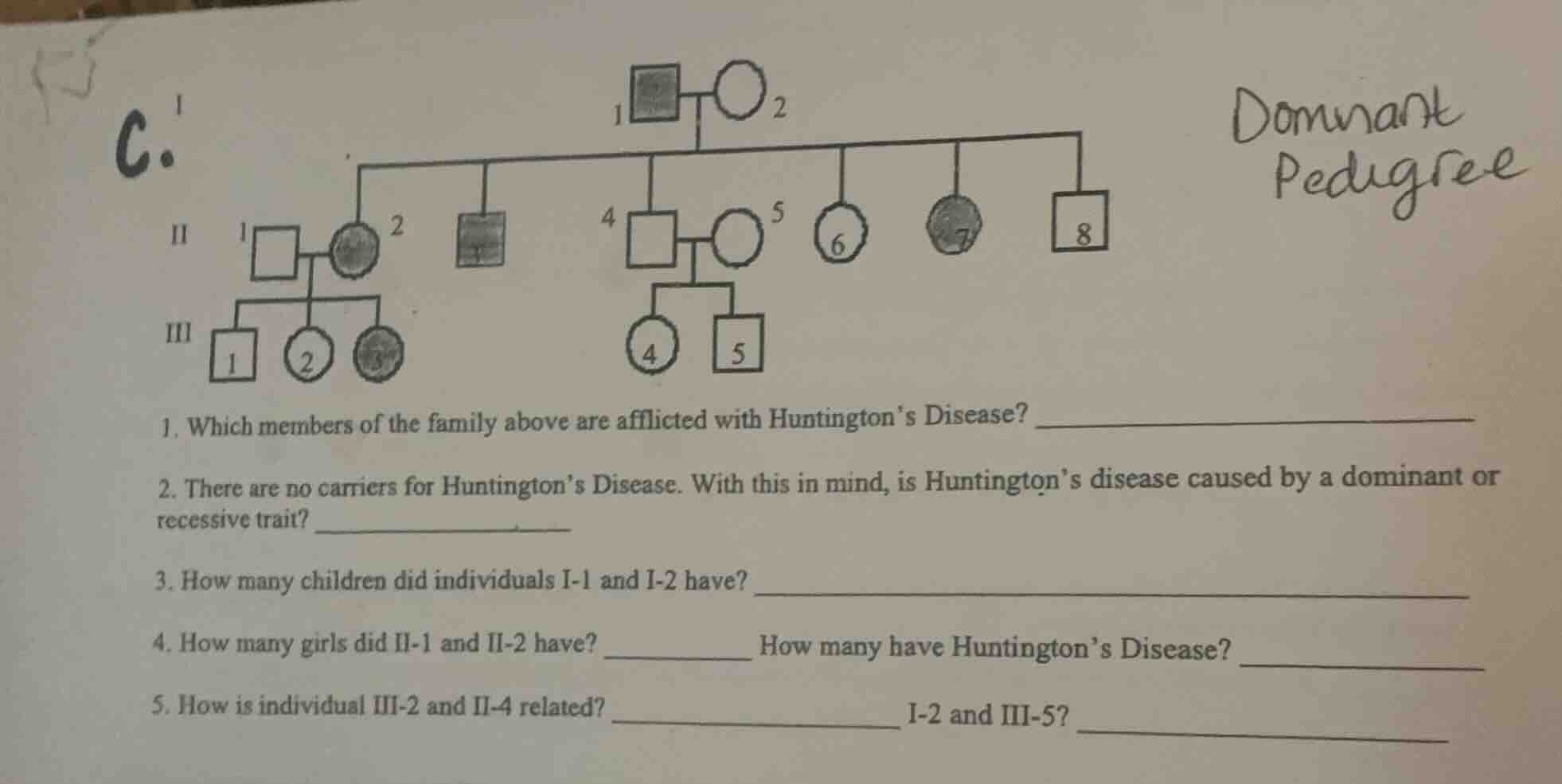
dominant pedigree
- which members of the family above are afflicted with huntingtons disease? ____________
- there are no carriers for huntingtons disease. with this in mind, is huntingtons disease caused by a dominant or recessive trait? ____________
- how many children did individuals i-1 and i-2 have? ____________
- how many girls did ii-1 and ii-2 have? __________ how many have huntingtons disease? __________
- how is individual iii-2 and ii-4 related? __________ i-2 and iii-5? __________
Brief Explanations
- Shaded symbols in the pedigree represent individuals afflicted with the disease.
- Dominant genetic disorders have no carriers—individuals either have the disease (dominant allele) or do not (recessive alleles only).
- Count all individuals in generation II who are children of I-1 and I-2.
- Count female (circle) children of II-1 and II-2, then count how many of those are shaded.
- II-4 is the uncle of III-2 (brother of III-2's mother II-2); I-2 is the great-grandmother of III-5 (grandmother of III-5's father II-4).

Snap & solve any problem in the app
Get step-by-step solutions on Sovi AI
Photo-based solutions with guided steps
Explore more problems and detailed explanations
- I-1, II-2, II-3, II-7, III-3
- Dominant
- 5
- 2; 1
- They are niece and uncle (or aunt and nephew, with III-2 as niece, II-4 as uncle); They are great-grandmother and great-grandson (I-2 is great-grandmother, III-5 is great-grandson)