QUESTION IMAGE
Question
drag and drop each equation to the model that it represents.
equations:
$36 - \square = 15$
$15 + 36 = \square$
$15 + \square = 36$
$\square - 15 = 36$
First, analyze the two models:
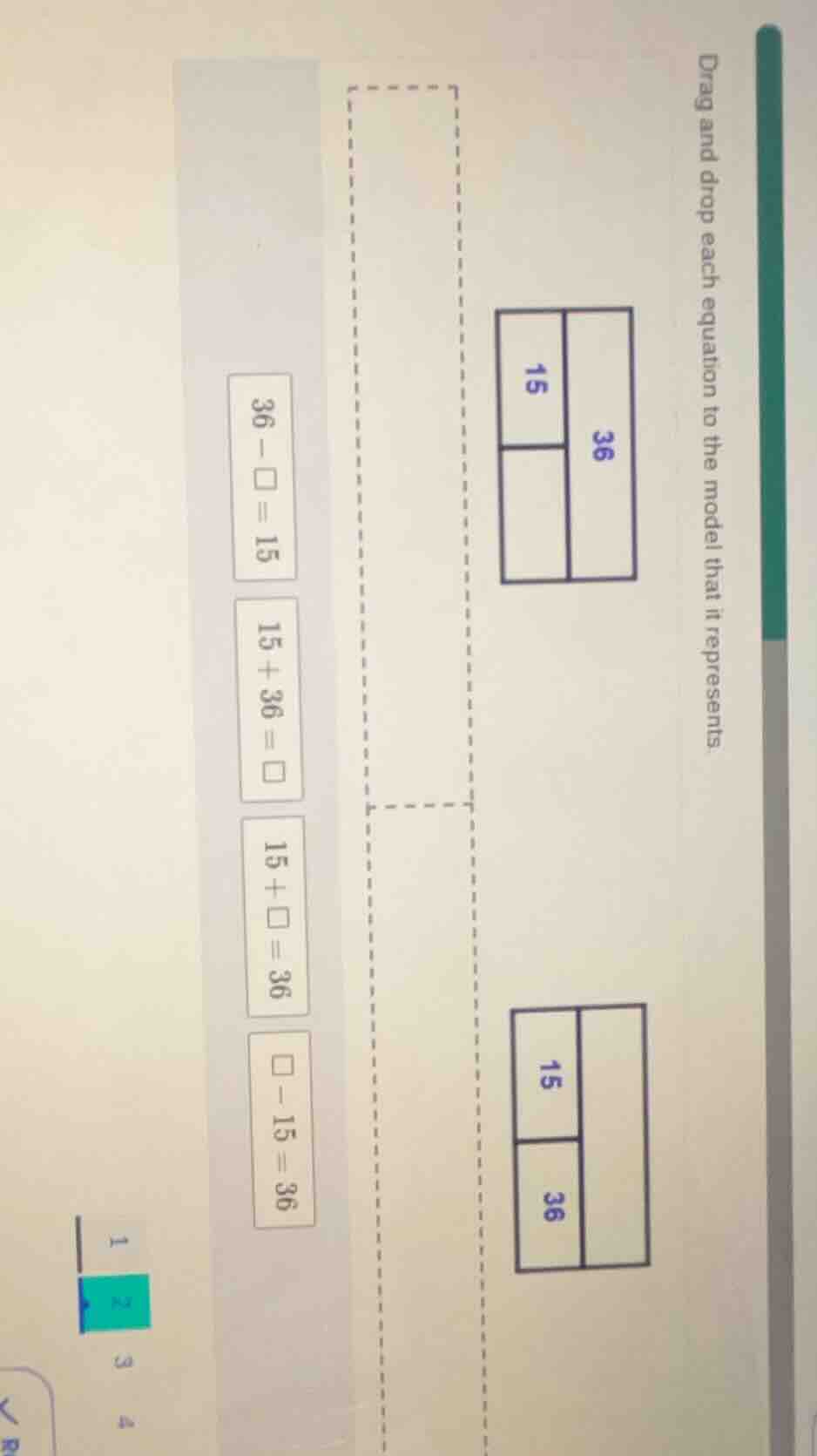
Top Model (with 15 and 36 in a vertical split? Wait, looking at the diagram: The top model has a rectangle with 36 on the right, and 15 on the top left, then a blank below 15. So the total of the left column (15 + blank) should equal the right column (36)? Wait, no, maybe the model is a bar where one part is 15, another part is unknown, and the total is 36? Wait, no, the first model: the big rectangle on the right is 36, and the left is split into 15 (top) and a blank (bottom). So the left side (15 + blank) is equal to the right side (36)? Wait, maybe the model is showing that 15 + x = 36, or 36 - x = 15, or x - 15 = 36? Wait, no, let's look at the equations:
Equations:
- \( 36 - \square = 15 \)
- \( 15 + 36 = \square \)
- \( 15 + \square = 36 \)
- \( \square - 15 = 36 \)
Top Diagram:
The top diagram has a vertical rectangle on the right labeled 36, and on the left, a vertical rectangle split into two parts: top is 15, bottom is blank. So the left side (15 + blank) should equal the right side (36)? Wait, no, maybe the right side (36) is the total, and the left side is 15 + blank, so 15 + blank = 36. Alternatively, 36 - blank = 15.
Bottom Diagram:
The bottom diagram has a vertical rectangle on the left split into two parts: top is 15, bottom is 36, and the right side is blank. So the left side (15 + 36) should equal the right side (blank). So that would be 15 + 36 = blank, or blank - 15 = 36 (since blank = 15 + 36, so blank - 15 = 36).
Now match each equation to the model:
Top Model (15, blank, 36):
- Equations that fit: \( 15 + \square = 36 \) (since 15 + blank = 36) and \( 36 - \square = 15 \) (since 36 - blank = 15, which is the same as 15 + blank = 36).
Bottom Model (15, 36, blank):
- Equations that fit: \( 15 + 36 = \square \) (since 15 + 36 = blank) and \( \square - 15 = 36 \) (since blank - 15 = 36, which is the same as blank = 15 + 36).
Let's solve each equation to find the blank:
- \( 36 - \square = 15 \): Solve for \( \square \): \( \square = 36 - 15 = 21 \)
- \( 15 + 36 = \square \): \( \square = 51 \)
- \( 15 + \square = 36 \): \( \square = 36 - 15 = 21 \)
- \( \square - 15 = 36 \): \( \square = 36 + 15 = 51 \)
Now match to the models:
- Top Model (15, blank, 36): The left side is 15 + blank, right side is 36. So equations where 15 + blank = 36 (i.e., \( 15 + \square = 36 \)) and 36 - blank = 15 (i.e., \( 36 - \square = 15 \)) belong here.
- Bottom Model (15, 36, blank): The left side is 15 + 36, right side is blank. So equations where 15 + 36 = blank (i.e., \( 15 + 36 = \square \)) and blank - 15 = 36 (i.e., \( \square - 15 = 36 \)) belong here.
So:
- Top Model (15, blank, 36) gets:
- \( 15 + \square = 36 \)
- \( 36 - \square = 15 \)
- Bottom Model (15, 36, blank) gets:
- \( 15 + 36 = \square \)
- \( \square - 15 = 36 \)
Let's verify:
For Top Model:
- \( 15 + \square = 36 \): If we solve, \( \square = 21 \). So 15 + 21 = 36, which matches the model (15 + blank = 36).
- \( 36 - \square = 15 \): \( \square = 21 \), so 36 - 21 = 15, which also matches (total 36, subtract blank to get 15).
For Bottom Model:
- \( 15 + 36 = \square \): \( \square = 51 \), so 15 + 36 = 51, which matches the model (15 + 36 = blank).
- \( \square - 15 = 36 \): \( \square = 51 \), so 51 - 15 = 36, which matches (blank - 15 = 36).
So the equations should be dragged as follows:
- Top Model (with 36 on the right, 15 top left, blank bottom left):
- \( 15 + \square = 36 \)
- \( 36 - \square = 15 \)
- Bottom Model (wit…

Snap & solve any problem in the app
Get step-by-step solutions on Sovi AI
Photo-based solutions with guided steps
Explore more problems and detailed explanations
First, analyze the two models:
Top Model (with 15 and 36 in a vertical split? Wait, looking at the diagram: The top model has a rectangle with 36 on the right, and 15 on the top left, then a blank below 15. So the total of the left column (15 + blank) should equal the right column (36)? Wait, no, maybe the model is a bar where one part is 15, another part is unknown, and the total is 36? Wait, no, the first model: the big rectangle on the right is 36, and the left is split into 15 (top) and a blank (bottom). So the left side (15 + blank) is equal to the right side (36)? Wait, maybe the model is showing that 15 + x = 36, or 36 - x = 15, or x - 15 = 36? Wait, no, let's look at the equations:
Equations:
- \( 36 - \square = 15 \)
- \( 15 + 36 = \square \)
- \( 15 + \square = 36 \)
- \( \square - 15 = 36 \)
Top Diagram:
The top diagram has a vertical rectangle on the right labeled 36, and on the left, a vertical rectangle split into two parts: top is 15, bottom is blank. So the left side (15 + blank) should equal the right side (36)? Wait, no, maybe the right side (36) is the total, and the left side is 15 + blank, so 15 + blank = 36. Alternatively, 36 - blank = 15.
Bottom Diagram:
The bottom diagram has a vertical rectangle on the left split into two parts: top is 15, bottom is 36, and the right side is blank. So the left side (15 + 36) should equal the right side (blank). So that would be 15 + 36 = blank, or blank - 15 = 36 (since blank = 15 + 36, so blank - 15 = 36).
Now match each equation to the model:
Top Model (15, blank, 36):
- Equations that fit: \( 15 + \square = 36 \) (since 15 + blank = 36) and \( 36 - \square = 15 \) (since 36 - blank = 15, which is the same as 15 + blank = 36).
Bottom Model (15, 36, blank):
- Equations that fit: \( 15 + 36 = \square \) (since 15 + 36 = blank) and \( \square - 15 = 36 \) (since blank - 15 = 36, which is the same as blank = 15 + 36).
Let's solve each equation to find the blank:
- \( 36 - \square = 15 \): Solve for \( \square \): \( \square = 36 - 15 = 21 \)
- \( 15 + 36 = \square \): \( \square = 51 \)
- \( 15 + \square = 36 \): \( \square = 36 - 15 = 21 \)
- \( \square - 15 = 36 \): \( \square = 36 + 15 = 51 \)
Now match to the models:
- Top Model (15, blank, 36): The left side is 15 + blank, right side is 36. So equations where 15 + blank = 36 (i.e., \( 15 + \square = 36 \)) and 36 - blank = 15 (i.e., \( 36 - \square = 15 \)) belong here.
- Bottom Model (15, 36, blank): The left side is 15 + 36, right side is blank. So equations where 15 + 36 = blank (i.e., \( 15 + 36 = \square \)) and blank - 15 = 36 (i.e., \( \square - 15 = 36 \)) belong here.
So:
- Top Model (15, blank, 36) gets:
- \( 15 + \square = 36 \)
- \( 36 - \square = 15 \)
- Bottom Model (15, 36, blank) gets:
- \( 15 + 36 = \square \)
- \( \square - 15 = 36 \)
Let's verify:
For Top Model:
- \( 15 + \square = 36 \): If we solve, \( \square = 21 \). So 15 + 21 = 36, which matches the model (15 + blank = 36).
- \( 36 - \square = 15 \): \( \square = 21 \), so 36 - 21 = 15, which also matches (total 36, subtract blank to get 15).
For Bottom Model:
- \( 15 + 36 = \square \): \( \square = 51 \), so 15 + 36 = 51, which matches the model (15 + 36 = blank).
- \( \square - 15 = 36 \): \( \square = 51 \), so 51 - 15 = 36, which matches (blank - 15 = 36).
So the equations should be dragged as follows:
- Top Model (with 36 on the right, 15 top left, blank bottom left):
- \( 15 + \square = 36 \)
- \( 36 - \square = 15 \)
- Bottom Model (with 15 top left, 36 bottom left, blank right):
- \( 15 + 36 = \square \)
- \( \square - 15 = 36 \)