QUESTION IMAGE
Question
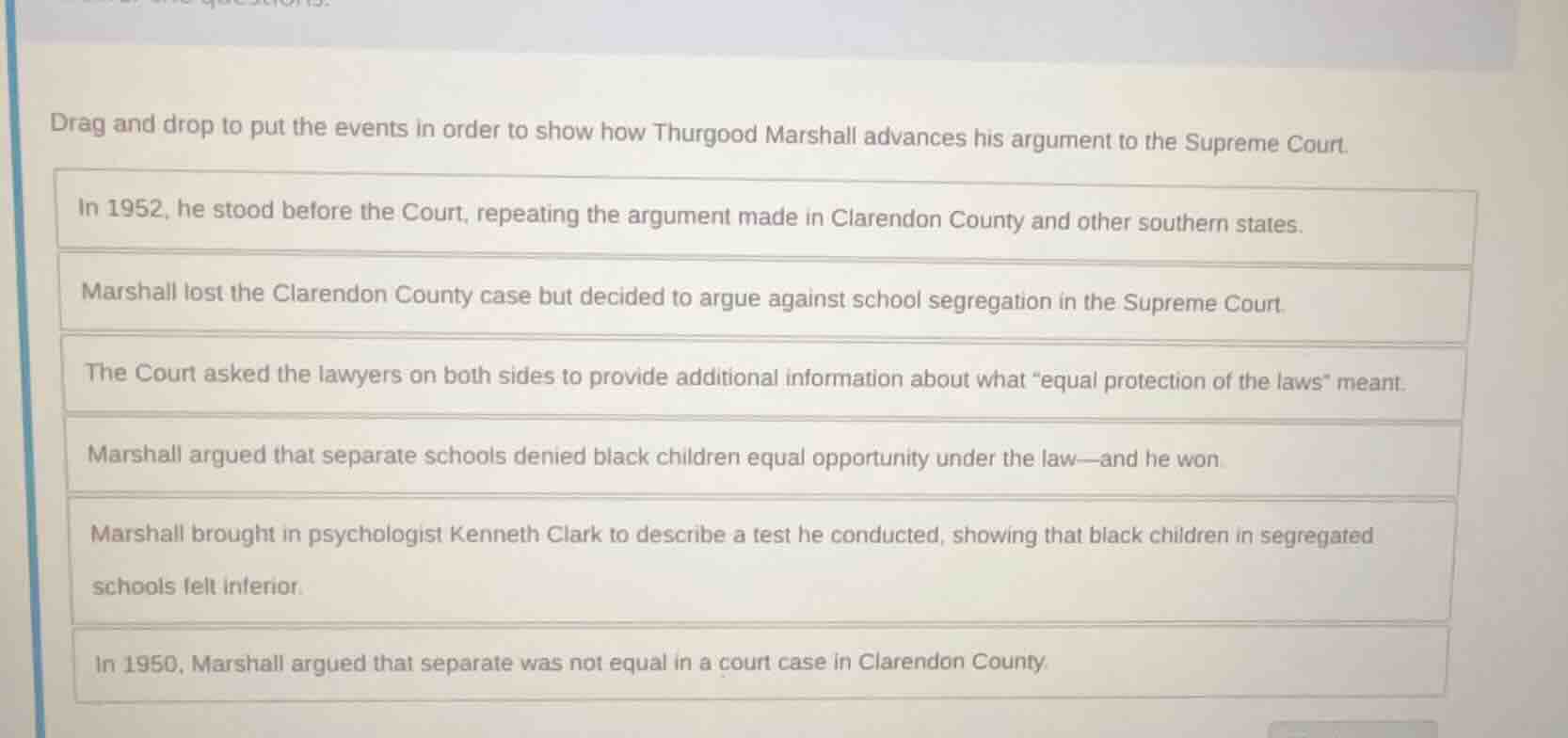
drag and drop to put the events in order to show how thurgood marshall advances his argument to the supreme court.
in 1952, he stood before the court, repeating the argument made in clarendon county and other southern states.
marshall lost the clarendon county case but decided to argue against school segregation in the supreme court.
the court asked the lawyers on both sides to provide additional information about what \equal protection of the laws\ meant.
marshall argued that separate schools denied black children equal opportunity under the law—and he won
marshall brought in psychologist kenneth clark to describe a test he conducted, showing that black children in segregated schools felt inferior.
in 1950, marshall argued that separate was not equal in a court case in clarendon county.
The events are ordered chronologically to trace Thurgood Marshall's path to arguing against school segregation at the Supreme Court, starting with his early county case, his loss leading to a Supreme Court challenge, his 1952 argument, the Court's request for more info, his use of social science evidence, and finally his successful ruling.

Snap & solve any problem in the app
Get step-by-step solutions on Sovi AI
Photo-based solutions with guided steps
Explore more problems and detailed explanations
- In 1950, Marshall argued that separate was not equal in a court case in Clarendon County.
- Marshall lost the Clarendon County case but decided to argue against school segregation in the Supreme Court.
- In 1952, he stood before the Court, repeating the argument made in Clarendon County and other southern states.
- The Court asked the lawyers on both sides to provide additional information about what "equal protection of the laws" meant.
- Marshall brought in psychologist Kenneth Clark to describe a test he conducted, showing that black children in segregated schools felt inferior.
- Marshall argued that separate schools denied black children equal opportunity under the law—and he won.