QUESTION IMAGE
Question
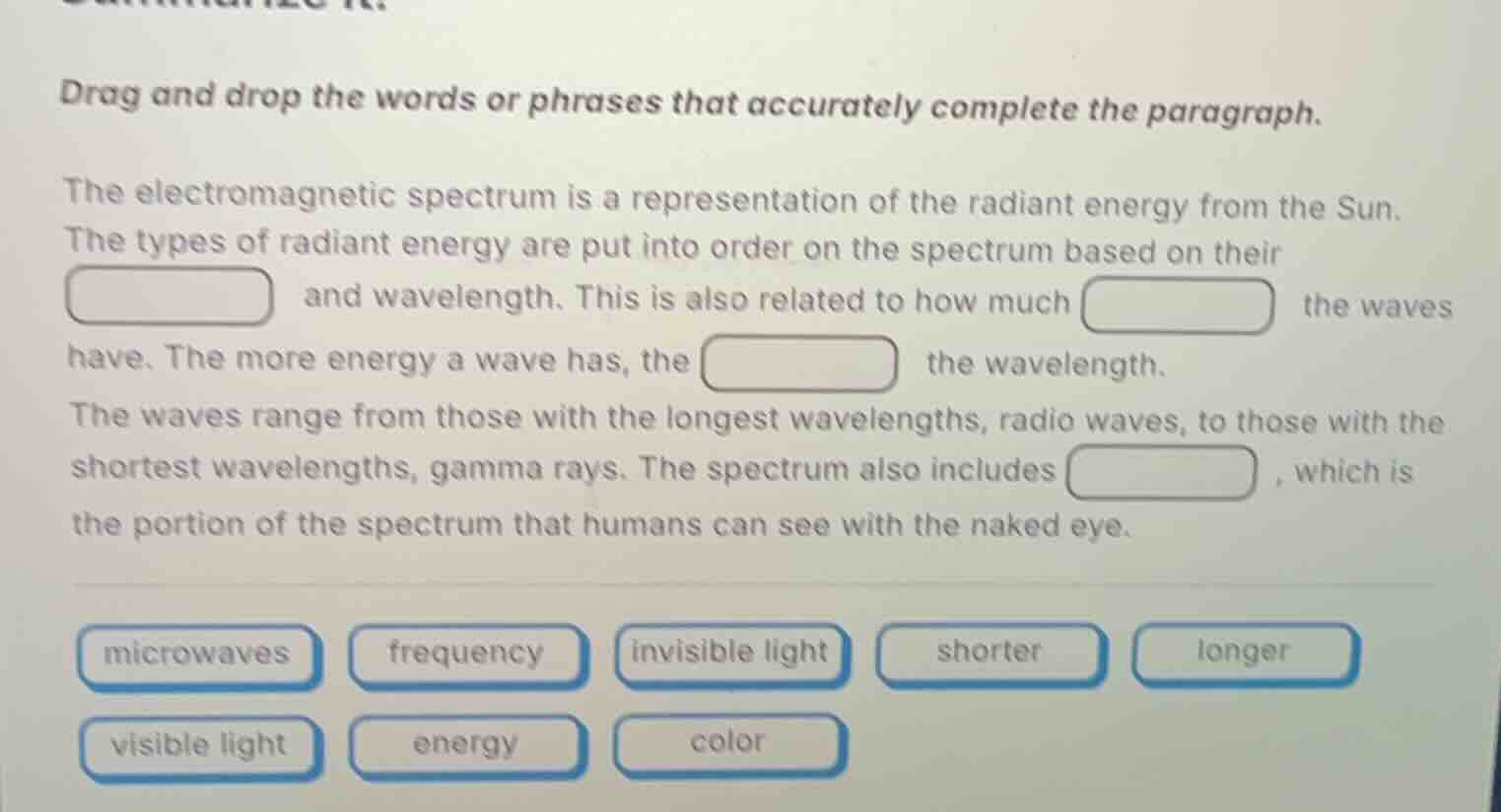
drag and drop the words or phrases that accurately complete the paragraph.
the electromagnetic spectrum is a representation of the radiant energy from the sun. the types of radiant energy are put into order on the spectrum based on their
and wavelength. this is also related to how much the waves
have. the more energy a wave has, the the wavelength.
the waves range from those with the longest wavelengths, radio waves, to those with the
shortest wavelengths, gamma rays. the spectrum also includes , which is
the portion of the spectrum that humans can see with the naked eye.
microwaves frequency invisible light shorter longer
visible light energy color
To solve this, we analyze the electromagnetic spectrum concepts:
- The first blank relates to how radiant energy is ordered on the spectrum. The two key properties of electromagnetic waves are frequency and wavelength, so "frequency" fits here.
- The second blank connects to the energy of the waves. The phrase "how much" refers to the quantity of energy, so "energy" is correct.
- The third blank follows the relationship \( E = hf=\frac{hc}{\lambda} \) (energy is inversely proportional to wavelength). So more energy means "shorter" wavelength.
- The fourth blank refers to the visible part of the spectrum. "Visible light" is the portion humans can see.
Filling the blanks:
- First blank: frequency
- Second blank: energy
- Third blank: shorter
- Fourth blank: visible light
The completed paragraph:
The electromagnetic spectrum is a representation of the radiant energy from the Sun. The types of radiant energy are put into order on the spectrum based on their \(\boldsymbol{\text{frequency}}\) and wavelength. This is also related to how much \(\boldsymbol{\text{energy}}\) the waves have. The more energy a wave has, the \(\boldsymbol{\text{shorter}}\) the wavelength. The waves range from those with the longest wavelengths, radio waves, to those with the shortest wavelengths, gamma rays. The spectrum also includes \(\boldsymbol{\text{visible light}}\), which is the portion of the spectrum that humans can see with the naked eye.

Snap & solve any problem in the app
Get step-by-step solutions on Sovi AI
Photo-based solutions with guided steps
Explore more problems and detailed explanations
To solve this, we analyze the electromagnetic spectrum concepts:
- The first blank relates to how radiant energy is ordered on the spectrum. The two key properties of electromagnetic waves are frequency and wavelength, so "frequency" fits here.
- The second blank connects to the energy of the waves. The phrase "how much" refers to the quantity of energy, so "energy" is correct.
- The third blank follows the relationship \( E = hf=\frac{hc}{\lambda} \) (energy is inversely proportional to wavelength). So more energy means "shorter" wavelength.
- The fourth blank refers to the visible part of the spectrum. "Visible light" is the portion humans can see.
Filling the blanks:
- First blank: frequency
- Second blank: energy
- Third blank: shorter
- Fourth blank: visible light
The completed paragraph:
The electromagnetic spectrum is a representation of the radiant energy from the Sun. The types of radiant energy are put into order on the spectrum based on their \(\boldsymbol{\text{frequency}}\) and wavelength. This is also related to how much \(\boldsymbol{\text{energy}}\) the waves have. The more energy a wave has, the \(\boldsymbol{\text{shorter}}\) the wavelength. The waves range from those with the longest wavelengths, radio waves, to those with the shortest wavelengths, gamma rays. The spectrum also includes \(\boldsymbol{\text{visible light}}\), which is the portion of the spectrum that humans can see with the naked eye.