QUESTION IMAGE
Question
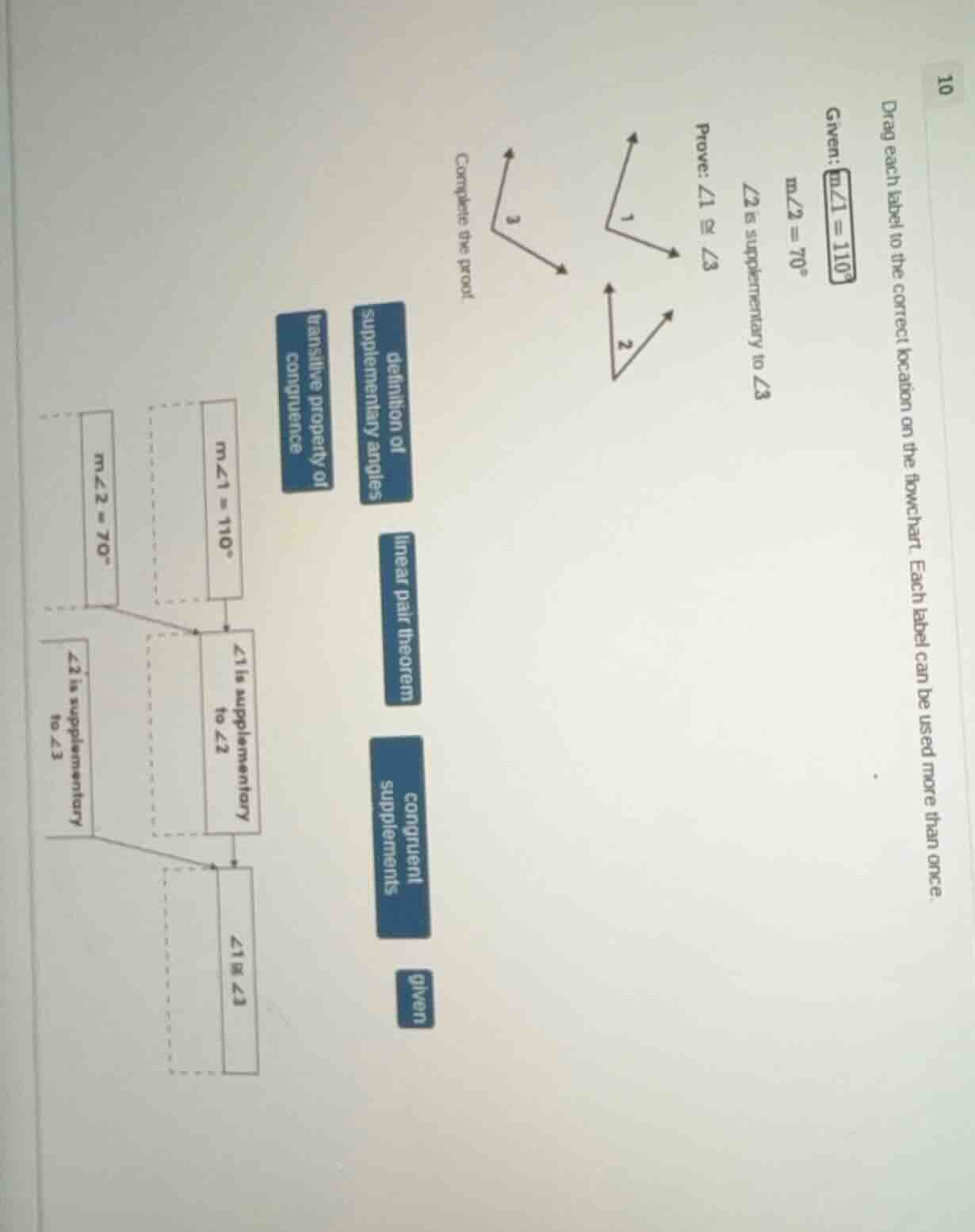
drag each label to the correct location on the flowchart. each label can be used more than once. given: ( mangle1 = 110^circ ), ( mangle2 = 70^circ ), ( angle2 ) is supplementary to ( angle3 ). prove: ( angle1 cong angle3 ). complete the proof. images of angles 1, 2, 3 and a flowchart with boxes: ( mangle1 = 110^circ ), ( mangle2 = 70^circ ), ( angle1 ) is supplementary to ( angle2 ), ( angle2 ) is supplementary to ( angle3 ), ( angle1 cong angle3 ); and labels: definition of supplementary angles, transitive property of congruence, linear pair theorem, congruent supplements, given
Step1: Identify the given information
We are given that \( m\angle1 = 110^\circ \) and \( m\angle2=70^\circ \), and \( \angle2 \) is supplementary to \( \angle3 \). We need to prove \( \angle1\cong\angle3 \).
Step2: Determine the relationship between \( \angle1 \) and \( \angle2 \)
First, check if \( \angle1 \) and \( \angle2 \) are supplementary. The sum of their measures is \( m\angle1 + m\angle2=110^\circ + 70^\circ = 180^\circ \). By the definition of supplementary angles, \( \angle1 \) is supplementary to \( \angle2 \).
Step3: Use the property of congruent supplements
We know that \( \angle2 \) is supplementary to \( \angle3 \) (given) and \( \angle1 \) is supplementary to \( \angle2 \) (from Step 2). By the theorem that congruent supplements (angles supplementary to the same angle) are congruent, we can conclude that \( \angle1\cong\angle3 \).
Now, for the flowchart:
- The box with \( m\angle1 = 110^\circ \) and \( m\angle2 = 70^\circ \) are labeled with "given".
- The step where we say \( \angle1 \) is supplementary to \( \angle2 \) uses the "definition of supplementary angles" (since their sum is \( 180^\circ \)).
- The step where we use the fact that \( \angle2 \) is supplementary to \( \angle3 \) (given) and \( \angle1 \) is supplementary to \( \angle2 \) to conclude \( \angle1\cong\angle3 \) uses the "congruent supplements" theorem.
- The step \( \angle2 \) is supplementary to \( \angle3 \) is "given" (or from the problem's given information).

Snap & solve any problem in the app
Get step-by-step solutions on Sovi AI
Photo-based solutions with guided steps
Explore more problems and detailed explanations
- For \( m\angle1 = 110^\circ \) and \( m\angle2 = 70^\circ \): label with "given".
- For \( \angle1 \) is supplementary to \( \angle2 \): label with "definition of supplementary angles".
- For \( \angle2 \) is supplementary to \( \angle3 \): label with "given".
- For \( \angle1\cong\angle3 \): label with "congruent supplements" (theorem that angles supplementary to the same angle are congruent).
(If we were to map the flowchart boxes:
- The top left box (\( m\angle1 = 110^\circ \)): "given"
- The box below it (\( m\angle2 = 70^\circ \)): "given"
- The box \( \angle1 \) is supplementary to \( \angle2 \): "definition of supplementary angles" (since \( 110 + 70 = 180 \))
- The box \( \angle2 \) is supplementary to \( \angle3 \): "given" (from the problem statement)
- The box \( \angle1\cong\angle3 \): "congruent supplements" (because \( \angle1 \) and \( \angle3 \) are both supplementary to \( \angle2 \)) )