QUESTION IMAGE
Question
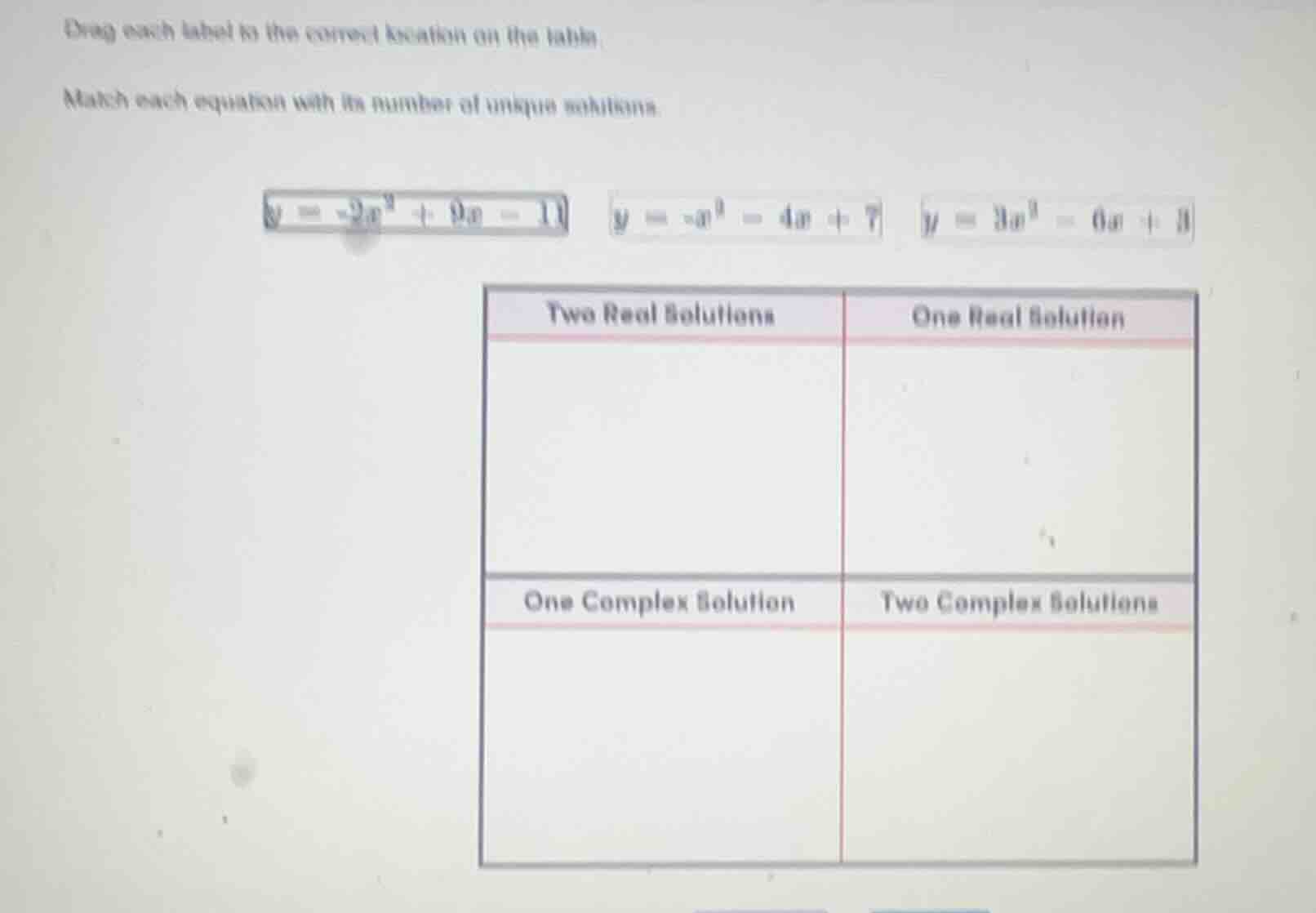
drag each label to the correct location on the table.
match each equation with its number of unique solutions.
$y = -2x^2 + 9x - 11$ $y = -x^2 - 4x + 7$ $y = 3x^2 - 6x + 3$
(table with four cells: two real solutions, one real solution, one complex solution, two complex solutions)
Step1: Recall discriminant formula
For quadratic $ax^2+bx+c=0$, discriminant $\Delta = b^2-4ac$
Step2: Calculate $\Delta$ for $y=-2x^2+9x-11$
$\Delta = 9^2 - 4(-2)(-11) = 81 - 88 = -7$
Step3: Calculate $\Delta$ for $y=-x^2-4x+7$
$\Delta = (-4)^2 - 4(-1)(7) = 16 + 28 = 44$
Step4: Calculate $\Delta$ for $y=3x^2-6x+3$
$\Delta = (-6)^2 - 4(3)(3) = 36 - 36 = 0$
Step5: Classify by $\Delta$
- $\Delta>0$: 2 real solutions; $\Delta=0$: 1 real solution; $\Delta<0$: 2 complex solutions

Snap & solve any problem in the app
Get step-by-step solutions on Sovi AI
Photo-based solutions with guided steps
Explore more problems and detailed explanations
| Two Real Solutions | One Real Solution |
|---|---|
| One Complex Solution | Two Complex Solutions |
| (Empty) | $y = -2x^2 + 9x - 11$ |
Note: "One Complex Solution" is not applicable here, as quadratic equations have either 0, 1, or 2 distinct solutions (real or complex; complex solutions come in conjugate pairs).