QUESTION IMAGE
Question
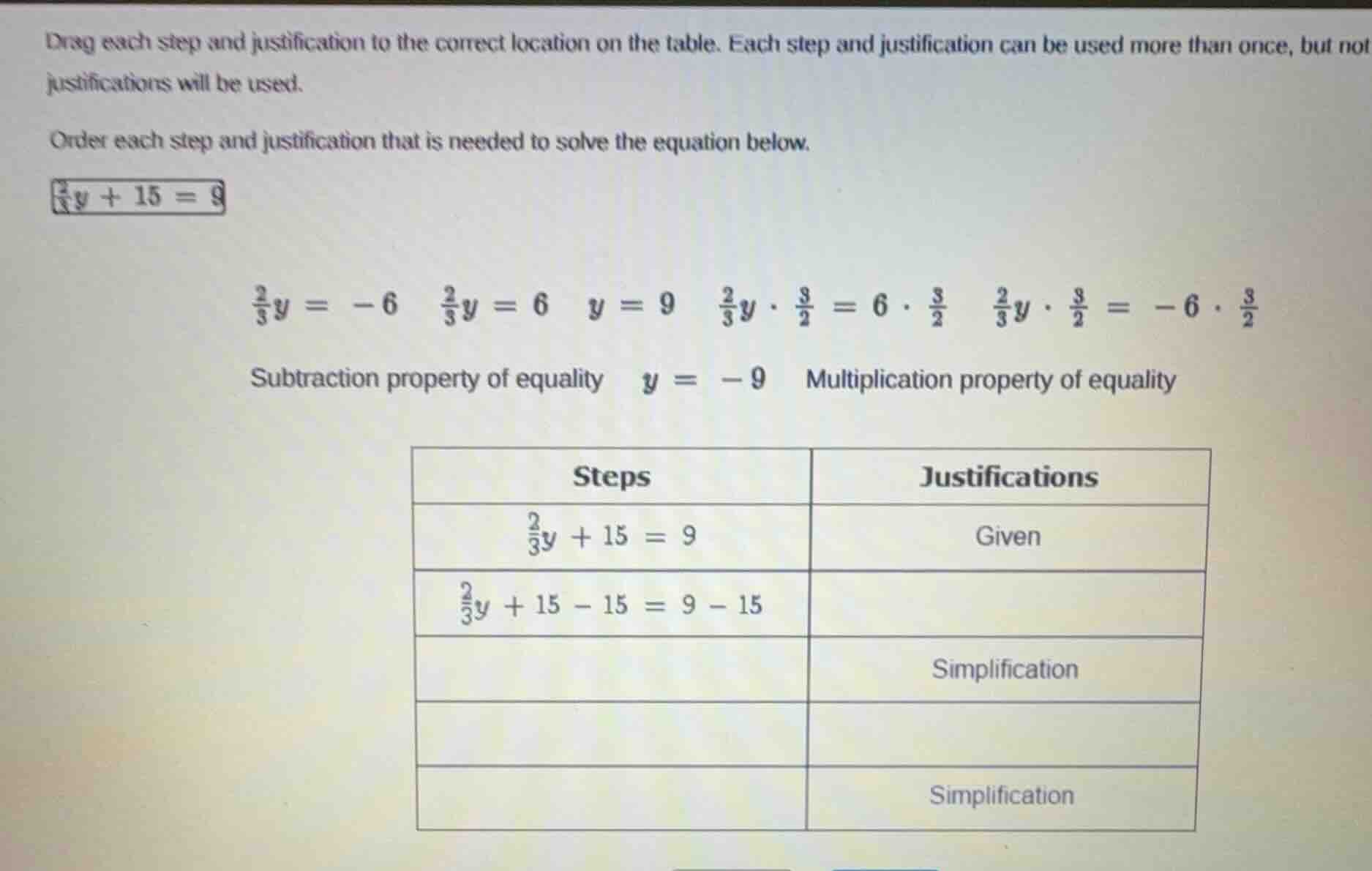
drag each step and justification to the correct location on the table. each step and justification can be used more than once, but not justifications will be used.
order each step and justification that is needed to solve the equation below.
\\(\boldsymbol{\frac{2}{3}y + 15 = 9}\\)
\\(\frac{2}{3}y = -6\\) \\(\frac{2}{3}y = 6\\) \\(y = 9\\) \\(\frac{2}{3}y cdot \frac{3}{2} = 6 cdot \frac{3}{2}\\) \\(\frac{2}{3}y cdot \frac{3}{2} = -6 cdot \frac{3}{2}\\)
subtraction property of equality \\(y = -9\\) multiplication property of equality
| steps | justifications |
|---|---|
| \\(\frac{2}{3}y + 15 - 15 = 9 - 15\\) | |
| simplification | |
| simplification |
Step1: Apply Subtraction Property of Equality
To isolate the term with \( y \), we subtract 15 from both sides of the equation \(\frac{2}{3}y + 15 = 9\). This gives \(\frac{2}{3}y + 15 - 15 = 9 - 15\), and the justification for this step is the Subtraction Property of Equality (subtracting the same number from both sides of an equation keeps it balanced).
Step2: Simplify the Equation
Simplify both sides of \(\frac{2}{3}y + 15 - 15 = 9 - 15\). The left - hand side simplifies to \(\frac{2}{3}y\) (since \(15 - 15 = 0\)), and the right - hand side simplifies to \(9-15=-6\). So we get \(\frac{2}{3}y=-6\), and the justification is Simplification.
Step3: Apply Multiplication Property of Equality
To solve for \( y \), we multiply both sides of the equation \(\frac{2}{3}y=-6\) by the reciprocal of \(\frac{2}{3}\), which is \(\frac{3}{2}\). So we have \(\frac{2}{3}y\times\frac{3}{2}=-6\times\frac{3}{2}\), and the justification for this step is the Multiplication Property of Equality (multiplying both sides of an equation by the same non - zero number keeps it balanced).
Step4: Simplify the Equation
Simplify both sides of \(\frac{2}{3}y\times\frac{3}{2}=-6\times\frac{3}{2}\). The left - hand side simplifies to \(y\) (since \(\frac{2}{3}\times\frac{3}{2} = 1\)), and the right - hand side simplifies to \(-9\) (since \(-6\times\frac{3}{2}=-9\)). So we get \(y = - 9\), and the justification is Simplification.
Filling the Table:
| Steps | Justifications |
|---|---|
| \(\frac{2}{3}y + 15 - 15 = 9 - 15\) | Subtraction property of equality |
| \(\frac{2}{3}y=-6\) | Simplification |
| \(\frac{2}{3}y\times\frac{3}{2}=-6\times\frac{3}{2}\) | Multiplication property of equality |
| \(y = - 9\) | Simplification |
If we just consider the steps and justifications to fill the blanks in the given table (with the existing rows):
- For the row \(\frac{2}{3}y + 15 - 15 = 9 - 15\), the justification is "Subtraction property of equality".
- The next step (after simplifying \(\frac{2}{3}y + 15 - 15 = 9 - 15\)) is \(\frac{2}{3}y=-6\) with justification "Simplification".
- Then the step \(\frac{2}{3}y\times\frac{3}{2}=-6\times\frac{3}{2}\) with justification "Multiplication property of equality".
- Then the step \(y = - 9\) with justification "Simplification".

Snap & solve any problem in the app
Get step-by-step solutions on Sovi AI
Photo-based solutions with guided steps
Explore more problems and detailed explanations
Step1: Apply Subtraction Property of Equality
To isolate the term with \( y \), we subtract 15 from both sides of the equation \(\frac{2}{3}y + 15 = 9\). This gives \(\frac{2}{3}y + 15 - 15 = 9 - 15\), and the justification for this step is the Subtraction Property of Equality (subtracting the same number from both sides of an equation keeps it balanced).
Step2: Simplify the Equation
Simplify both sides of \(\frac{2}{3}y + 15 - 15 = 9 - 15\). The left - hand side simplifies to \(\frac{2}{3}y\) (since \(15 - 15 = 0\)), and the right - hand side simplifies to \(9-15=-6\). So we get \(\frac{2}{3}y=-6\), and the justification is Simplification.
Step3: Apply Multiplication Property of Equality
To solve for \( y \), we multiply both sides of the equation \(\frac{2}{3}y=-6\) by the reciprocal of \(\frac{2}{3}\), which is \(\frac{3}{2}\). So we have \(\frac{2}{3}y\times\frac{3}{2}=-6\times\frac{3}{2}\), and the justification for this step is the Multiplication Property of Equality (multiplying both sides of an equation by the same non - zero number keeps it balanced).
Step4: Simplify the Equation
Simplify both sides of \(\frac{2}{3}y\times\frac{3}{2}=-6\times\frac{3}{2}\). The left - hand side simplifies to \(y\) (since \(\frac{2}{3}\times\frac{3}{2} = 1\)), and the right - hand side simplifies to \(-9\) (since \(-6\times\frac{3}{2}=-9\)). So we get \(y = - 9\), and the justification is Simplification.
Filling the Table:
| Steps | Justifications |
|---|---|
| \(\frac{2}{3}y + 15 - 15 = 9 - 15\) | Subtraction property of equality |
| \(\frac{2}{3}y=-6\) | Simplification |
| \(\frac{2}{3}y\times\frac{3}{2}=-6\times\frac{3}{2}\) | Multiplication property of equality |
| \(y = - 9\) | Simplification |
If we just consider the steps and justifications to fill the blanks in the given table (with the existing rows):
- For the row \(\frac{2}{3}y + 15 - 15 = 9 - 15\), the justification is "Subtraction property of equality".
- The next step (after simplifying \(\frac{2}{3}y + 15 - 15 = 9 - 15\)) is \(\frac{2}{3}y=-6\) with justification "Simplification".
- Then the step \(\frac{2}{3}y\times\frac{3}{2}=-6\times\frac{3}{2}\) with justification "Multiplication property of equality".
- Then the step \(y = - 9\) with justification "Simplification".