QUESTION IMAGE
Question
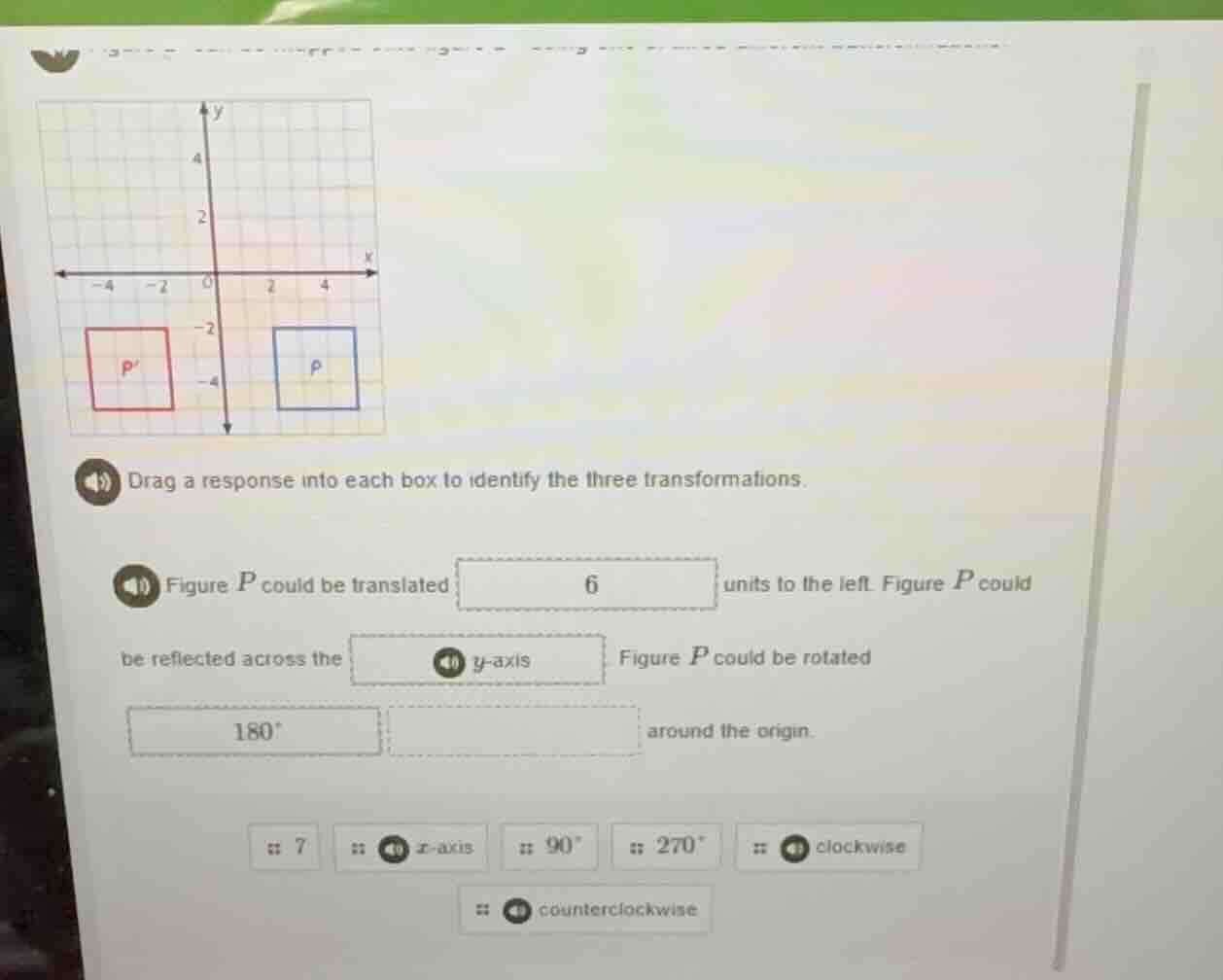
drag a response into each box to identify the three transformations. figure p could be translated 6 units to the left. figure p could be reflected across the y - axis. figure p could be rotated 180° around the origin. options: 7, x - axis, 90°, 270°, clockwise, counterclockwise
Step1: Analyze Translation
To find the translation units, observe the horizontal distance between Figure \( P \) (blue) and \( P' \) (red). The center of \( P \) (e.g., if we take the center coordinates) - let's assume the center of \( P \) is at \( (3, -3) \) and center of \( P' \) is at \( (-3, -3) \). The difference in \( x \)-coordinates is \( -3 - 3=-6 \), so translation is 6 units left.
Step2: Analyze Reflection
Reflection across \( y \)-axis swaps \( x \)-coordinates' sign. The \( y \)-coordinate of points in \( P \) and \( P' \) remain same, \( x \)-coordinates are negatives (e.g., a point \( (a, b) \) in \( P \) becomes \( (-a, b) \) in \( P' \)), so reflection across \( y \)-axis.
Step3: Analyze Rotation
Rotating \( 180^\circ \) around origin transforms \( (x, y) \) to \( (-x, -y) \). But in our case, the \( y \)-coordinate remains same (since both are below \( x \)-axis, \( y=-3 \) for centers), wait - actually, for \( 180^\circ \) rotation, \( (x,y)\to(-x,-y) \). But here, the \( y \)-coordinate of center of \( P \) is \( -3 \), after \( 180^\circ \) rotation, it becomes \( -(-3)=3 \)? Wait no, maybe my center assumption was wrong. Wait, the figures are symmetric about origin? Wait, no, the \( y \)-coordinate is same (both are at \( y=-3 \) region). Wait, actually, when rotating \( 180^\circ \) clockwise or counterclockwise, the result is same. For \( 180^\circ \) rotation, direction (clockwise or counterclockwise) doesn't matter because \( 180^\circ \) rotation clockwise is same as counterclockwise. But the options have "clockwise" or "counterclockwise". Wait, let's check: a \( 180^\circ \) rotation around origin, regardless of clockwise or counterclockwise, takes \( (x,y) \) to \( (-x,-y) \). But in our case, the \( y \)-coordinate of the center of \( P \) is \( -3 \), after rotation, it should be \( 3 \)? But the figure \( P' \) is also at \( y=-3 \). Wait, maybe I made a mistake. Wait, the figures are in the same horizontal line (same \( y \)-level), so rotation by \( 180^\circ \) (either clockwise or counterclockwise) - but the key is that \( 180^\circ \) rotation, and the direction: since \( 180^\circ \) rotation clockwise is same as counterclockwise, but the option is "clockwise" or "counterclockwise". Wait, actually, when you rotate a figure \( 180^\circ \) around the origin, the direction (clockwise or counterclockwise) doesn't change the result. But the problem has a box for rotation direction. Wait, maybe the intended is that \( 180^\circ \) rotation, and the direction can be either, but the option given is "clockwise" or "counterclockwise". Wait, but in the options, after \( 180^\circ \), we need to choose between clockwise or counterclockwise. But for \( 180^\circ \), both are same. However, looking at the options, the last box is for the direction of \( 180^\circ \) rotation. But since \( 180^\circ \) rotation clockwise is equivalent to counterclockwise, but the option is "clockwise" (or counterclockwise). Wait, maybe the correct direction is "clockwise" (or counterclockwise, but the option available is "clockwise" or "counterclockwise". Wait, the options have "clockwise" and "counterclockwise". Let's think: when you rotate \( 180^\circ \) clockwise, \( (x,y)\to(-x,-y) \). But in our case, the \( y \)-coordinate is same (both are \( -3 \)), so \( -y = -(-3)=3 \), which is not matching. Wait, I think my center was wrong. Let's take a vertex: suppose a vertex of \( P \) is \( (2, -2) \), then \( P' \) vertex is \( (-2, -2) \). Wait, no, the red square is at left, blue at right. So a point \( (4, -2)…

Snap & solve any problem in the app
Get step-by-step solutions on Sovi AI
Photo-based solutions with guided steps
Explore more problems and detailed explanations
- Translation: 6 units left (already filled as 6)
- Reflection: \( y \)-axis (already filled)
- Rotation: \( 180^\circ \) clockwise (so the last box should be "clockwise")