QUESTION IMAGE
Question
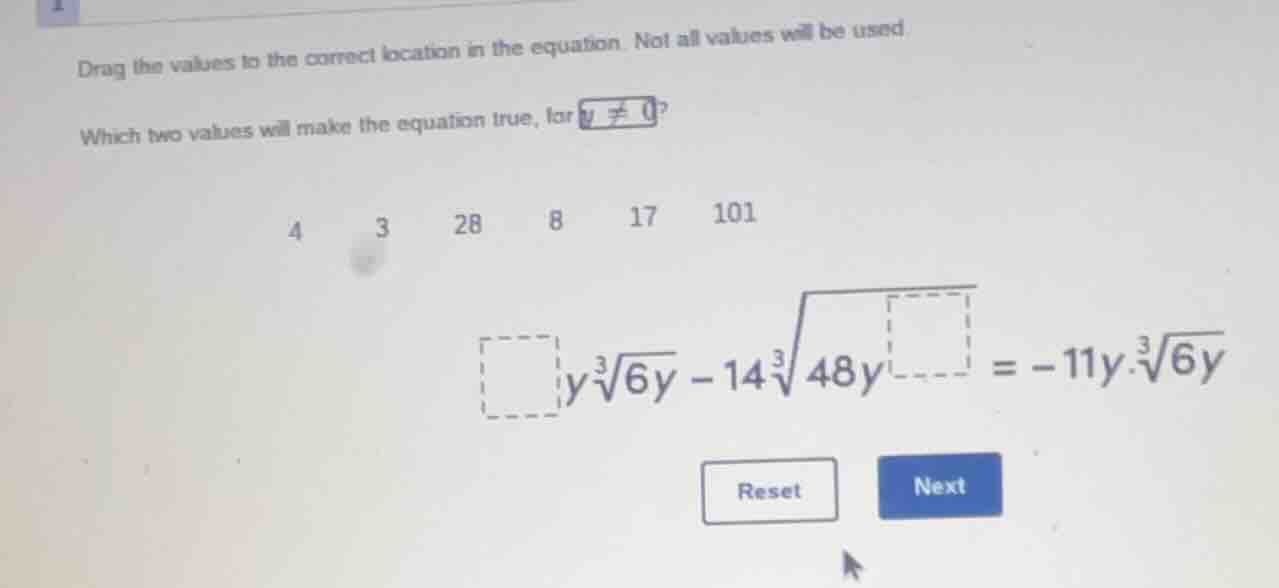
drag the values to the correct location in the equation. not all values will be used. which two values will make the equation true, for y ≠ 0? 4 3 28 8 17 101 \\(\square y\sqrt3{6y} - 14\sqrt3{48y^{\square}} = -11y\cdot\sqrt3{6y}\\)
Step1: Simplify the second radical
First, factor 48 to extract a perfect cube:
$48 = 8 \times 6$, so $\sqrt[3]{48y^n} = \sqrt[3]{8 \times 6y^n} = \sqrt[3]{8} \times \sqrt[3]{6y^n} = 2\sqrt[3]{6y^n}$
Substitute back into the equation:
$\square y\sqrt[3]{6y} - 14 \times 2\sqrt[3]{6y^n} = -11y\sqrt[3]{6y}$
$\square y\sqrt[3]{6y} - 28\sqrt[3]{6y^n} = -11y\sqrt[3]{6y}$
Step2: Match radical terms
For the radicals to be like terms, the exponents of $y$ under the cube root must be equal. The first and final terms have $\sqrt[3]{6y} = \sqrt[3]{6y^1}$, so $n=1$. This means the second radical becomes $\sqrt[3]{48y^1}$, so the right blank is 1.
Now rewrite the equation with like terms:
$\square y\sqrt[3]{6y} - 28y\sqrt[3]{6y} = -11y\sqrt[3]{6y}$
Divide all terms by $y\sqrt[3]{6y}$ (since $y
eq 0$):
$\square - 28 = -11$
Step3: Solve for the left blank
Rearrange to find the left value:
$\square = -11 + 28 = 17$

Snap & solve any problem in the app
Get step-by-step solutions on Sovi AI
Photo-based solutions with guided steps
Explore more problems and detailed explanations
Left blank: 17, Right blank: 1