QUESTION IMAGE
Question
drag the words to complete the paragraph.
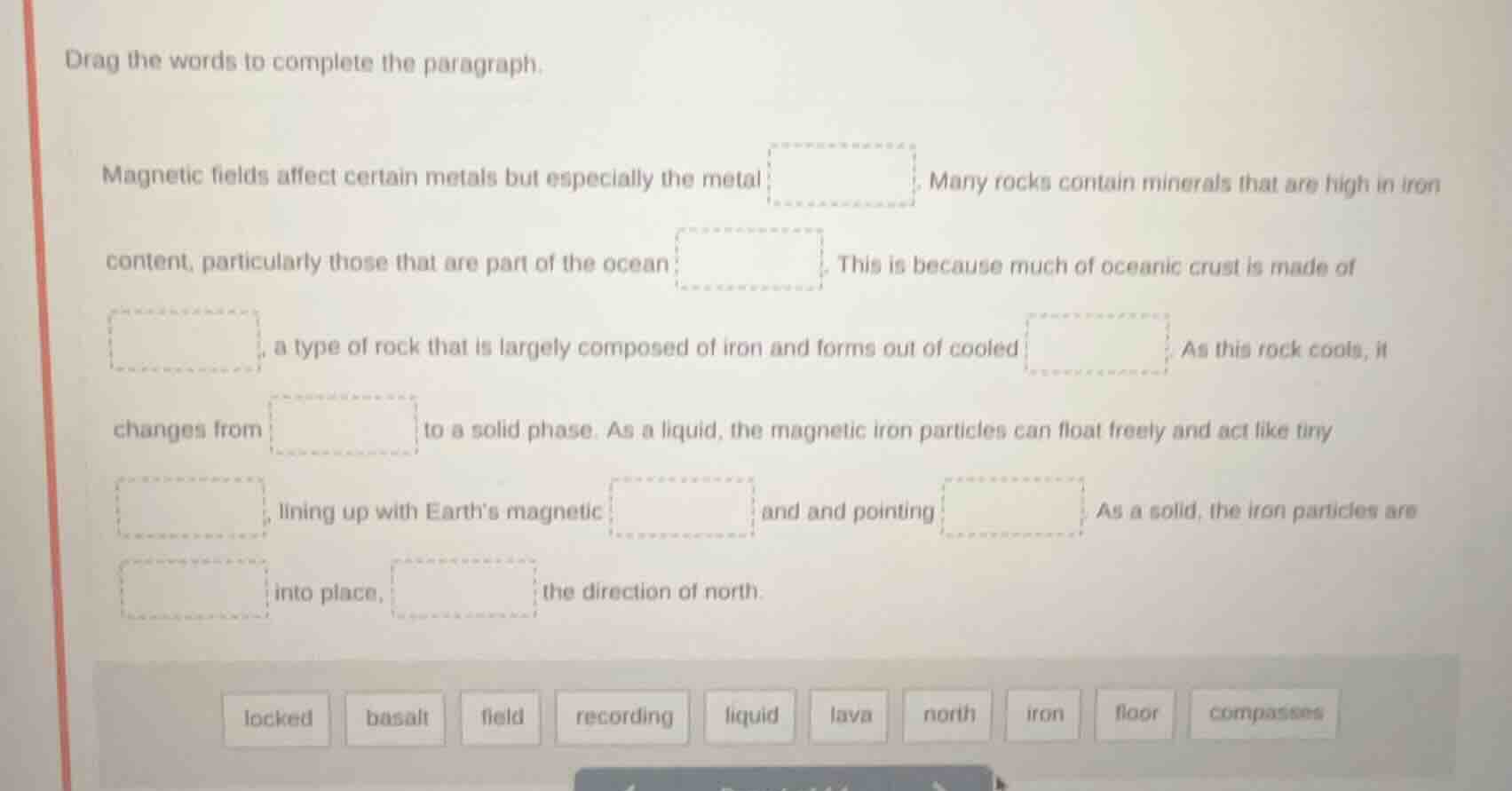
magnetic fields affect certain metals but especially the metal. many rocks contain minerals that are high in iron
content, particularly those that are part of the ocean. this is because much of oceanic crust is made of
, a type of rock that is largely composed of iron and forms out of cooled. as this rock cools, it
changes from to a solid phase. as a liquid, the magnetic iron particles can float freely and act like tiny
, lining up with earths magnetic and and pointing. as a solid, the iron particles are
into place, the direction of north.
locked basalt field recording liquid lava north iron floor compasses
This is a fill-in-the-blank exercise about paleomagnetism and ocean floor geology. The words are matched based on geological and magnetic science context:
- Magnetic fields target iron most strongly among common metals.
- The text references oceanic crust features, so "floor" fits "ocean ____".
- Basalt is the iron-rich rock forming oceanic crust.
- Basalt forms from cooled lava.
- Lava transitions from liquid to solid as it cools.
- Free-floating iron particles act like tiny compasses.
- They align with Earth's magnetic field.
- They point north, the magnetic pole direction.
- Solidified particles get locked in place.
- This locks them in, recording the north direction.

Snap & solve any problem in the app
Get step-by-step solutions on Sovi AI
Photo-based solutions with guided steps
Explore more problems and detailed explanations
- Magnetic fields affect certain metals but especially the metal iron
- particularly those that are part of the ocean floor
- much of oceanic crust is made of basalt
- forms out of cooled lava
- changes from liquid to a solid phase
- act like tiny compasses
- lining up with Earth's magnetic field
- pointing north
- the iron particles are locked into place
- recording the direction of north