QUESTION IMAGE
Question
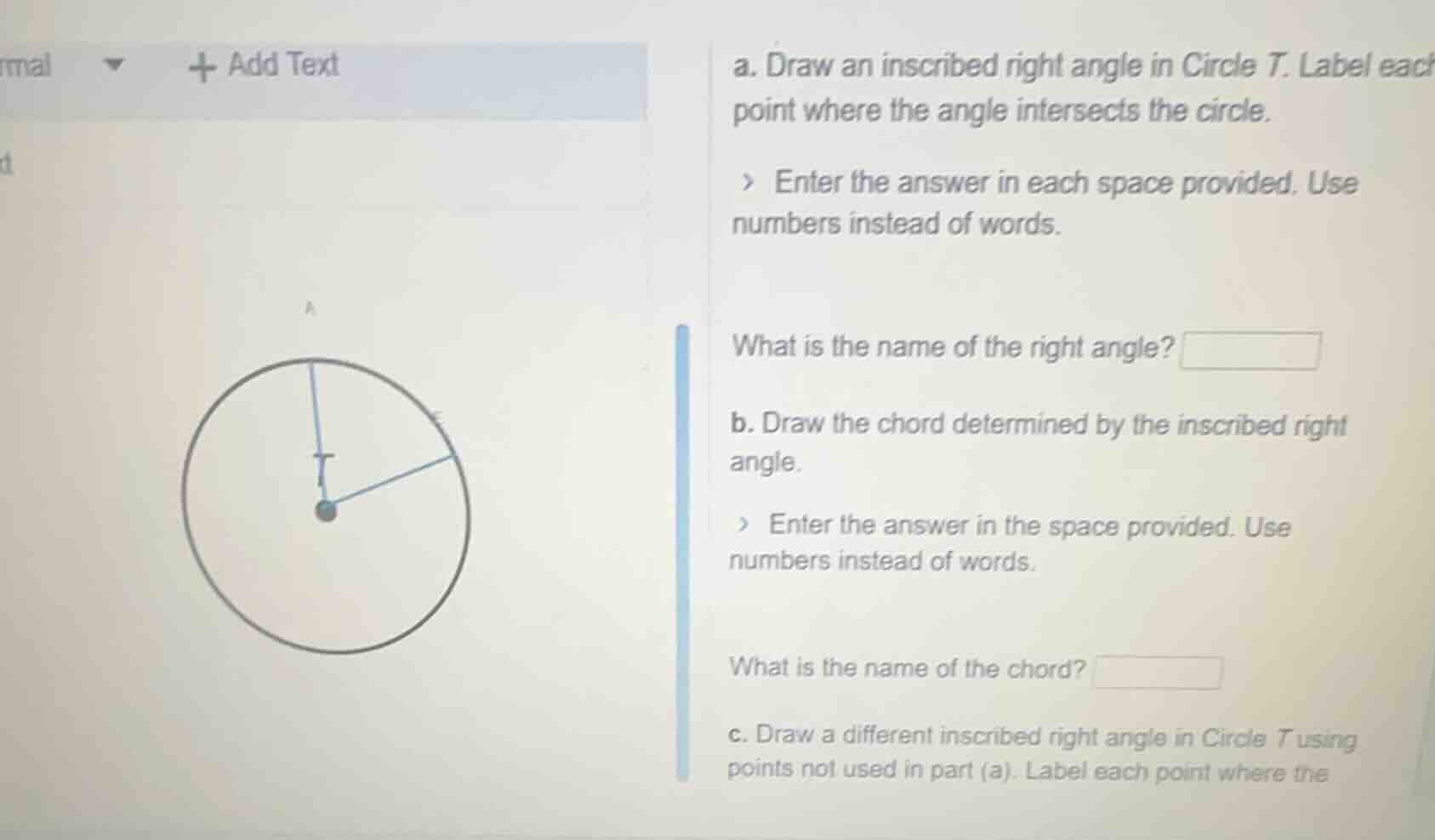
a. draw an inscribed right angle in circle t. label each point where the angle intersects the circle.
enter the answer in each space provided. use numbers instead of words.
what is the name of the right angle?
b. draw the chord determined by the inscribed right angle.
enter the answer in the space provided. use numbers instead of words.
what is the name of the chord?
c. draw a different inscribed right angle in circle t using points not used in part (a). label each point where the
Part (a)
To form an inscribed right angle in a circle, we can use the property that an angle inscribed in a semicircle is a right angle. Let's assume we choose two points on the circle and a third point such that the angle is right. If we take points, say, \( A \), \( B \) (a new point) and \( C \) (another new point), but more simply, using the given circle with center \( T \), if we have a diameter (which we can form), the angle subtended by the diameter is a right angle. Let's say we have points \( A \), \( B \) (on the circle) and the right angle is \( \angle ABC \) but more appropriately, if we take two points on the circle and the right angle is at a point on the circle. Wait, actually, the inscribed right angle should have its vertex on the circle and the sides intersecting the circle at two other points. So if we have a circle with center \( T \), and we draw a right angle with vertex at, say, \( A \) (on the circle) and the other two points \( B \) and \( C \) on the circle, but the key is that the hypotenuse of the right - angled triangle (the chord opposite the right angle) is a diameter. But for the name of the right angle, if we have points \( A \), \( B \), and \( C \) on the circle with \( \angle ABC = 90^\circ \), but in the given circle, let's assume we have points \( A \), \( E \), and another point, say \( D \). Wait, maybe a better approach: the inscribed right angle can be named as \( \angle AED \) (but we need to use the points. Wait, the circle has center \( T \), and point \( A \) and \( E \) are on the circle. Let's say we draw a right angle with vertex at a point, say, \( A \), and the other two points \( B \) (a new point) and \( C \) (another new point), but the problem says "use numbers instead of words" no, wait, the problem says "label each point where the angle intersects the circle" and "enter the answer in each space provided. Use numbers instead of words" - no, maybe it's a typo, and we can use letters. Wait, the circle has center \( T \), point \( A \) and \( E \) are on the circle. Let's assume that we form a right angle with vertex at a point, say, \( A \), and the other two points \( B \) and \( C \) on the circle, but actually, the correct way is that if we have a diameter, the angle subtended by the diameter is a right angle. So if we have a diameter, say, \( AE \) (but \( AE \) is not a diameter, \( TA \) and \( TE \) are radii). Wait, maybe the right angle is \( \angle ADE \) where \( D \) is a point on the circle. But maybe a simpler way: the inscribed right angle can be named as \( \angle ABE \) (but we need to define the points. Alternatively, if we take three points on the circle \( A \), \( B \), \( C \) such that \( \angle ABC = 90^\circ \), and the chord \( AC \) is the diameter. But in the given circle, let's assume that the right angle is \( \angle ADE \) with \( D \) and \( E \) on the circle, but the problem says "label each point where the angle intersects the circle". So the right angle will have its vertex on the circle and two sides intersecting the circle at two other points. So the name of the right angle could be \( \angle AFE \) (where \( F \) and \( E \) are on the circle and \( A \) is the vertex), but maybe a more concrete example: if we have a circle, and we draw a right angle with vertex at \( A \) (on the circle) and the other two points \( B \) and \( C \) on the circle, the angle is \( \angle ABC \) (vertex at \( B \))? Wait, no, the vertex of the angle is on the circle. So the right angle is named by its vertex and the two points where the sides intersect the circle. So if…
The chord determined by the inscribed right angle is the chord that is opposite the right angle (the hypotenuse of the right - angled triangle). Since the inscribed right angle is subtended by a diameter (by the property of inscribed angles in a circle), the chord is the diameter. If the right angle is \( \angle ADE \) with \( A \) and \( E \) on the circle, then the chord is \( AE \).
Step 1: Recall the property of inscribed right angles
The hypotenuse of a right - angled triangle inscribed in a circle is the diameter of the circle. So the chord opposite the right angle (the hypotenuse) is a diameter.
Step 2: Determine the chord
If the inscribed right angle has its sides intersecting the circle at points \( A \) and \( E \) (and the vertex at another point on the circle), then the chord determined by the inscribed right angle is \( AE \).
To draw a different inscribed right angle, we need to use points not used in part (a). Let's assume in part (a) we used points \( A \), \( E \), and \( D \). We can choose new points, say, \( B \), \( C \), and \( F \) on the circle such that \( \angle BCF = 90^\circ \). The vertex \( F \) is on the circle, and \( B \) and \( C \) are new points on the circle (not \( A \) or \( E \)). We label the points: \( B \) (on the circle), \( C \) (on the circle), and \( F \) (on the circle) where \( \angle BCF = 90^\circ \). The key is to use the property that the angle subtended by a diameter is a right angle, so we can draw a new diameter (using new points) and then place the right - angle vertex on the circle.
Step 1: Choose new points
Select two new points \( B \) and \( C \) on the circle (not used in part (a)) and a third point \( F \) on the circle such that \( \angle BCF = 90^\circ \).
Step 2: Label the points
Label the vertex of the right angle as \( F \) and the other two points as \( B \) and \( C \) on the circle.

Snap & solve any problem in the app
Get step-by-step solutions on Sovi AI
Photo-based solutions with guided steps
Explore more problems and detailed explanations
(a):
\( \angle ADE \) (or other valid inscribed right - angle name based on the circle's points. If we assume points \( A \), \( B \), \( C \) with \( \angle ABC = 90^\circ \), it can be \( \angle ABC \))