QUESTION IMAGE
Question
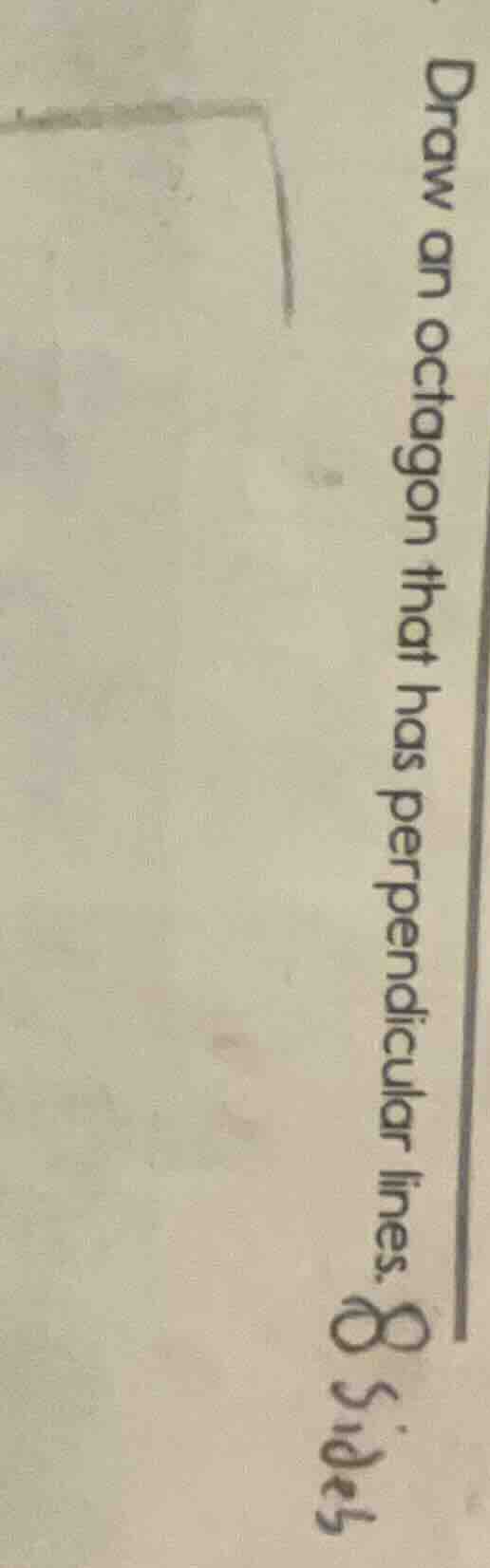
draw an octagon that has perpendicular lines. 8 sides
To draw an octagon with perpendicular lines (a rectangle - like base with additional sides, or a regular octagon has right angles in a way when considering its structure? Wait, a regular octagon has internal angles of 135 degrees, but to have perpendicular lines, a rectangle - based octagon (a rectangle with its corners cut off at 45 - degree angles, but actually, a more straightforward way is to draw a rectangle, then extend or cut sides to make 8 sides with right angles at some vertices. Alternatively, a "rectangular octagon" where 4 of the angles are right angles (90 degrees) and the other 4 are 270 degrees? Wait, no, the sum of internal angles of an octagon is \((8 - 2)\times180=1080\) degrees. If we have 4 right angles (90 each) and 4 angles of \(x\), then \(4\times90 + 4x=1080\), so \(360+4x = 1080\), \(4x = 720\), \(x = 180\) which is a straight line, so that's not possible. Wait, maybe a better approach: draw a square, then on each side, add a smaller square (or a rectangle) attached to the side, but that would make more than 8 sides. Wait, no. Let's think of a rectangle with length \(L\) and width \(W\), then on each of the four sides, we cut off a right - angled triangle (or add a right - angled triangle) such that the total number of sides becomes 8. For example, start with a rectangle. Then, on the top side, instead of a straight side, we have a horizontal segment, a vertical segment up, a horizontal segment, and a vertical segment down? No, that's more complicated. Alternatively, draw a regular octagon, but a regular octagon doesn't have perpendicular lines (its internal angles are 135 degrees). Wait, maybe the problem means a octagon with some sides perpendicular to each other. Let's take a simple approach: draw a rectangle. Then, on the top - left corner, instead of a right angle, we draw a horizontal line to the left, a vertical line up, a horizontal line to the right, and a vertical line down? No, that's not right. Wait, maybe the problem is to draw an octagon where at least some lines are perpendicular. Let's draw a square. Then, on each of the four sides, we extend the side by a small length and then turn 90 degrees. For example, start with a square with side length \(s\). Then, on the top side, from the left end, move right by \(a\), then up by \(a\), then right by \(s - 2a\), then down by \(a\) to meet the original top - right corner? No, that's not clear. Alternatively, draw a rectangle with length \(L\) and width \(W\). Then, on the top edge, we have a horizontal line of length \(L - 2x\), then a vertical line up of length \(x\), then a horizontal line of length \(2x\), then a vertical line down of length \(x\) to the original top - right corner? No, this is getting too complicated. A better way: draw a "stop - sign - like" octagon but with some right angles. Wait, maybe the problem is simpler. Let's draw a rectangle. Then, on each of the four sides, we add a small square (or a rectangle) attached to the side, but that would make 12 sides. No. Wait, the key is to have 8 sides with some of them perpendicular. Let's draw a square. Then, on each of the four sides, we cut off a right - angled triangle (with legs of length \(a\)) from each corner. So the original square has 4 sides, and after cutting off 4 triangles (one from each corner), we have 4 new sides (the hypotenuses of the triangles) and the remaining parts of the original sides. Wait, the original square has 4 sides, each of length \(s\). After cutting off a triangle with legs \(a\) from each corner, the length of the remaining part of each original side…

Snap & solve any problem in the app
Get step-by-step solutions on Sovi AI
Photo-based solutions with guided steps
Explore more problems and detailed explanations
To draw the octagon with perpendicular lines:
- Draw a square.
- On each of the four corners of the square, cut off a right - angled triangle (with legs of equal length) such that the remaining figure has 8 sides. The sides that were originally part of the square (the horizontal and vertical segments) will be perpendicular to each other. (You can also draw this on a piece of paper by first sketching a square, then marking equal - length segments on each side near the corners and connecting the marks to form the octagon.)