QUESTION IMAGE
Question
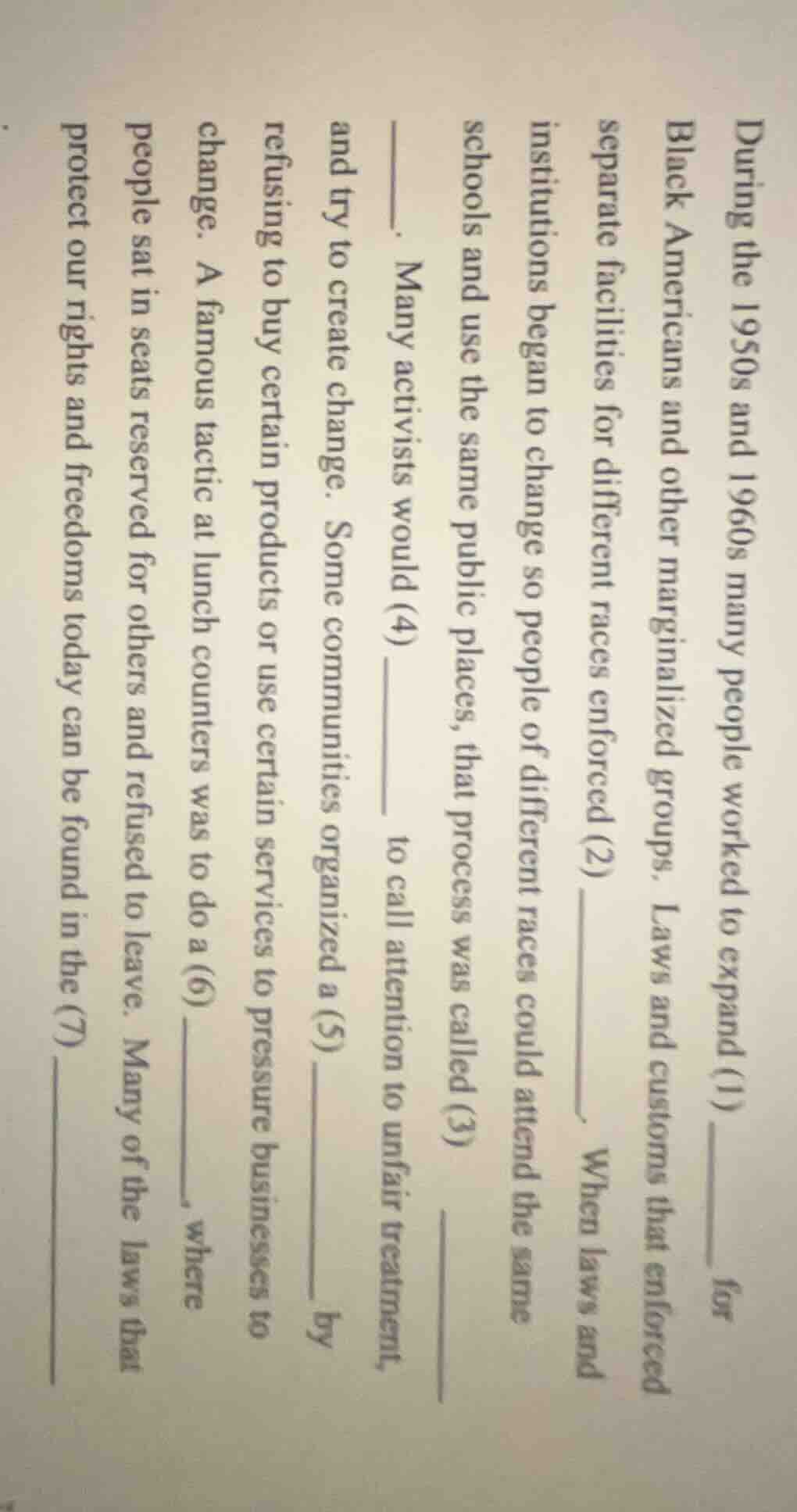
during the 1950s and 1960s many people worked to expand (1) ____ for black americans and other marginalized groups. laws and customs that enforced separate facilities for different races enforced (2) __. when laws and institutions began to change so people of different races could attend the same schools and use the same public places, that process was called (3) __ __. many activists would (4) __ to call attention to unfair treatment, and try to create change. some communities organized a (5) __ by refusing to buy certain products or use certain services to pressure businesses to change. a famous tactic at lunch counters was to do a (6) __, where people sat in seats reserved for others and refused to leave. many of the laws that protect our rights and freedoms today can be found in the (7) ____
- The context is about expanding rights for marginalized groups in the US civil rights era, so "rights" fits the first blank.
- The described enforced separation of races is the definition of "segregation".
- The process of ending segregation to integrate different races in public spaces is "desegregation".
- Activists would "protest" to draw attention to unfair treatment.
- Communities organized "boycotts" by refusing to use products/services to pressure businesses.
- The tactic of sitting in reserved seats and refusing to leave is a "sit-in".
- The rights protecting freedoms today are outlined in the "Constitution" (and its amendments) of the United States.

Snap & solve any problem in the app
Get step-by-step solutions on Sovi AI
Photo-based solutions with guided steps
Explore more problems and detailed explanations
- rights
- segregation
- desegregation
- protest
- boycott
- sit-in
- Constitution