QUESTION IMAGE
Question
during an energy transformation, some types of energy may not change.
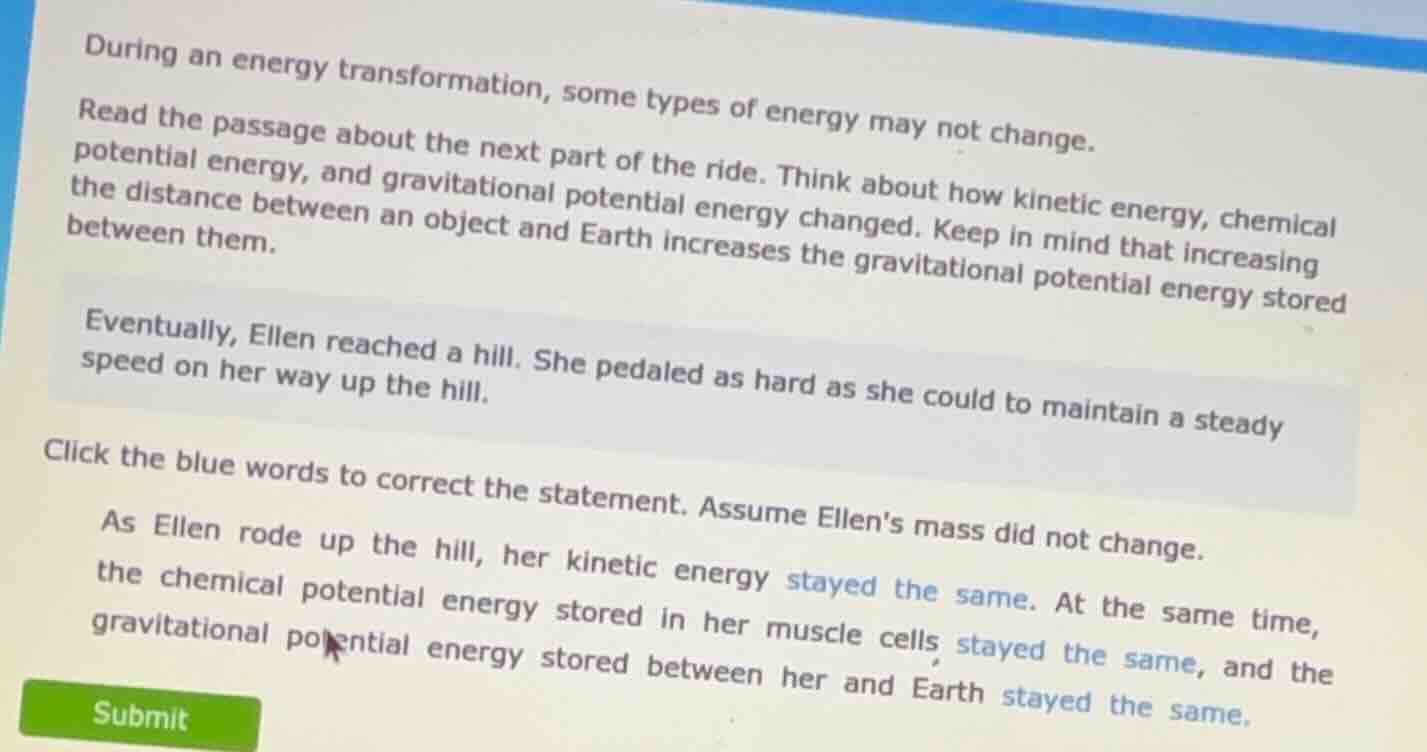
read the passage about the next part of the ride. think about how kinetic energy, chemical potential energy, and gravitational potential energy changed. keep in mind that increasing the distance between an object and earth increases the gravitational potential energy stored between them.
eventually, ellen reached a hill. she pedaled as hard as she could to maintain a steady speed on her way up the hill.
click the blue words to correct the statement. assume ellens mass did not change.
as ellen rode up the hill, her kinetic energy stayed the same. at the same time, the chemical potential energy stored in her muscle cells stayed the same, and the gravitational potential energy stored between her and earth stayed the same.
- Kinetic Energy: Kinetic energy formula is \( KE=\frac{1}{2}mv^{2} \). Mass (\( m \)) is constant, speed (\( v \)) is steady (given she maintains steady speed), so \( KE \) stays the same. So "stayed the same" for kinetic energy is correct? Wait, no—wait, when moving up a hill, if speed is steady, but wait, is there a mistake? Wait, no, the problem says she pedals to maintain steady speed. So \( KE=\frac{1}{2}mv^{2} \), \( m \) constant, \( v \) constant, so \( KE \) stays the same. But wait, the other energies:
- Chemical Potential Energy (Muscle Cells): She is pedaling (using energy from muscle cells, which store chemical potential energy). As she uses this energy to pedal, the chemical potential energy in her muscle cells should decrease (since she's converting it to other forms like kinetic and gravitational potential energy). So "stayed the same" here is wrong; it should "decreased".
- Gravitational Potential Energy (Between Her and Earth): Gravitational potential energy formula (near Earth) is \( GPE = mgh \), where \( h \) is height (distance from Earth). As she moves up the hill, \( h \) increases, so \( GPE \) increases. So "stayed the same" here is wrong; it should "increased".
Wait, the problem says "Click the blue words to correct the statement". The blue words are "stayed the same" (three instances: for kinetic, chemical, gravitational). Let's re - evaluate:
- Kinetic Energy: The problem states she maintains a steady speed. \( KE=\frac{1}{2}mv^{2} \), \( m \) (mass) constant, \( v \) (speed) constant. So \( KE \) does stay the same. So that blue "stayed the same" for kinetic energy is correct.
- Chemical Potential Energy (Muscle Cells): She is using energy from her muscles to pedal. Chemical potential energy in muscle cells is converted to other forms (kinetic, gravitational potential). So as she uses it, the chemical potential energy in her muscle cells decreases. So the blue "stayed the same" here should be changed to "decreased".
- Gravitational Potential Energy (Her and Earth): \( GPE = mgh \), \( h \) (height) increases as she goes up the hill, \( m \) and \( g \) constant. So \( GPE \) increases. So the blue "stayed the same" here should be changed to "increased".
So the corrections are:
- For "the chemical potential energy stored in her muscle cells, stayed the same" → change "stayed the same" to "decreased".
- For "the gravitational potential energy stored between her and Earth stayed the same" → change "stayed the same" to "increased".
The kinetic energy part: since \( v \) is steady, \( KE \) stays the same, so that "stayed the same" is correct.

Snap & solve any problem in the app
Get step-by-step solutions on Sovi AI
Photo-based solutions with guided steps
Explore more problems and detailed explanations
- For "her kinetic energy stayed the same": This is correct (no change needed) as \( KE=\frac{1}{2}mv^{2} \), mass and speed are constant.
- For "the chemical potential energy stored in her muscle cells, stayed the same": Change "stayed the same" to "decreased" (she uses chemical energy to pedal).
- For "the gravitational potential energy stored between her and Earth stayed the same": Change "stayed the same" to "increased" (height increases, \( GPE = mgh \) increases).