QUESTION IMAGE
Question
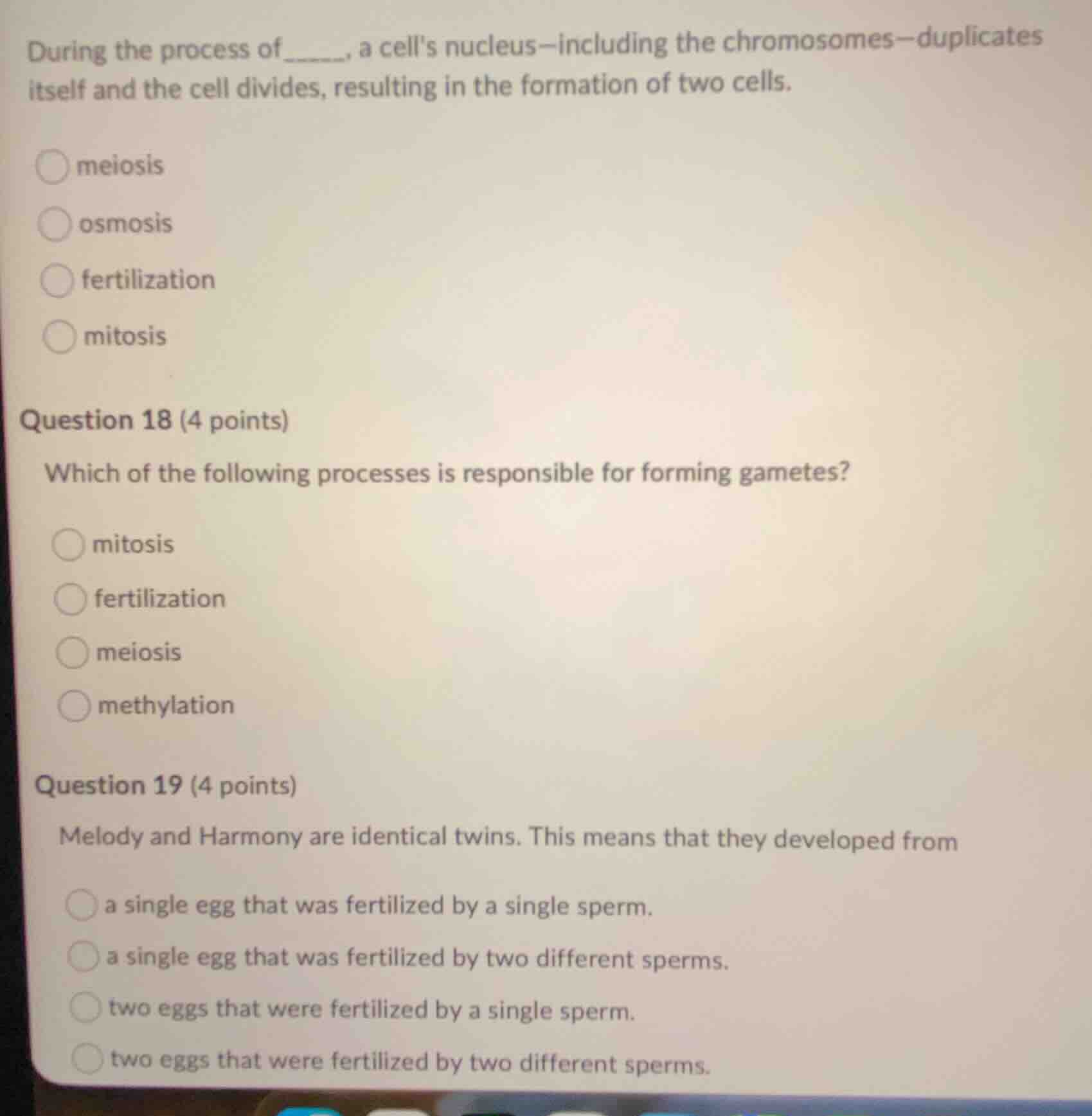
during the process of_____, a cells nucleus—including the chromosomes—duplicates itself and the cell divides, resulting in the formation of two cells. meiosis osmosis fertilization mitosis question 18 (4 points) which of the following processes is responsible for forming gametes? mitosis fertilization meiosis methylation question 19 (4 points) melody and harmony are identical twins. this means that they developed from a single egg that was fertilized by a single sperm. a single egg that was fertilized by two different sperms. two eggs that were fertilized by a single sperm. two eggs that were fertilized by two different sperms.
Question 1 (First Fill - in - the - blank Question)
- Meiosis: It is a type of cell division that reduces the chromosome number by half and results in four non - identical daughter cells (gametes), not two identical cells with nucleus duplication as described.
- Osmosis: It is the movement of water molecules across a semi - permeable membrane, not a cell division process.
- Fertilization: It is the fusion of gametes (sperm and egg) to form a zygote, not a cell division process for forming two cells from one.
- Mitosis: During mitosis, the cell's nucleus (including chromosomes) duplicates, and then the cell divides into two genetically identical daughter cells. This matches the description in the question.
- Mitosis: It is used for growth, repair, and asexual reproduction, and it produces two identical daughter cells (somatic cells), not gametes.
- Fertilization: It is the union of sperm and egg to form a zygote, not the process of forming gametes.
- Meiosis: Meiosis is a specialized cell division process that reduces the chromosome number by half and produces four non - identical gametes (sperm or egg cells).
- Methylation: It is a chemical modification (usually of DNA) related to gene regulation, not a process for forming gametes.
- Option 1 (a single egg that was fertilized by a single sperm): Identical twins (monozygotic twins) develop from a single fertilized egg (zygote) that splits into two. So they share the same genetic material.
- Option 2 (a single egg that was fertilized by two different sperms): This is not possible as a single egg is usually fertilized by only one sperm, and even if there was a rare case of polyspermy, it would not result in normal twin development.
- Option 3 (two eggs that were fertilized by a single sperm): A single sperm can only fertilize one egg at a time, and fraternal twins (dizygotic) come from two different eggs fertilized by two different sperms.
- Option 4 (two eggs that were fertilized by two different sperms): This results in fraternal twins, not identical twins.

Snap & solve any problem in the app
Get step-by-step solutions on Sovi AI
Photo-based solutions with guided steps
Explore more problems and detailed explanations
D. mitosis