QUESTION IMAGE
Question
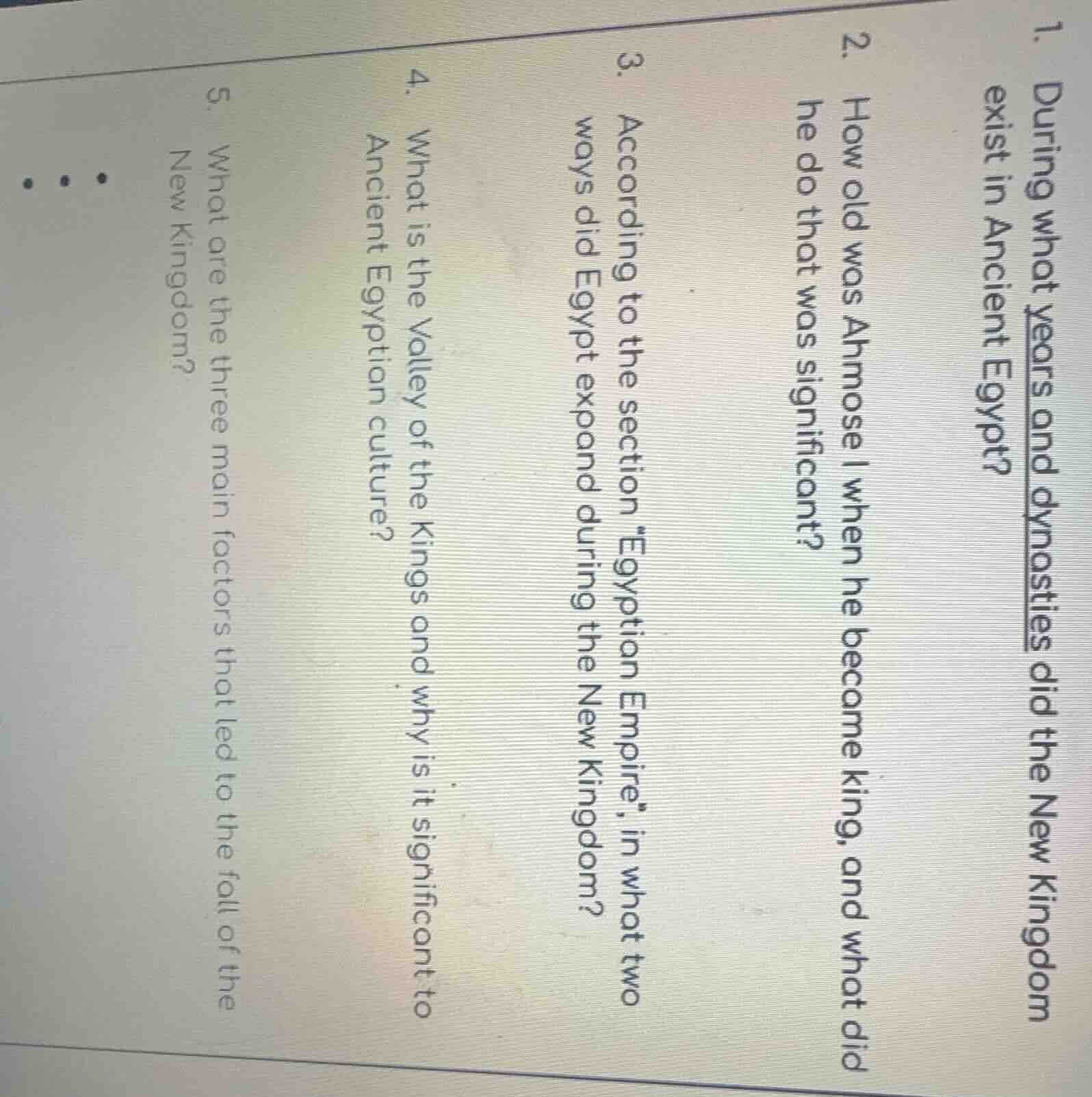
- during what years and dynasties did the new kingdom exist in ancient egypt?
- how old was ahmose i when he became king, and what did he do that was significant?
- according to the section \egyptian empire\, in what two ways did egypt expand during the new kingdom?
- what is the valley of the kings and why is it significant to ancient egyptian culture?
- what are the three main factors that led to the fall of the new kingdom?
...
Brief Explanations
- The New Kingdom of Ancient Egypt is dated to the 18th to 20th Dynasties, spanning approximately 1550 BCE to 1070 BCE.
- Ahmose I was around 10 years old when he became king. His key significant act was expelling the Hyksos from Egypt, which reunified the country and began the New Kingdom.
- Egypt expanded in two main ways during the New Kingdom: 1) Military conquests into regions like Canaan, Syria, and Nubia to gain territory and resources; 2) Establishing vassal states and diplomatic alliances to extend political influence over neighboring lands.
- The Valley of the Kings is a desert valley in Egypt where most pharaohs of the New Kingdom were buried. It is significant because it contains elaborate, well-preserved royal tombs that provide critical insights into Ancient Egyptian burial practices, art, and royal life.
- The three main factors leading to the fall of the New Kingdom are: 1) Weakening central authority and infighting among royal officials and nobles; 2) External invasions from groups like the Sea Peoples and Libyan tribes; 3) Economic decline from overspending on wars and loss of control over resource-rich vassal states.

Snap & solve any problem in the app
Get step-by-step solutions on Sovi AI
Photo-based solutions with guided steps
Explore more problems and detailed explanations
- The New Kingdom existed from approximately 1550 BCE to 1070 BCE, covering the 18th, 19th, and 20th Dynasties.
- Ahmose I was about 10 years old when he became king. His significant action was driving out the Hyksos invaders, reuniting Egypt and founding the New Kingdom.
- Egypt expanded via: 1. Military conquests of Nubia, Canaan, and Syria; 2. Establishing vassal states and diplomatic control over neighboring regions.
- The Valley of the Kings is a burial site in Upper Egypt for New Kingdom pharaohs. It is significant for its well-preserved royal tombs that offer key evidence of Ancient Egyptian culture, burial rituals, and royal history.
- The three main factors are: 1. Weakened central government and internal power struggles; 2. Invasions by the Sea Peoples and Libyan groups; 3. Economic collapse from costly wars and lost control of resource territories.