QUESTION IMAGE
Question
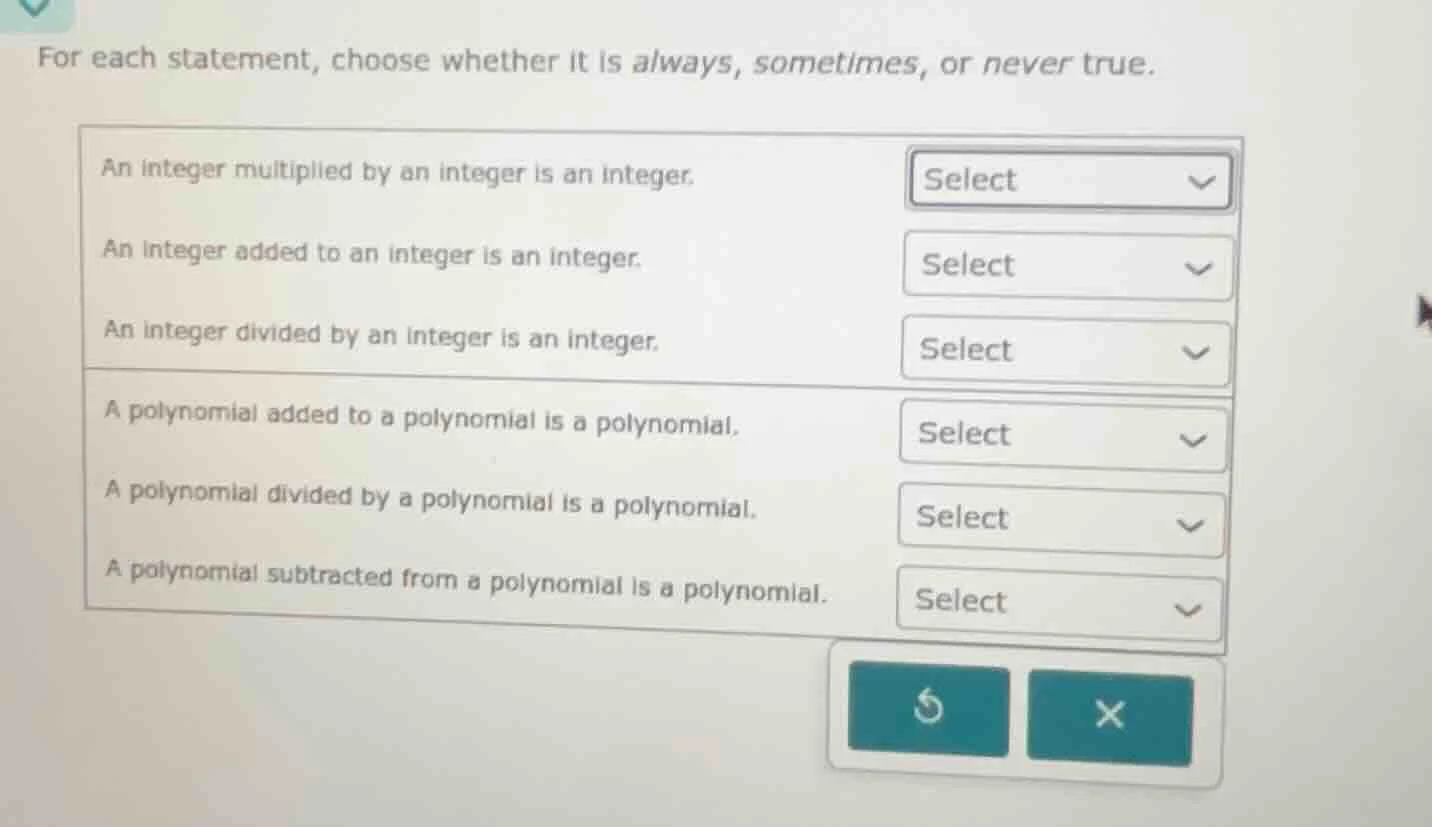
for each statement, choose whether it is always, sometimes, or never true.
an integer multiplied by an integer is an integer. select
an integer added to an integer is an integer. select
an integer divided by an integer is an integer. select
a polynomial added to a polynomial is a polynomial. select
a polynomial divided by a polynomial is a polynomial. select
a polynomial subtracted from a polynomial is a polynomial. select
1. "An integer multiplied by an integer is an integer."
The set of integers is closed under multiplication. By the definition of integers (..., -2, -1, 0, 1, 2, ...) and the rules of multiplication, multiplying any two integers (positive, negative, or zero) results in another integer. For example, \(2 \times 3 = 6\), \((-2) \times 3 = -6\), \(0 \times 5 = 0\), all of which are integers. So this statement is always true.
Integers are closed under addition. When adding two integers (e.g., \(3 + (-5) = -2\), \(0 + 7 = 7\), \(-4 + (-1) = -5\)), the result is always an integer. This is a fundamental property of the integer set, so the statement is always true.
Dividing integers does not always yield an integer. For example, \(5 \div 2 = 2.5\), where 5 and 2 are integers, but the result is not an integer. However, there are cases where it is an integer (e.g., \(6 \div 3 = 2\)). So the result can sometimes be an integer and sometimes not.

Snap & solve any problem in the app
Get step-by-step solutions on Sovi AI
Photo-based solutions with guided steps
Explore more problems and detailed explanations
always