QUESTION IMAGE
Question
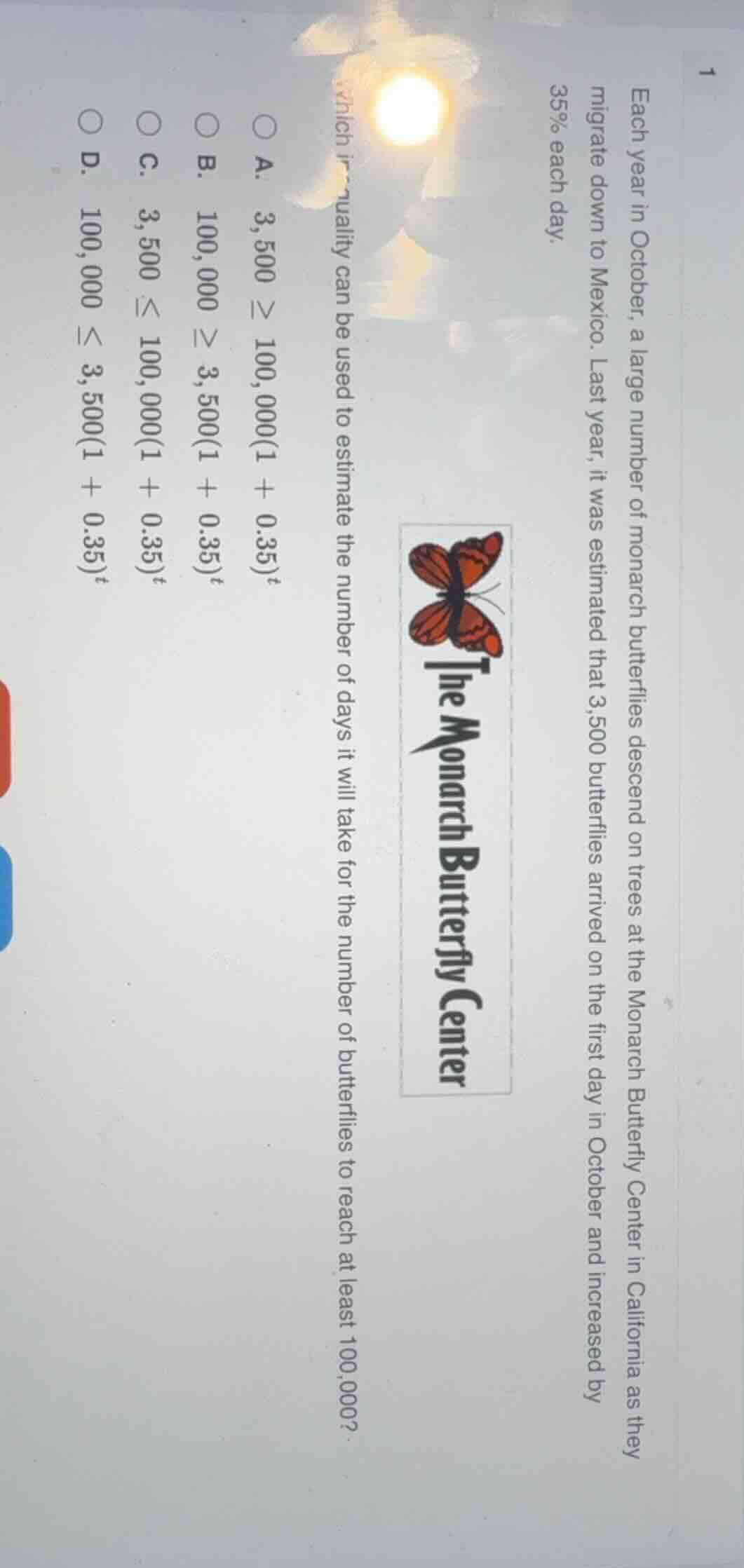
each year in october, a large number of monarch butterflies descend on trees at the monarch butterfly center in california as they migrate down to mexico. last year, it was estimated that 3,500 butterflies arrived on the first day in october and increased by 35% each day.
which inequality can be used to estimate the number of days it will take for the number of butterflies to reach at least 100,000?
a. ( 3,500 geq 100,000(1 + 0.35)^t )
b. ( 100,000 geq 3,500(1 + 0.35)^t )
c. ( 3,500 leq 100,000(1 + 0.35)^t )
d. ( 100,000 leq 3,500(1 + 0.35)^t )
Step1: Identify growth formula
The number of butterflies follows exponential growth, starting at 3,500 with a daily 35% increase. The growth formula is $N(t) = 3500(1+0.35)^t$, where $t$ is days.
Step2: Set up inequality for target
We need the number to be at least 100,000, so $N(t) \geq 100000$. Substitute the growth formula:
$3500(1+0.35)^t \geq 100000$
Step3: Match to options
Rearrange the inequality to match the option format: $100,000 \leq 3,500(1 + 0.35)^t$

Snap & solve any problem in the app
Get step-by-step solutions on Sovi AI
Photo-based solutions with guided steps
Explore more problems and detailed explanations
D. $100,000 \leq 3,500(1 + 0.35)^t$