QUESTION IMAGE
Question
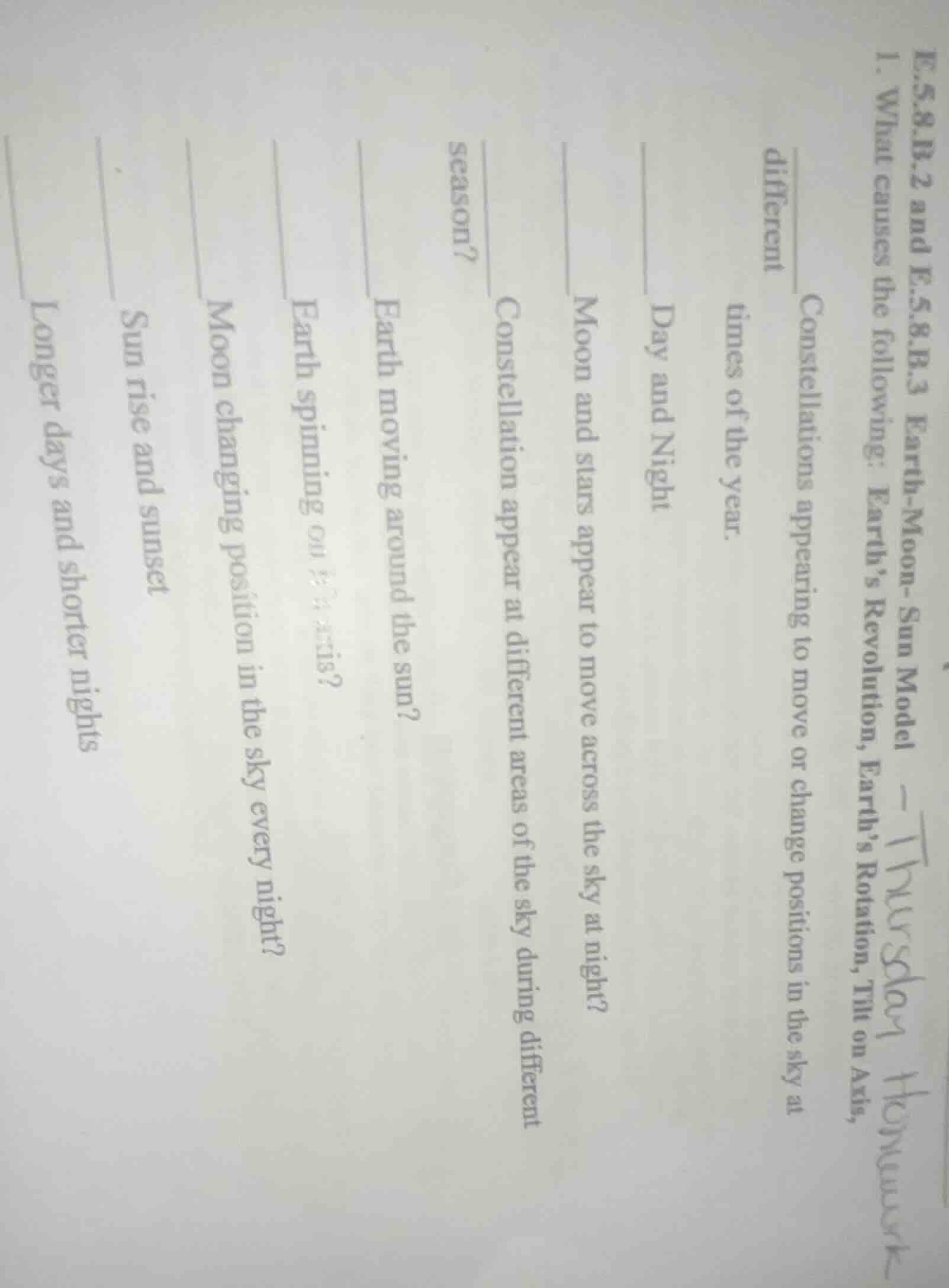
e.5.8.b.2 and e.5.8.b.3 earth - moon - sun model
- what causes the following: earth’s revolution, earth’s rotation, tilt on axis,
constellations appearing to move or change positions in the sky at different times of the year.
day and night
moon and stars appear to move across the sky at night?
constellation appear at different areas of the sky during different season?
earth moving around the sun?
earth spinning on its axis?
moon changing position in the sky every night?
sun rise and sunset
longer days and shorter nights
Response
To solve this, we match each astronomical phenomenon with its cause:
1. Constellations appearing to move/change positions (different times of year)
- Cause: Earth moving around the sun (Earth’s revolution). As Earth orbits the Sun, our perspective of the night sky changes, making constellations appear to shift over the year.
2. Day and Night
- Cause: Earth spinning on its axis (Earth’s rotation). As Earth rotates, different parts face the Sun (day) or away (night).
3. Moon and stars appearing to move across the sky at night
- Cause: Earth spinning on its axis. Earth’s rotation makes celestial objects (Moon, stars) appear to move from east to west.
4. Constellation appear at different areas of the sky during different season?
- Cause: Earth moving around the sun. Earth’s orbit changes our vantage point, so constellations visible in one season are not in others.
5. Earth moving around the sun?
- This is a cause (Earth’s revolution), which explains phenomena like seasonal constellations and seasons.
6. Earth spinning on its axis?
- This is a cause (Earth’s rotation), explaining day/night and apparent motion of Moon/stars.
7. Moon changing position in the sky every night?
- Cause: Moon orbiting Earth. The Moon moves around Earth, so its position shifts nightly relative to stars/horizon.
8. Sun rise and sunset
- Cause: Earth spinning on its axis. Rotation brings different locations into sunlight (sunrise) and out (sunset).
9. Longer days and shorter nights (or vice versa, seasonal)
- Cause: Tilt on Axis + Earth moving around the sun. Earth’s axial tilt (≈23.5°) and revolution create seasons: in summer, a hemisphere is tilted toward the Sun, leading to longer days.
Final Matches (summarized):
- Constellations (different times/season): Earth moving around the sun (revolution)
- Day/Night, Sun rise/set, Moon/stars’ apparent motion, Earth’s spin: Earth spinning on its axis (rotation)
- Moon’s nightly position: Moon orbiting Earth
- Longer days/nights: Earth’s tilt + revolution

Snap & solve any problem in the app
Get step-by-step solutions on Sovi AI
Photo-based solutions with guided steps
Explore more problems and detailed explanations
To solve this, we match each astronomical phenomenon with its cause:
1. Constellations appearing to move/change positions (different times of year)
- Cause: Earth moving around the sun (Earth’s revolution). As Earth orbits the Sun, our perspective of the night sky changes, making constellations appear to shift over the year.
2. Day and Night
- Cause: Earth spinning on its axis (Earth’s rotation). As Earth rotates, different parts face the Sun (day) or away (night).
3. Moon and stars appearing to move across the sky at night
- Cause: Earth spinning on its axis. Earth’s rotation makes celestial objects (Moon, stars) appear to move from east to west.
4. Constellation appear at different areas of the sky during different season?
- Cause: Earth moving around the sun. Earth’s orbit changes our vantage point, so constellations visible in one season are not in others.
5. Earth moving around the sun?
- This is a cause (Earth’s revolution), which explains phenomena like seasonal constellations and seasons.
6. Earth spinning on its axis?
- This is a cause (Earth’s rotation), explaining day/night and apparent motion of Moon/stars.
7. Moon changing position in the sky every night?
- Cause: Moon orbiting Earth. The Moon moves around Earth, so its position shifts nightly relative to stars/horizon.
8. Sun rise and sunset
- Cause: Earth spinning on its axis. Rotation brings different locations into sunlight (sunrise) and out (sunset).
9. Longer days and shorter nights (or vice versa, seasonal)
- Cause: Tilt on Axis + Earth moving around the sun. Earth’s axial tilt (≈23.5°) and revolution create seasons: in summer, a hemisphere is tilted toward the Sun, leading to longer days.
Final Matches (summarized):
- Constellations (different times/season): Earth moving around the sun (revolution)
- Day/Night, Sun rise/set, Moon/stars’ apparent motion, Earth’s spin: Earth spinning on its axis (rotation)
- Moon’s nightly position: Moon orbiting Earth
- Longer days/nights: Earth’s tilt + revolution