QUESTION IMAGE
Question
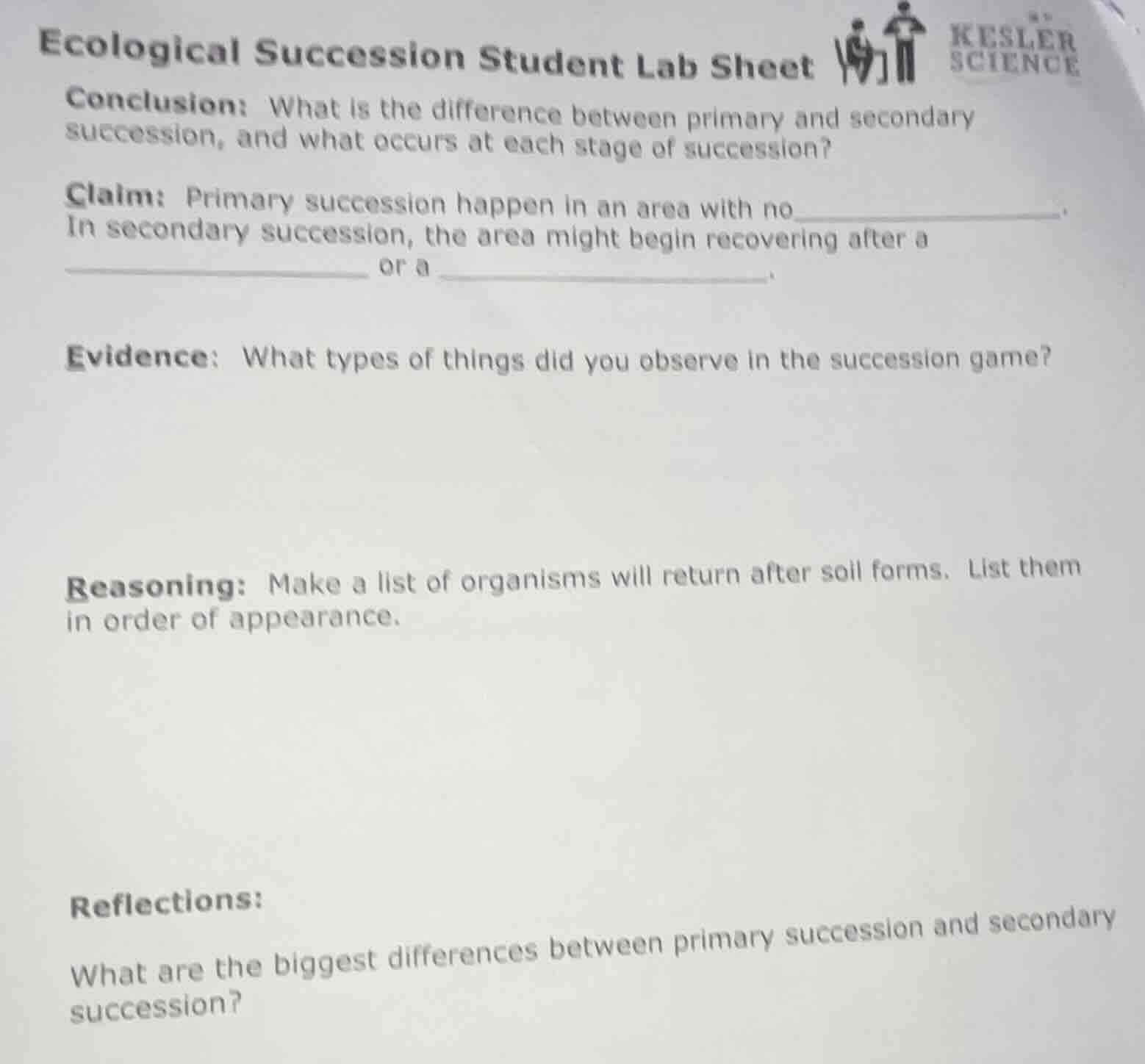
ecological succession student lab sheet conclusion: what is the difference between primary and secondary succession, and what occurs at each stage of succession? claim: primary succession happen in an area with no________. in secondary succession, the area might begin recovering after a ______ or a ________. evidence: what types of things did you observe in the succession game? reasoning: make a list of organisms will return after soil forms. list them in order of appearance. reflections: what are the biggest differences between primary succession and secondary succession?
For the "Claim" section:
- Primary succession occurs in an area with no soil (or no previous life/biotic community). This is because primary succession starts on bare rock, newly formed volcanic islands, or glacial retreat areas where there is no existing soil or organic matter from previous life.
- In secondary succession, the area might begin recovering after a natural disaster (like a forest fire, flood, hurricane) or a human - caused disturbance (like deforestation, agricultural abandonment). Secondary succession happens in areas where the soil is still intact, and there was a previous community of organisms that was disrupted.
For the "Evidence" section:
In a typical ecological succession simulation (the "succession game"), you might observe the following:
- At the start (especially for primary succession - like scenarios), there could be bare "ground" (represented in the game, maybe as a barren area). Then, pioneer species such as lichens (if simulating primary) or fast - growing plants like grasses (if simulating secondary, where soil is already there) might appear. As time progresses (in the game's timeline), small shrubs could start to grow, followed by trees in the later stages of succession. You may also observe changes in the types of organisms, with more complex and diverse species appearing as the ecosystem develops.
For the "Reasoning" section:
After soil forms (in primary succession, soil forms over time from the breakdown of rock by pioneer species like lichens and mosses; in secondary succession, soil is already present), the organisms that return in order of appearance are generally:
- Grasses and herbaceous plants: These are fast - growing, small plants that can colonize the area quickly. They have shallow root systems and can tolerate a relatively wide range of conditions.
- Shrubs: Once the grasses have established and improved the soil (by adding organic matter, holding the soil in place), shrubs start to grow. They are larger than grasses and can outcompete them for resources in the long run.
- Trees: Depending on the climate, different types of trees will appear. For example, in a temperate forest succession, first, pioneer tree species like pine (in some cases) or aspen might grow, and then later, more shade - tolerant and long - lived species like oak or maple will establish as the forest matures.
For the "Reflections" section:
The biggest differences between primary and secondary succession are:
- Starting Point: Primary succession starts on a completely barren surface with no soil or previous biotic community. Secondary succession starts in an area where the soil is intact and there was a previous community of organisms (even if it was disturbed).
- Time Frame: Primary succession takes a much longer time to reach a climax community (a stable, mature ecosystem). This is because it has to go through the process of soil formation, which is a slow process. Secondary succession is much faster because the soil is already present, and there may be seeds, roots, or other propagules of plants still in the soil.
- Pioneer Species: In primary succession, the pioneer species are usually very hardy and adapted to extreme conditions, like lichens (which can grow on bare rock). In secondary succession, the pioneer species are often grasses or other fast - growing herbaceous plants that can take advantage of the existing soil and the nutrients left behind after the disturbance.

Snap & solve any problem in the app
Get step-by-step solutions on Sovi AI
Photo-based solutions with guided steps
Explore more problems and detailed explanations
For the "Claim" section:
- Primary succession occurs in an area with no soil (or no previous life/biotic community). This is because primary succession starts on bare rock, newly formed volcanic islands, or glacial retreat areas where there is no existing soil or organic matter from previous life.
- In secondary succession, the area might begin recovering after a natural disaster (like a forest fire, flood, hurricane) or a human - caused disturbance (like deforestation, agricultural abandonment). Secondary succession happens in areas where the soil is still intact, and there was a previous community of organisms that was disrupted.
For the "Evidence" section:
In a typical ecological succession simulation (the "succession game"), you might observe the following:
- At the start (especially for primary succession - like scenarios), there could be bare "ground" (represented in the game, maybe as a barren area). Then, pioneer species such as lichens (if simulating primary) or fast - growing plants like grasses (if simulating secondary, where soil is already there) might appear. As time progresses (in the game's timeline), small shrubs could start to grow, followed by trees in the later stages of succession. You may also observe changes in the types of organisms, with more complex and diverse species appearing as the ecosystem develops.
For the "Reasoning" section:
After soil forms (in primary succession, soil forms over time from the breakdown of rock by pioneer species like lichens and mosses; in secondary succession, soil is already present), the organisms that return in order of appearance are generally:
- Grasses and herbaceous plants: These are fast - growing, small plants that can colonize the area quickly. They have shallow root systems and can tolerate a relatively wide range of conditions.
- Shrubs: Once the grasses have established and improved the soil (by adding organic matter, holding the soil in place), shrubs start to grow. They are larger than grasses and can outcompete them for resources in the long run.
- Trees: Depending on the climate, different types of trees will appear. For example, in a temperate forest succession, first, pioneer tree species like pine (in some cases) or aspen might grow, and then later, more shade - tolerant and long - lived species like oak or maple will establish as the forest matures.
For the "Reflections" section:
The biggest differences between primary and secondary succession are:
- Starting Point: Primary succession starts on a completely barren surface with no soil or previous biotic community. Secondary succession starts in an area where the soil is intact and there was a previous community of organisms (even if it was disturbed).
- Time Frame: Primary succession takes a much longer time to reach a climax community (a stable, mature ecosystem). This is because it has to go through the process of soil formation, which is a slow process. Secondary succession is much faster because the soil is already present, and there may be seeds, roots, or other propagules of plants still in the soil.
- Pioneer Species: In primary succession, the pioneer species are usually very hardy and adapted to extreme conditions, like lichens (which can grow on bare rock). In secondary succession, the pioneer species are often grasses or other fast - growing herbaceous plants that can take advantage of the existing soil and the nutrients left behind after the disturbance.