QUESTION IMAGE
Question
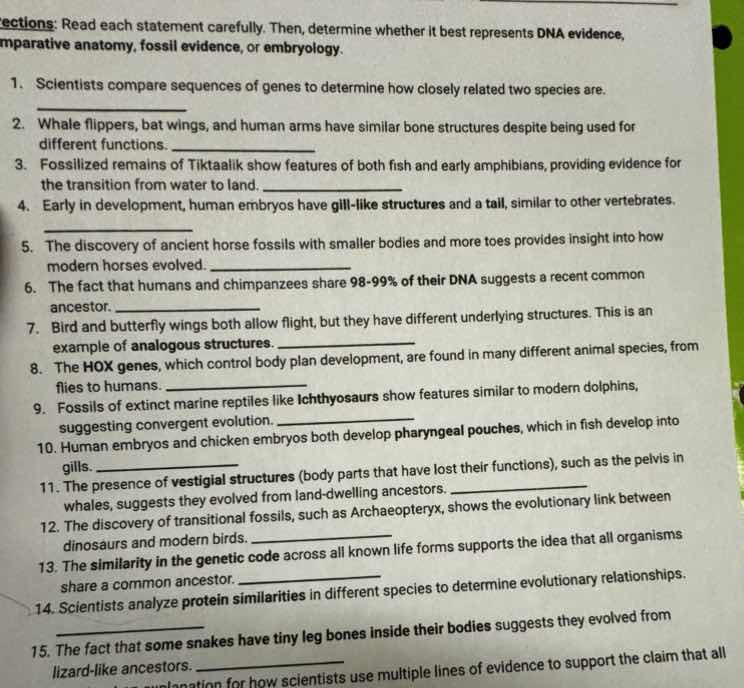
ections: read each statement carefully. then, determine whether it best represents dna evidence, omparative anatomy, fossil evidence, or embryology.
- scientists compare sequences of genes to determine how closely related two species are.
- whale flippers, bat wings, and human arms have similar bone structures despite being used for different functions.
- fossilized remains of tiktaalik show features of both fish and early amphibians, providing evidence for the transition from water to land.
- early in development, human embryos have gill-like structures and a tail, similar to other vertebrates.
- the discovery of ancient horse fossils with smaller bodies and more toes provides insight into how modern horses evolved.
- the fact that humans and chimpanzees share 98-99% of their dna suggests a recent common ancestor.
- bird and butterfly wings both allow flight, but they have different underlying structures. this is an example of analogous structures.
- the hox genes, which control body plan development, are found in many different animal species, from flies to humans.
- fossils of extinct marine reptiles like ichthyosaurs show features similar to modern dolphins, suggesting convergent evolution.
- human embryos and chicken embryos both develop pharyngeal pouches, which in fish develop into gills.
- the presence of vestigial structures (body parts that have lost their functions), such as the pelvis in whales, suggests they evolved from land-dwelling ancestors.
- the discovery of transitional fossils, such as archaeopteryx, shows the evolutionary link between dinosaurs and modern birds.
- the similarity in the genetic code across all known life forms supports the idea that all organisms share a common ancestor.
- scientists analyze protein similarities in different species to determine evolutionary relationships.
- the fact that some snakes have tiny leg bones inside their bodies suggests they evolved from lizard-like ancestors.
explanation for how scientists use multiple lines of evidence to support the claim that all
Brief Explanations
Each statement is matched to the corresponding evolutionary evidence type based on key identifiers: DNA/genetic sequence comparisons link to DNA evidence; physical bone/body structure similarities (living organisms) link to comparative anatomy; preserved ancient remains link to fossil evidence; embryonic developmental traits link to embryology.

Snap & solve any problem in the app
Get step-by-step solutions on Sovi AI
Photo-based solutions with guided steps
Explore more problems and detailed explanations
- DNA evidence
- Comparative anatomy
- Fossil evidence
- Embryology
- Fossil evidence
- DNA evidence
- Comparative anatomy
- DNA evidence
- Fossil evidence
- Embryology
- Comparative anatomy
- Fossil evidence
- DNA evidence
- DNA evidence
- Comparative anatomy