QUESTION IMAGE
Question
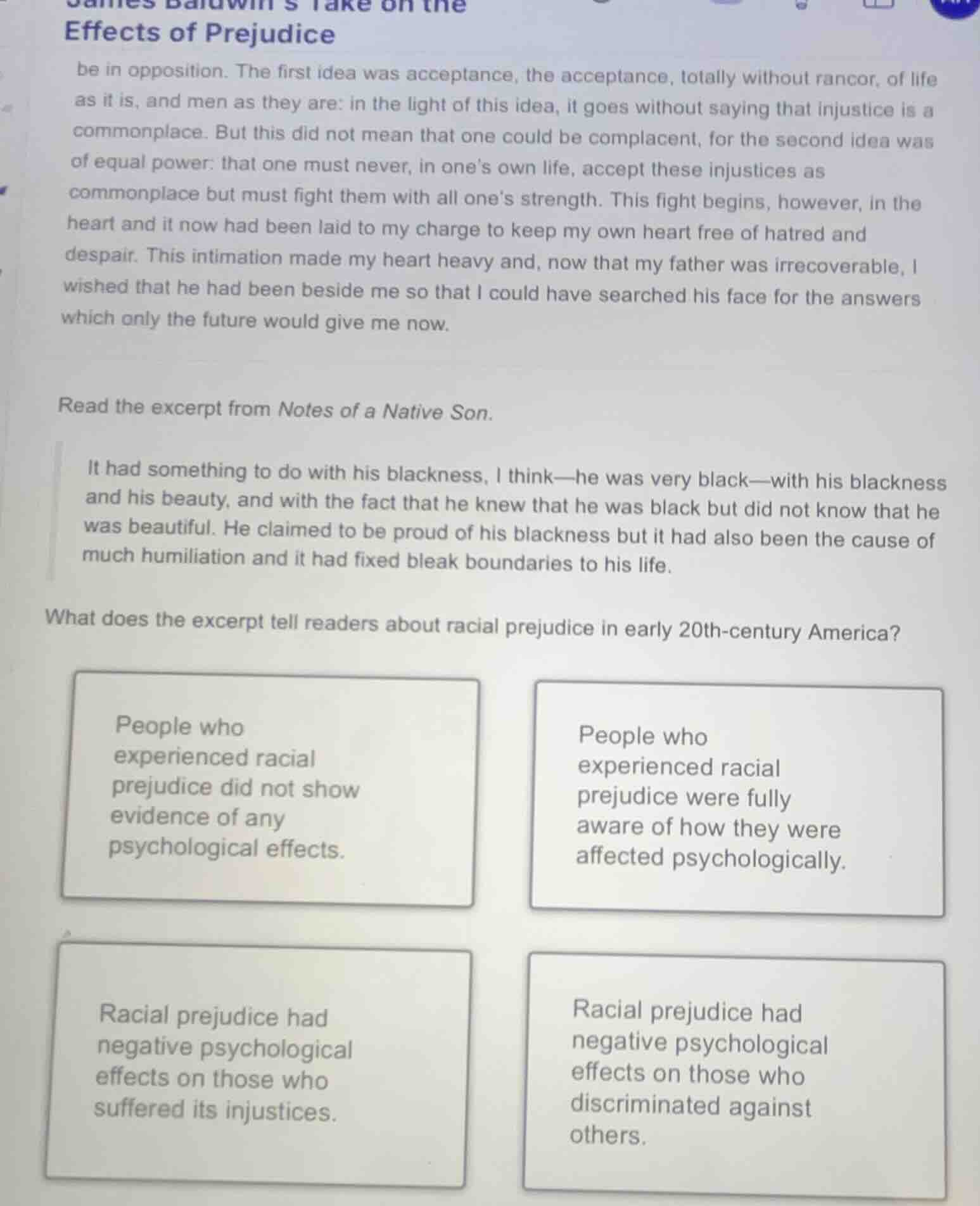
effects of prejudice
b e in opposition. the first idea was acceptance, the acceptance, totally without rancor, of life
as it is, and men as they are: in the light of this idea, it goes without saying that injustice is a
commonplace. but this did not mean that one could be complacent, for the second idea was
of equal power: that one must never, in one’s own life, accept these injustices as
commonplace but must fight them with all one’s strength. this fight begins, however, in the
heart and it now had been laid to my charge to keep my own heart free of hatred and
despair. this intimation made my heart heavy and, now that my father was irrecoverable, i
wished that he had been beside me so that i could have searched his face for the answers
which only the future would give me now.
read the excerpt from notes of a native son.
it had something to do with his blackness, i think—he was very black—with his blackness
and his beauty, and with the fact that he knew that he was black but did not know that he
was beautiful. he claimed to be proud of his blackness but it had also been the cause of
much humiliation and it had fixed bleak boundaries to his life.
what does the excerpt tell readers about racial prejudice in early 20th - century america?
people who
experienced racial
prejudice did not show
evidence of any
psychological effects.
people who
experienced racial
prejudice were fully
aware of how they were
affected psychologically.
racial prejudice had
negative psychological
effects on those who
suffered its injustices.
racial prejudice had
negative psychological
effects on those who
discriminated against
others.
- Analyze each option:
- First option: The excerpt shows the father had psychological effects (humiliation, bleak boundaries) from prejudice, so this is wrong.
- Second option: The father "did not know that he was beautiful" and faced humiliation, so he wasn't fully aware of psychological impacts, making this wrong.
- Third option: The excerpt states his blackness (linked to racial prejudice) caused humiliation and bleak life boundaries, showing negative psychological effects on the victim, so this is correct.
- Fourth option: The excerpt focuses on the victim (the father), not the discriminators, so this is wrong.

Snap & solve any problem in the app
Get step-by-step solutions on Sovi AI
Photo-based solutions with guided steps
Explore more problems and detailed explanations
Racial prejudice had negative psychological effects on those who suffered its injustices.