QUESTION IMAGE
Question
(elearning 1-28)
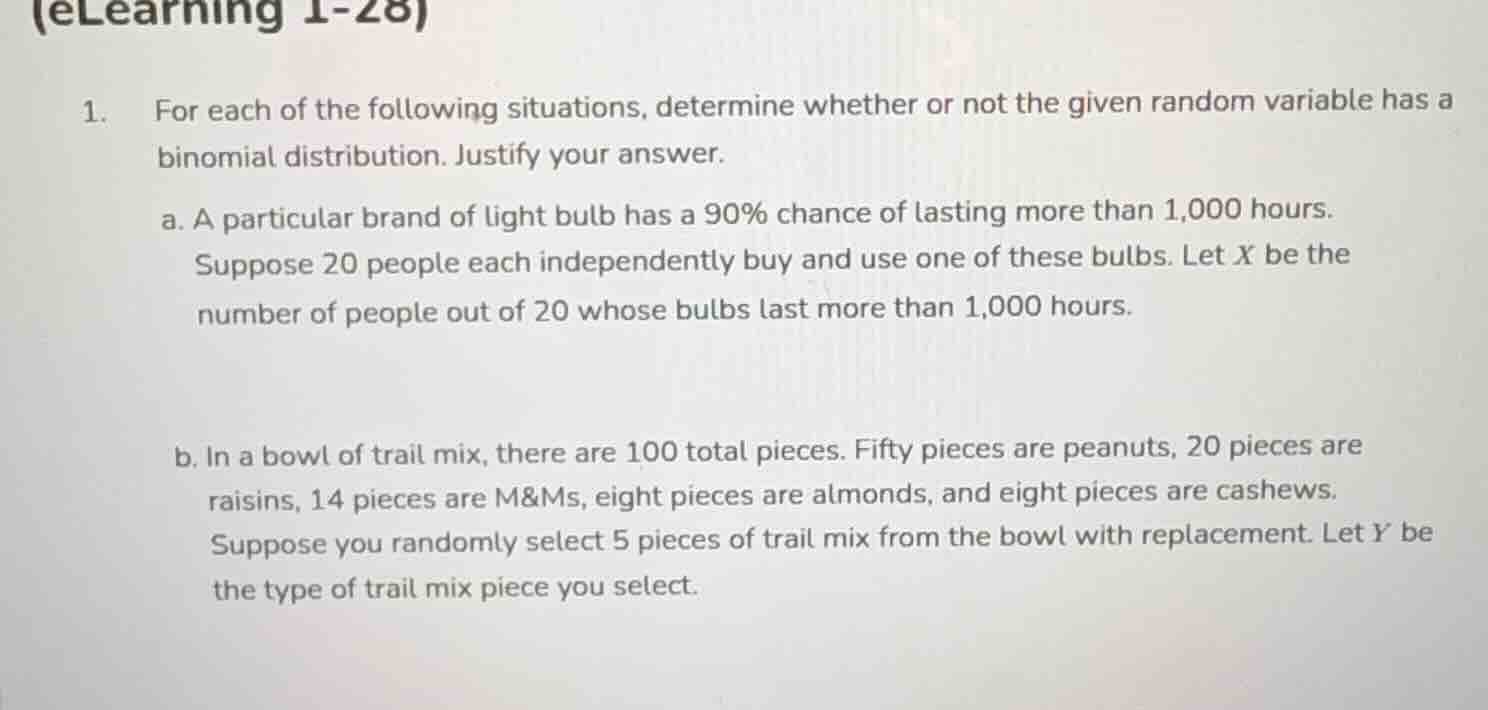
- for each of the following situations, determine whether or not the given random variable has a binomial distribution. justify your answer.
a. a particular brand of light bulb has a 90% chance of lasting more than 1,000 hours. suppose 20 people each independently buy and use one of these bulbs. let x be the number of people out of 20 whose bulbs last more than 1,000 hours.
b. in a bowl of trail mix, there are 100 total pieces. fifty pieces are peanuts, 20 pieces are raisins, 14 pieces are m&ms, eight pieces are almonds, and eight pieces are cashews. suppose you randomly select 5 pieces of trail mix from the bowl with replacement. let y be the type of trail mix piece you select.
a. A binomial distribution requires: fixed number of independent trials, 2 mutually exclusive outcomes, constant success probability, and the variable counts successes. Here, there are 20 independent trials (people buying bulbs), 2 outcomes (bulb lasts >1000h or not), constant 90% success probability, and X counts successes.
b. A binomial distribution requires only 2 mutually exclusive outcomes. Y represents the type of trail mix piece, which has 5 distinct categories, not 2 outcomes, so it cannot be binomial.

Snap & solve any problem in the app
Get step-by-step solutions on Sovi AI
Photo-based solutions with guided steps
Explore more problems and detailed explanations
a. Yes, X has a binomial distribution. It meets all binomial criteria: fixed n=20 independent trials, two outcomes, constant p=0.9 success probability, and X counts the number of successes.
b. No, Y does not have a binomial distribution. The variable Y represents multiple (5) distinct outcomes, not the two mutually exclusive outcomes required for a binomial distribution.