QUESTION IMAGE
Question
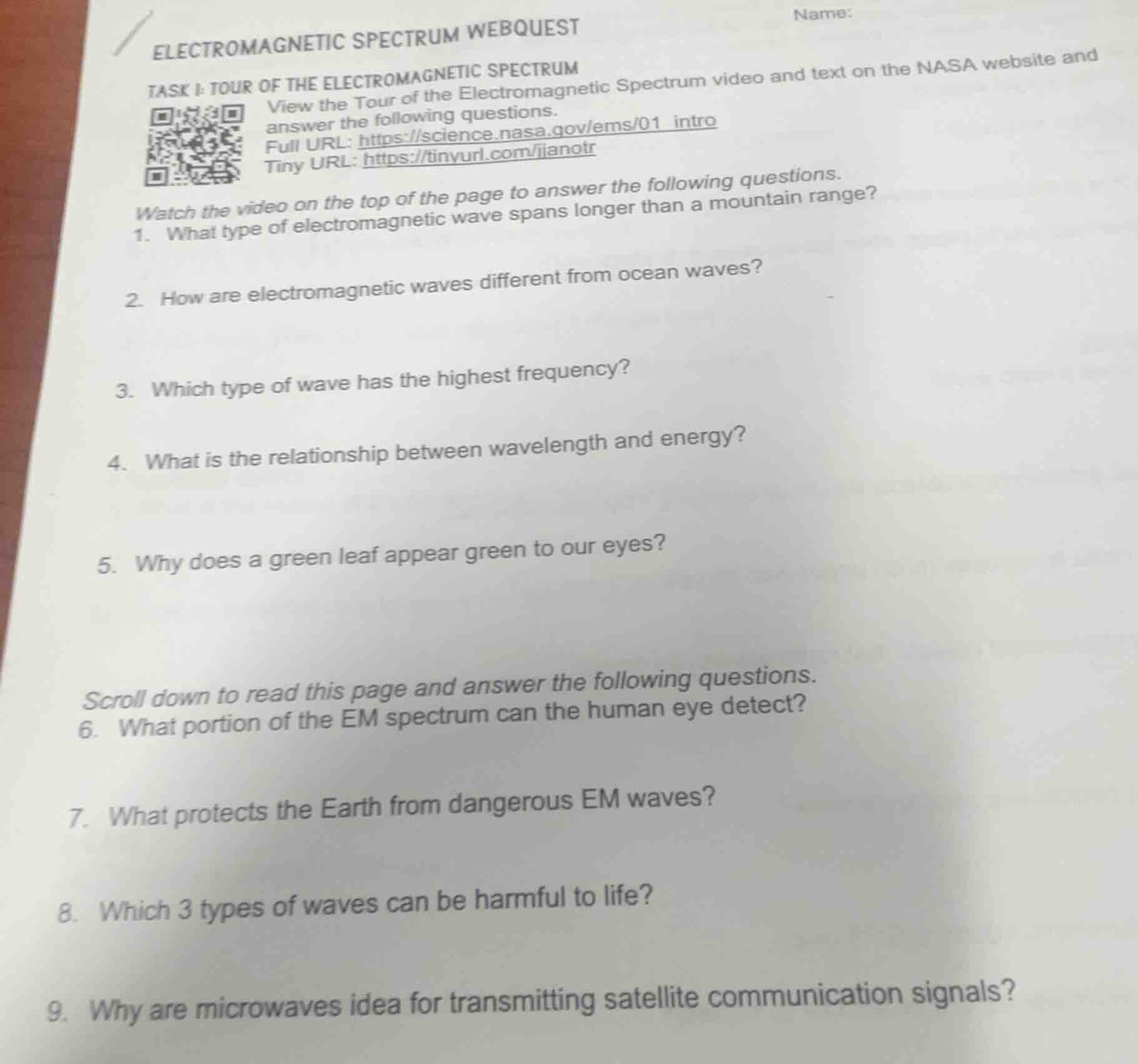
electromagnetic spectrum webquest
name:
task i: tour of the electromagnetic spectrum
view the tour of the electromagnetic spectrum video and text on the nasa website and answer the following questions.
full url: https://science.nasa.gov/ems/01_intro
tiny url: https://tinyurl.com/fijanotr
watch the video on the top of the page to answer the following questions.
- what type of electromagnetic wave spans longer than a mountain range?
- how are electromagnetic waves different from ocean waves?
- which type of wave has the highest frequency?
- what is the relationship between wavelength and energy?
- why does a green leaf appear green to our eyes?
scroll down to read this page and answer the following questions.
- what portion of the em spectrum can the human eye detect?
- what protects the earth from dangerous em waves?
- which 3 types of waves can be harmful to life?
- why are microwaves idea for transmitting satellite communication signals?
To answer these questions, you need to access the provided NASA website (either via the full URL or the tiny URL) and explore the "Tour of the Electromagnetic Spectrum" content (video and text). Here's a guide on how to approach each question after accessing the resource:
Question 1: What type of electromagnetic wave spans longer than a mountain range?
- How to find it: Watch the video or read the text to identify EM waves with wavelengths comparable to (or longer than) mountain ranges (e.g., radio waves, which have very long wavelengths).
Question 2: How are electromagnetic waves different from ocean waves?
- How to find it: Compare the nature of EM waves (transverse, no medium required, composed of electric and magnetic fields) vs. ocean waves (mechanical, require a medium like water, involve particle motion).
Question 3: Which type of wave has the highest frequency?
- How to find it: Recall the EM spectrum order (from lowest to highest frequency: radio, microwave, infrared, visible, ultraviolet, X - ray, gamma ray) or check the NASA resource. Gamma rays typically have the highest frequency.
Question 4: What is the relationship between wavelength and energy?
- How to find it: Use the formula \( E = hf=\frac{hc}{\lambda} \) (where \( E \) is energy, \( h \) is Planck’s constant, \( f \) is frequency, \( c \) is speed of light, and \( \lambda \) is wavelength). The resource will likely state that energy and wavelength are inversely proportional (shorter wavelength = higher energy, longer wavelength = lower energy).
Question 5: Why does a green leaf appear green to our eyes?
- How to find it: A green leaf reflects green light (in the visible spectrum) and absorbs other colors (like red, blue). The reflected green light enters our eyes, so we perceive it as green.
Question 6: What portion of the EM spectrum can the human eye detect?
- How to find it: The visible light spectrum (wavelengths ~400 - 700 nm) is detectable by the human eye.
Question 7: What protects the Earth from dangerous EM waves?
- How to find it: The Earth’s atmosphere (e.g., ozone layer blocks ultraviolet, ionosphere reflects some radio waves, magnetosphere deflects charged particles) and magnetic field protect against harmful EM radiation.
Question 8: Which 3 types of waves can be harmful to life?
- How to find it: Typically, ultraviolet (UV), X - rays, and gamma rays are harmful (due to high energy, which can damage cells/DNA).
Question 9: Why are microwaves ideal for transmitting satellite communication signals?
- How to find it: Microwaves can pass through the Earth’s atmosphere (ionosphere) with little absorption, making them suitable for satellite - to - Earth (or vice - versa) communication.
To get precise answers, visit the NASA link and explore the interactive content or text explanations provided there.

Snap & solve any problem in the app
Get step-by-step solutions on Sovi AI
Photo-based solutions with guided steps
Explore more problems and detailed explanations
To answer these questions, you need to access the provided NASA website (either via the full URL or the tiny URL) and explore the "Tour of the Electromagnetic Spectrum" content (video and text). Here's a guide on how to approach each question after accessing the resource:
Question 1: What type of electromagnetic wave spans longer than a mountain range?
- How to find it: Watch the video or read the text to identify EM waves with wavelengths comparable to (or longer than) mountain ranges (e.g., radio waves, which have very long wavelengths).
Question 2: How are electromagnetic waves different from ocean waves?
- How to find it: Compare the nature of EM waves (transverse, no medium required, composed of electric and magnetic fields) vs. ocean waves (mechanical, require a medium like water, involve particle motion).
Question 3: Which type of wave has the highest frequency?
- How to find it: Recall the EM spectrum order (from lowest to highest frequency: radio, microwave, infrared, visible, ultraviolet, X - ray, gamma ray) or check the NASA resource. Gamma rays typically have the highest frequency.
Question 4: What is the relationship between wavelength and energy?
- How to find it: Use the formula \( E = hf=\frac{hc}{\lambda} \) (where \( E \) is energy, \( h \) is Planck’s constant, \( f \) is frequency, \( c \) is speed of light, and \( \lambda \) is wavelength). The resource will likely state that energy and wavelength are inversely proportional (shorter wavelength = higher energy, longer wavelength = lower energy).
Question 5: Why does a green leaf appear green to our eyes?
- How to find it: A green leaf reflects green light (in the visible spectrum) and absorbs other colors (like red, blue). The reflected green light enters our eyes, so we perceive it as green.
Question 6: What portion of the EM spectrum can the human eye detect?
- How to find it: The visible light spectrum (wavelengths ~400 - 700 nm) is detectable by the human eye.
Question 7: What protects the Earth from dangerous EM waves?
- How to find it: The Earth’s atmosphere (e.g., ozone layer blocks ultraviolet, ionosphere reflects some radio waves, magnetosphere deflects charged particles) and magnetic field protect against harmful EM radiation.
Question 8: Which 3 types of waves can be harmful to life?
- How to find it: Typically, ultraviolet (UV), X - rays, and gamma rays are harmful (due to high energy, which can damage cells/DNA).
Question 9: Why are microwaves ideal for transmitting satellite communication signals?
- How to find it: Microwaves can pass through the Earth’s atmosphere (ionosphere) with little absorption, making them suitable for satellite - to - Earth (or vice - versa) communication.
To get precise answers, visit the NASA link and explore the interactive content or text explanations provided there.