QUESTION IMAGE
Question
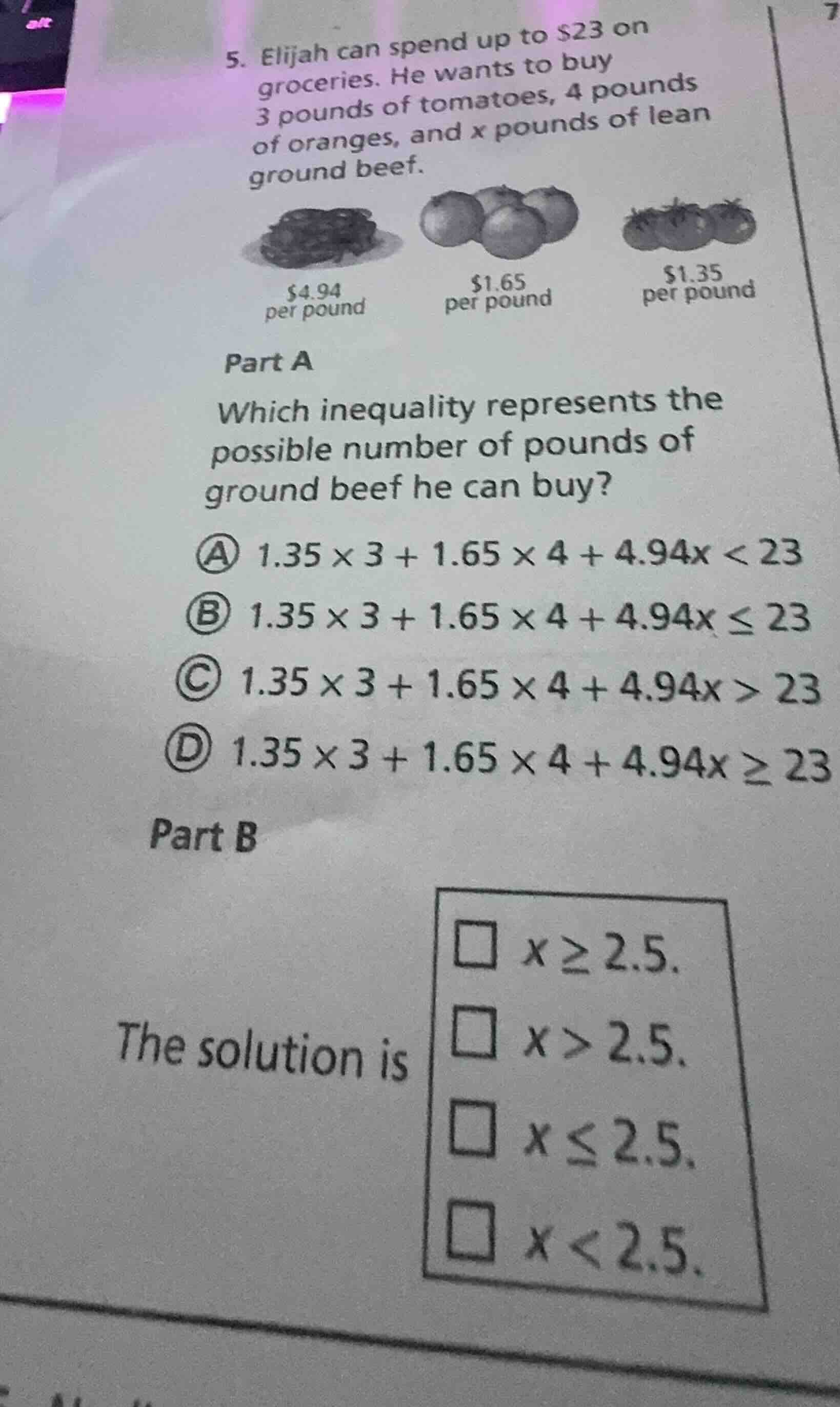
- elijah can spend up to $23 on groceries. he wants to buy 3 pounds of tomatoes, 4 pounds of oranges, and x pounds of lean ground beef.
$4.94 per pound
$1.65 per pound
$1.35 per pound
part a
which inequality represents the possible number of pounds of ground beef he can buy?
a ( 1.35 \times 3 + 1.65 \times 4 + 4.94x < 23 )
b ( 1.35 \times 3 + 1.65 \times 4 + 4.94x leq 23 )
c ( 1.35 \times 3 + 1.65 \times 4 + 4.94x > 23 )
d ( 1.35 \times 3 + 1.65 \times 4 + 4.94x geq 23 )
part b
the solution is (square) ( x geq 2.5 ).
(square) ( x > 2.5 ).
(square) ( x leq 2.5 ).
(square) ( x < 2.5 ).
Part A
Step1: Calculate cost of tomatoes
Tomatoes cost $1.35 per pound, 3 pounds: $1.35×3$
Step2: Calculate cost of oranges
Oranges cost $1.65 per pound, 4 pounds: $1.65×4$
Step3: Calculate cost of ground beef
Ground beef costs $4.94 per pound, x pounds: $4.94x$
Step4: Total cost and inequality
Total cost is sum of these, and he can spend up to $23 (≤23). So inequality: $1.35×3 + 1.65×4 + 4.94x ≤ 23$ (matches option B)
Step1: Solve the inequality from Part A
First, calculate \( 1.35×3 = 4.05 \), \( 1.65×4 = 6.6 \)
Sum: \( 4.05 + 6.6 = 10.65 \)
Inequality: \( 10.65 + 4.94x ≤ 23 \)
Subtract 10.65: \( 4.94x ≤ 23 - 10.65 = 12.35 \)
Divide by 4.94: \( x ≤ \frac{12.35}{4.94} = 2.5 \)

Snap & solve any problem in the app
Get step-by-step solutions on Sovi AI
Photo-based solutions with guided steps
Explore more problems and detailed explanations
B. \( 1.35 \times 3 + 1.65 \times 4 + 4.94x \leq 23 \)