QUESTION IMAGE
Question
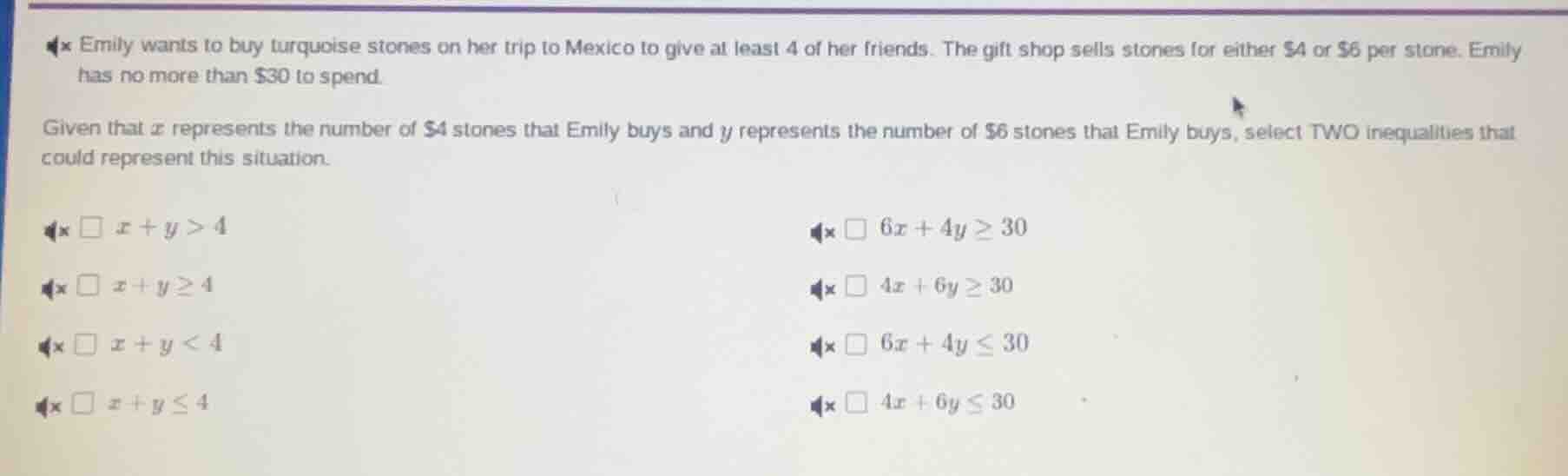
emily wants to buy turquoise stones on her trip to mexico to give at least 4 of her friends. the gift shop sells stones for either $4 or $6 per stone. emily has no more than $30 to spend. given that ( x ) represents the number of $4 stones that emily buys and ( y ) represents the number of $6 stones that emily buys, select two inequalities that could represent this situation. ( square x + y > 4 ) ( square 6x + 4y geq 30 ) ( square x + y geq 4 ) ( square 4x + 6y geq 30 ) ( square x + y < 4 ) ( square 6x + 4y leq 30 ) ( square x + y leq 4 ) ( square 4x + 6y leq 30 )
Step1: Analyze the number of stones
Emily wants to give at least 4 friends a stone, so the total number of stones \(x + y\) (where \(x\) is the number of \$4 stones and LXI2 is the number of \$6 stones) must be greater than or equal to 4. So the inequality for the number of stones is \(x + y\geq4\).
Step2: Analyze the cost
The cost of \(x\) \$4 stones is LXI1 dollars, and the cost of LXI2 \$6 stones is \(6y\) dollars. Emily has no more than \$30 to spend, meaning the total cost \(4x + 6y\) must be less than or equal to 30. So the inequality for the cost is \(4x + 6y\leq30\).

Snap & solve any problem in the app
Get step-by-step solutions on Sovi AI
Photo-based solutions with guided steps
Explore more problems and detailed explanations
\(x + y\geq4\), \(4x + 6y\leq30\)