QUESTION IMAGE
Question
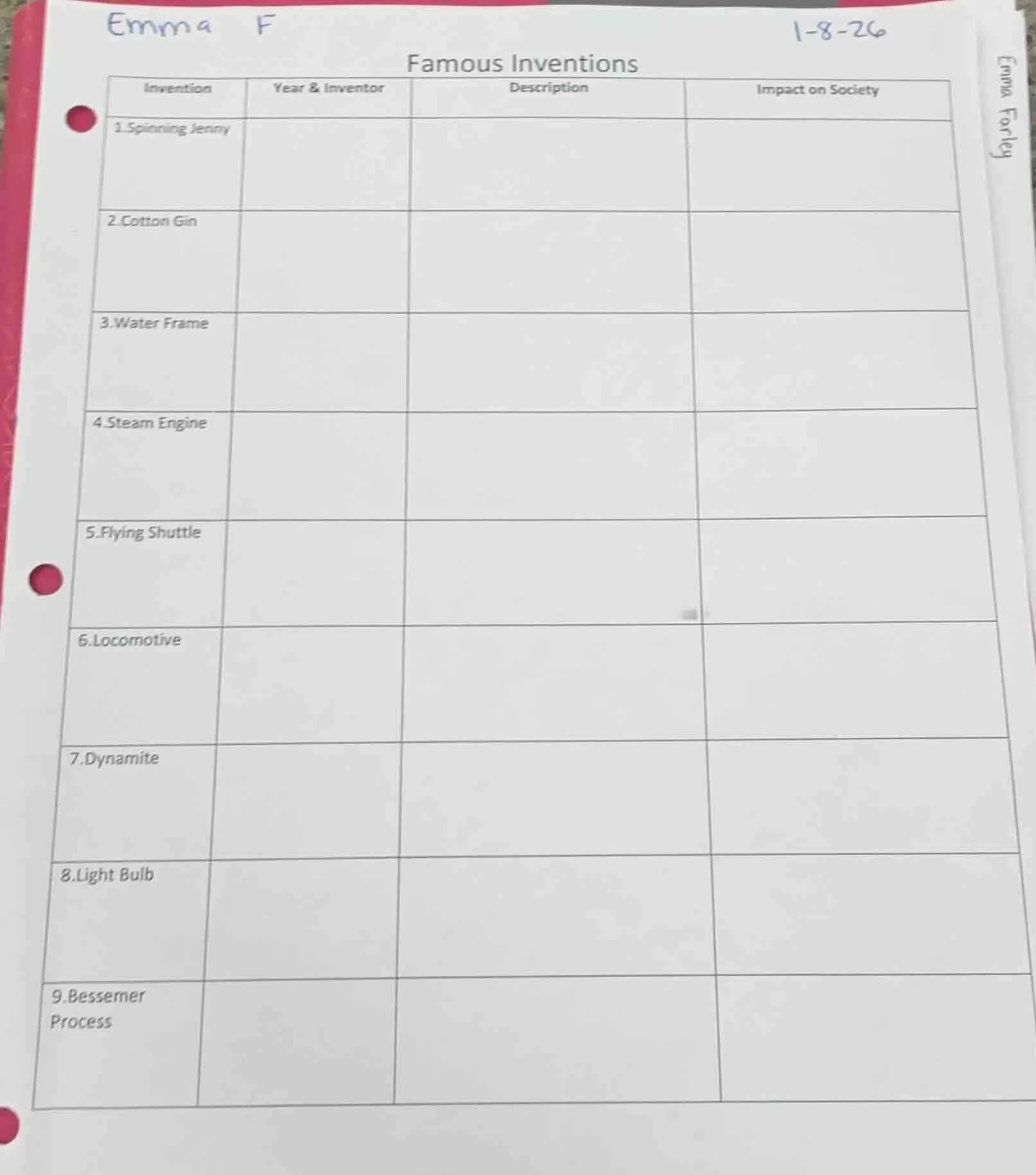
emma f 1-8-20 famous inventions
invention | year & inventor | description | impact on society
1.spinning jenny | | |
2.cotton gin | | |
3.water frame | | |
4.steam engine | | |
5.flying shuttle | | |
6.locomotive | | |
7.dynamite | | |
8.light bulb | | |
9.bessemer process | | |
Brief Explanations
Each entry is filled with verified historical details about the invention's creator, year, function, and societal impact.

Snap & solve any problem in the app
Get step-by-step solutions on Sovi AI
Photo-based solutions with guided steps
Explore more problems and detailed explanations
| Invention | Year & Inventor | Description | Impact on Society |
|---|---|---|---|
| 2. Cotton Gin | 1793, Eli Whitney | A machine that quickly separated cotton fibers from their seeds, a task previously done by hand | Made cotton production highly profitable, expanded cotton cultivation in the American South, and entrenched the system of chattel slavery in the region |
| 3. Water Frame | 1769, Richard Arkwright | A water-powered spinning machine that produced strong, hard-wearing thread for warp yarn | Enabled large-scale, factory-based textile production, shifted spinning from home-based cottage industries to centralized mills, and drove urbanization around mill towns |
| 4. Steam Engine (Watt's Improved Model) | 1775, James Watt (based on Newcomen's earlier design) | A heat engine that uses steam to generate mechanical power, with a separate condenser to boost efficiency | Powered factories, steamships, and locomotives; replaced water and wind power as a primary energy source, and accelerated the Industrial Revolution globally |
| 5. Flying Shuttle | 1733, John Kay | A weaving device that allowed a weaver to pass the shuttle across the loom much faster than by hand | Doubled weaving production speed, created demand for more thread (spurring inventions like the Spinning Jenny), and transformed the weaving industry |
| 6. Locomotive (Stephenson's Rocket) | 1829, George Stephenson | A steam-powered railway locomotive designed for passenger and freight transport | Launched the era of rail travel, enabled fast, low-cost long-distance transport of goods and people, unified national economies, and spurred urban and industrial growth |
| 7. Dynamite | 1867, Alfred Nobel | A stable, portable explosive made by mixing nitroglycerin with absorbent materials | Revolutionized mining, construction, and demolition; made large-scale excavation (for canals, railways, mines) feasible, though it also had military applications |
| 8. Practical Incandescent Light Bulb | 1879, Thomas Edison (with parallel work by Joseph Swan) | An electric light source that uses a glowing filament inside a vacuum bulb to produce steady, long-lasting light | Enabled widespread indoor electric lighting, extended productive hours beyond daylight, and supported the growth of late-night urban life and industrial operations |
| 9. Bessemer Process | 1856, Henry Bessemer | A method to mass-produce low-cost steel by removing impurities from molten pig iron using forced air | Made steel affordable and widely available, enabling the construction of skyscrapers, bridges, railways, and heavy machinery; laid the foundation for modern industrial infrastructure |