QUESTION IMAGE
Question
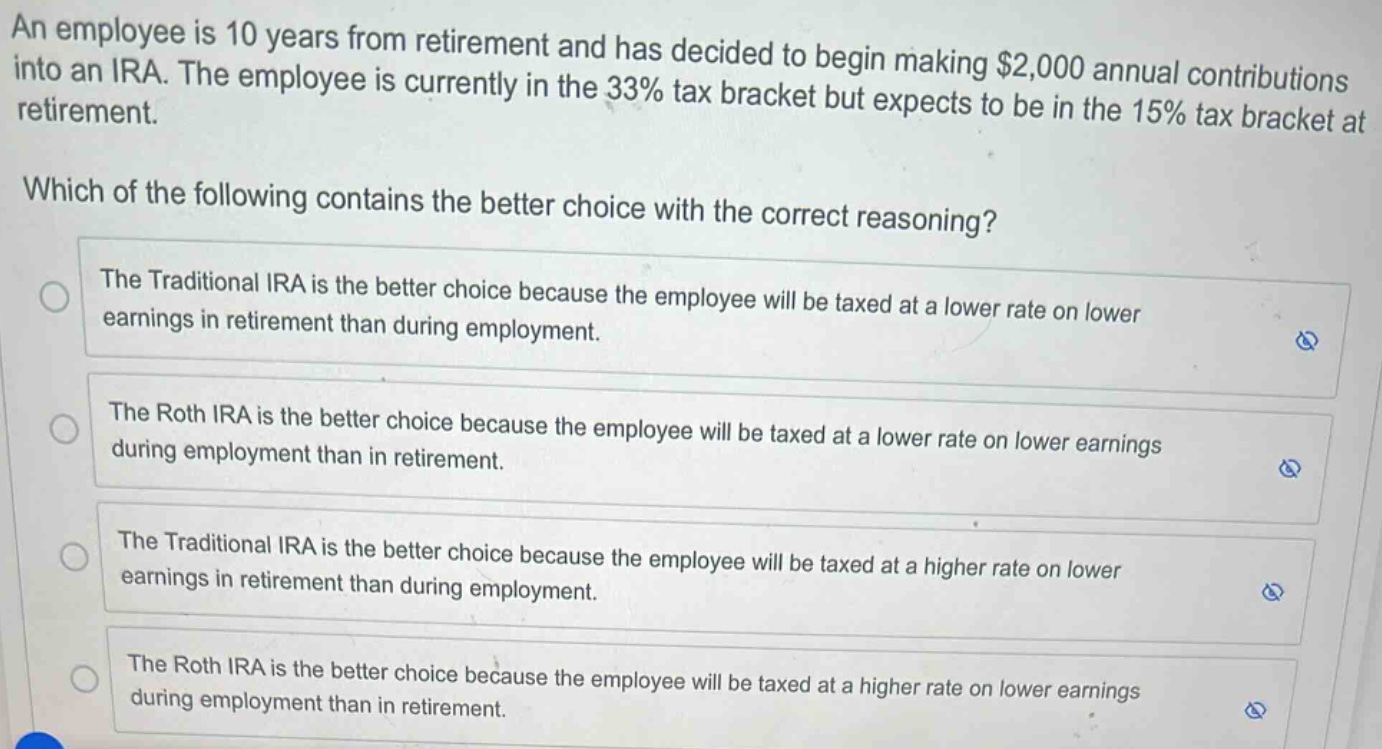
an employee is 10 years from retirement and has decided to begin making $2,000 annual contributions into an ira. the employee is currently in the 33% tax bracket but expects to be in the 15% tax bracket at retirement. which of the following contains the better choice with the correct reasoning? the traditional ira is the better choice because the employee will be taxed at a lower rate on lower earnings in retirement than during employment. the roth ira is the better choice because the employee will be taxed at a lower rate on lower earnings during employment than in retirement. the traditional ira is the better choice because the employee will be taxed at a higher rate on lower earnings in retirement than during employment. the roth ira is the better choice because the employee will be taxed at a higher rate on lower earnings during employment than in retirement.
To determine the better IRA choice, we analyze tax treatment:
- Traditional IRA: Contributions are tax - deductible now (employee is in 33% tax bracket), and withdrawals in retirement are taxed. The employee expects to be in 15% tax bracket in retirement (lower than 33% now). So, being taxed at a lower rate on retirement earnings (which may be lower or from IRA withdrawals) is beneficial.
- Roth IRA: Contributions are made with after - tax dollars (taxed at current rate, 33%), and withdrawals in retirement are tax - free. But since the retirement tax rate (15%) is lower, paying tax now at 33% is worse than paying later at 15% (as with Traditional IRA).
Now, let's analyze the options:
- Option 1: Says Traditional IRA is better because the employee will be taxed at a lower rate on lower earnings in retirement than during employment. This matches the Traditional IRA's benefit (taxed at 15% vs. 33%).
- Option 2: Claims Roth IRA is better, but Roth is taxed at current (higher) rate, so this is wrong.
- Option 3: States the employee will be taxed at a higher rate in retirement, which is false (15% < 33%).
- Option 4: Claims Roth is better and says the employee is taxed at a higher rate during employment (but Roth is taxed at current rate, and the reasoning is incorrect).

Snap & solve any problem in the app
Get step-by-step solutions on Sovi AI
Photo-based solutions with guided steps
Explore more problems and detailed explanations
The Traditional IRA is the better choice because the employee will be taxed at a lower rate on lower earnings in retirement than during employment.