QUESTION IMAGE
Question
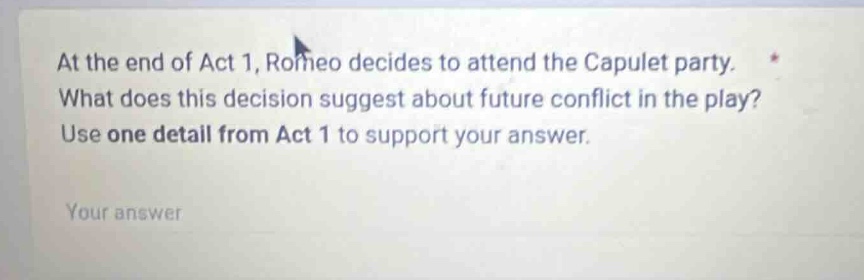
at the end of act 1, romeo decides to attend the capulet party. what does this decision suggest about future conflict in the play? use one detail from act 1 to support your answer.
Romeo is a Montague, and the Montagues and Capulets are feuding (e.g., the street brawl in Act 1 shows their hostility). Attending the Capulet party, a space of Capulet territory, risks confrontation. This decision suggests future conflict as Romeo, a Montague, entering Capulet - dominated space will likely spark tension between the families, and also, if he interacts with Capulet members (like Juliet), romantic or social conflict could arise. For example, the feud is established when Sampson and Gregory (Capulets) and Abram (Montague) fight, showing the deep - seated hatred. Romeo’s presence at the party will violate the social and familial boundaries of the feud, leading to conflict.

Snap & solve any problem in the app
Get step-by-step solutions on Sovi AI
Photo-based solutions with guided steps
Explore more problems and detailed explanations
Romeo’s decision to attend the Capulet party suggests future conflict because the Montagues and Capulets are in a bitter feud (seen in the Act 1 street brawl between their servants). As a Montague, Romeo entering Capulet - controlled space (the party) violates the feud’s boundaries, so he will likely face hostility from Capulets (sparking family - based conflict) and may also encounter personal conflict (e.g., romantic conflict if he connects with a Capulet like Juliet) due to the forbidden nature of his presence.