QUESTION IMAGE
Question
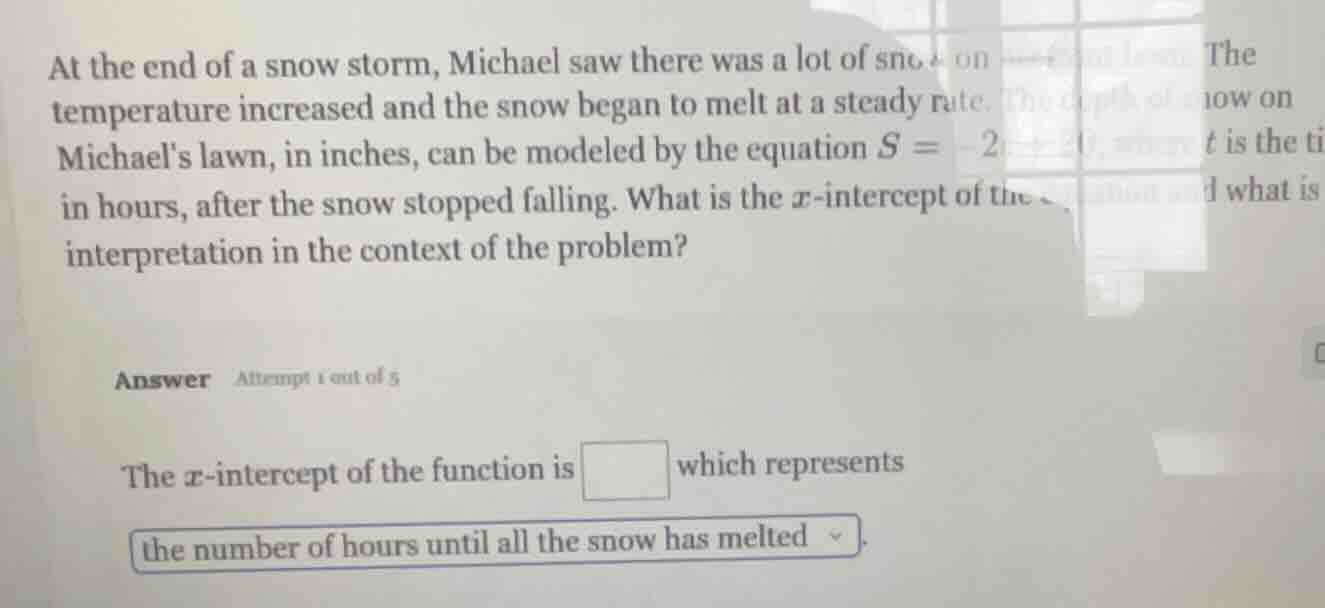
at the end of a snow storm, michael saw there was a lot of snow on his lawn. the temperature increased and the snow began to melt at a steady rate. the depth of snow on michaels lawn, in inches, can be modeled by the equation ( s = -2t + 20 ), where ( t ) is the time in hours, after the snow stopped falling. what is the ( x )-intercept of the equation and what is its interpretation in the context of the problem?
answer attempt 1 out of 5
the ( x )-intercept of the function is (square) which represents
the number of hours until all the snow has melted (\boldsymbol{downarrow}).
Step1: Identify the equation (assuming the correct equation is \( S = -2t + 20 \) as the text seems to have a typo)
We know that for the \( x \)-intercept (here \( t \)-intercept since \( t \) is the independent variable), we set \( S = 0 \) (because the snow depth \( S \) is zero when all snow has melted). So the equation becomes \( 0=-2t + 20 \).
Step2: Solve for \( t \)
Add \( 2t \) to both sides of the equation: \( 2t=20 \). Then divide both sides by 2: \( t = \frac{20}{2}=10 \).

Snap & solve any problem in the app
Get step-by-step solutions on Sovi AI
Photo-based solutions with guided steps
Explore more problems and detailed explanations
The \( x \)-intercept (here \( t \)-intercept) of the function is \( 10 \) which represents the number of hours until all the snow has melted.