QUESTION IMAGE
Question
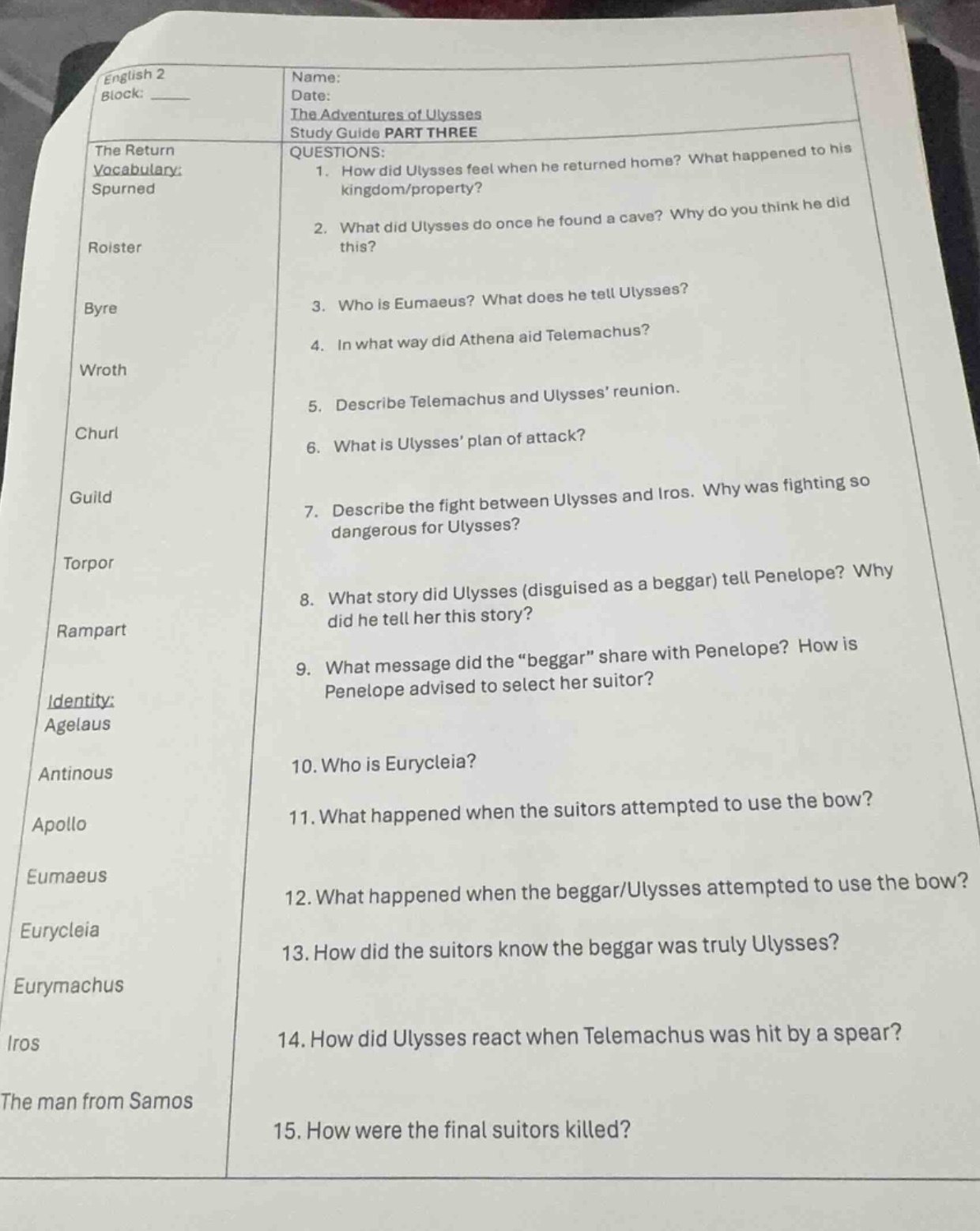
english 2
block:
name:
date:
the adventures of ulysses
study guide part three
the return
vocabulary:
spurned
roister
byre
wroth
churl
guild
torpor
rampart
identity:
agelaus
antinous
apollo
eumaeus
eurycleia
eurymachus
iros
the man from samos
questions:
- how did ulysses feel when he returned home? what happened to his kingdom/property?
- what did ulysses do once he found a cave? why do you think he did this?
- who is eumaeus? what does he tell ulysses?
- in what way did athena aid telemachus?
- describe telemachus and ulysses reunion.
- what is ulysses plan of attack?
- describe the fight between ulysses and iros. why was fighting so dangerous for ulysses?
- what story did ulysses (disguised as a beggar) tell penelope? why did he tell her this story?
- what message did the \beggar\ share with penelope? how is penelope advised to select her suitor?
- who is eurycleia?
- what happened when the suitors attempted to use the bow?
- what happened when the beggar/ulysses attempted to use the bow?
- how did the suitors know the beggar was truly ulysses?
- how did ulysses react when telemachus was hit by a spear?
- how were the final suitors killed?
Brief Explanations
- Answers are based on Homer's The Odyssey (Ulysses = Odysseus)
- Vocabulary terms are defined using standard literary context
- Character and plot details align with the epic's "Return" section

Snap & solve any problem in the app
Get step-by-step solutions on Sovi AI
Photo-based solutions with guided steps
Explore more problems and detailed explanations
Vocabulary Definitions:
- Spurned: Rejected with contempt
- Roister: To celebrate noisily; carouse
- Byre: A cowshed
- Wroth: Angry; furious
- Churl: A rude, ill-mannered person
- Guild: An association of craftspeople; a group
- Torpor: A state of physical or mental inactivity
- Rampart: A defensive wall of a fortification
Identity Definitions:
- Agelaus: A leading suitor of Penelope
- Antinous: The most arrogant and violent suitor of Penelope
- Apollo: Greek god of archery, music, and prophecy
- Eumaeus: Odysseus' loyal swineherd
- Eurycleia: Odysseus' loyal old nurse
- Eurymachus: A manipulative suitor of Penelope
- Iros: A beggar who taunts Odysseus in Ithaca
- The man from Samos: A suitor who brings gifts to Penelope
Study Guide Questions:
- Ulysses felt bitter and vengeful; his palace was overrun by suitors squandering his wealth and courting Penelope.
- He hid his treasure there; to secure his valuables before confronting the suitors.
- He is Ulysses' loyal swineherd; he tells Ulysses (disguised as a beggar) about the suitors' cruelty and Penelope's loyalty.
- She disguised herself as Mentor to guide Telemachus to search for news of Ulysses, and gave him courage.
- Telemachus initially does not recognize the disguised Ulysses; when Ulysses reveals his identity, they embrace and plot against the suitors.
- He will disguise himself as a beggar, test Penelope's loyalty, and with Telemachus' help, kill the suitors using his bow.
- Iros taunts Ulysses, so Ulysses beats him easily; fighting was dangerous because it could have revealed his strength and identity to the suitors.
- He told her a false story of meeting Ulysses in Crete; to test her loyalty and avoid revealing his true identity prematurely.
- He told her Ulysses is alive and will return soon; he advises her to hold a bow contest (stringing Ulysses' bow) to select a suitor.
- She is Ulysses' loyal childhood nurse who later recognizes him by his scar.
- None of them could string Ulysses' powerful bow, let alone shoot an arrow through the axe heads.
- He easily strung the bow and shot an arrow cleanly through all the axe heads, revealing his true skill.
- He revealed the scar on his foot (from a boar hunt) that only his loved ones knew about, and he knew the secret of the bed he carved from an olive tree.
- He calmed Telemachus, assured him the wound was minor, and urged him to keep fighting.
- Ulysses, Telemachus, Eumaeus, and Philoetius trapped the suitors in the palace and killed them with arrows, spears, and swords; some were killed by falling from the palace walls.