QUESTION IMAGE
Question
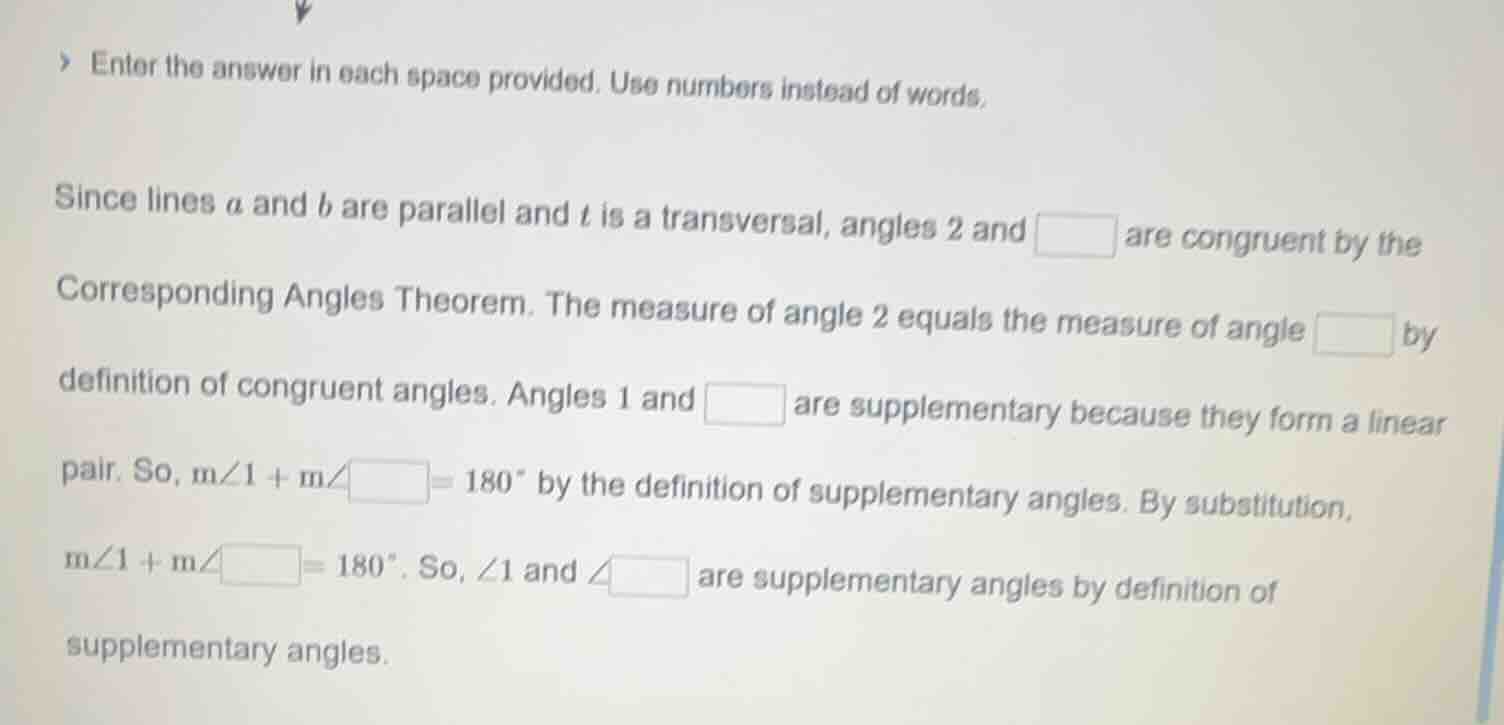
enter the answer in each space provided. use numbers instead of words. since lines a and b are parallel and t is a transversal, angles 2 and \boxed{} are congruent by the corresponding angles theorem. the measure of angle 2 equals the measure of angle \boxed{} by definition of congruent angles. angles 1 and \boxed{} are supplementary because they form a linear pair. so, m\angle 1 + m\angle \boxed{} = 180^\circ by the definition of supplementary angles. by substitution, m\angle 1 + m\angle \boxed{} = 180^\circ. so, \angle 1 and \angle \boxed{} are supplementary angles by definition of supplementary angles.
Step1: Recall Corresponding Angles Theorem
When two parallel lines are cut by a transversal, corresponding angles are congruent. So angle 2 and its corresponding angle (let's assume the corresponding angle to 2 is, say, angle 6 if we follow standard transversal - parallel lines angle numbering, but generally, the corresponding angle to angle 2 (when lines a and b are parallel and t is transversal) would be the angle in the same relative position. So first blank: the corresponding angle (let's assume the angle is, for example, angle 6, but more generally, the angle that is corresponding to angle 2. Let's proceed with the logic.
Step2: Congruent Angles Definition
If angle 2 and angle \( x \) (the corresponding angle) are congruent, then \( m\angle2=m\angle x \) by definition of congruent angles.
Step3: Linear Pair (Supplementary Angles)
Angles 1 and angle 2 (or the angle congruent to angle 2) form a linear pair? Wait, no. Angles 1 and angle 2 (if they are adjacent and form a linear pair) or angles 1 and the angle congruent to angle 2. Wait, let's re - establish:
- By Corresponding Angles Theorem, if lines \( a\parallel b \) and \( t \) is transversal, angle 2 and its corresponding angle (let's say angle 6) are congruent. So first blank: the corresponding angle (e.g., angle 6, but in general, the angle in the same position relative to the transversal and the parallel lines). Let's assume the standard diagram where angle 2 and angle 6 are corresponding. So first blank: 6 (assuming standard numbering).
- Then \( m\angle2 = m\angle6 \) by definition of congruent angles. So second blank: 6.
- Angles 1 and angle 2 are supplementary (if they form a linear pair). Wait, no. If angle 1 and angle 2 are adjacent and form a linear pair, then they are supplementary. Or if angle 1 and the angle congruent to angle 2 (angle 6) are supplementary? Wait, let's correct. Angles 1 and angle 2 form a linear pair (if they are adjacent and on a straight line), so they are supplementary. So third blank: 2. Then \( m\angle1 + m\angle2=180^{\circ} \) (fourth blank: 2). Then by substitution, since \( m\angle2 = m\angle6 \), \( m\angle1 + m\angle6 = 180^{\circ} \) (fifth blank: 6). Then \( \angle1 \) and \( \angle6 \) are supplementary (sixth blank: 6).
(Note: The actual angle numbers depend on the diagram, but the logic is as follows:
- Corresponding Angles Theorem: Angle 2 and its corresponding angle (let's call it angle \( x \)) are congruent.
- Congruent angles have equal measures, so \( m\angle2=m\angle x \).
- Angles 1 and angle 2 (or angle \( x \)): If angle 1 and angle 2 form a linear pair, they are supplementary. So \( m\angle1 + m\angle2 = 180^{\circ} \), then substituting \( m\angle2=m\angle x \), we get \( m\angle1 + m\angle x=180^{\circ} \), so \( \angle1 \) and \( \angle x \) are supplementary.)
Assuming the standard diagram where:
- First blank (Corresponding Angles): Let's say the corresponding angle to angle 2 is angle 6.
- Second blank (Congruent Angles Definition): 6 (since \( m\angle2 = m\angle6 \))
- Third blank (Linear Pair - Supplementary): 2 (if angle 1 and angle 2 form a linear pair)
- Fourth blank (Supplementary Angles Definition): 2 (since \( m\angle1 + m\angle2 = 180^{\circ} \))
- Fifth blank (Substitution): 6 (since \( m\angle2 = m\angle6 \), so \( m\angle1 + m\angle6 = 180^{\circ} \))
- Sixth blank (Supplementary Angles): 6 (since \( m\angle1 + m\angle6 = 180^{\circ} \))

Snap & solve any problem in the app
Get step-by-step solutions on Sovi AI
Photo-based solutions with guided steps
Explore more problems and detailed explanations
First blank: 6 (or the corresponding angle to 2)
Second blank: 6
Third blank: 2
Fourth blank: 2
Fifth blank: 6
Sixth blank: 6
(Note: The angle numbers may vary depending on the specific diagram, but the logical flow is: Corresponding angle for angle 2 (first blank), equal to that angle (second blank), angle 1 and angle 2 (or the corresponding angle) are supplementary (third blank), sum with angle 2 (fourth blank), substitute with the corresponding angle (fifth blank), and the supplementary angle is the corresponding angle (sixth blank).)