QUESTION IMAGE
Question
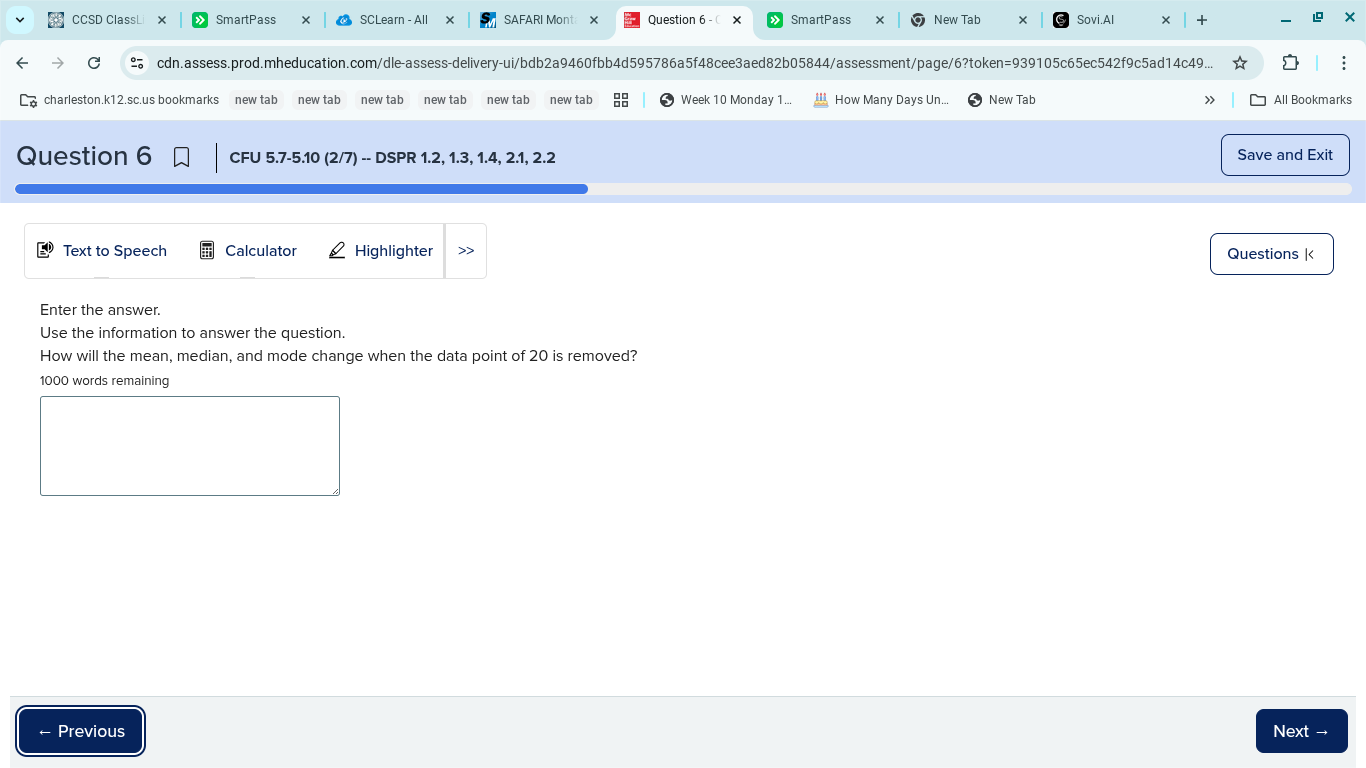
enter the answer. use the information to answer the question. how will the mean, median, and mode change when the data point of 20 is removed? 1000 words remaining
To answer this, we assume a dataset (since the original data isn't provided, we'll use a common example where 20 is an outlier or a distinct value). Let's take a sample dataset, e.g., \(\{10, 15, 20, 15\}\) (mode = 15, median: sort \(\{10,15,15,20\}\), median = \(\frac{15 + 15}{2}=15\), mean = \(\frac{10 + 15 + 20 + 15}{4}=\frac{60}{4}=15\)).
Step 1: Remove 20, new dataset \(\{10, 15, 15\}\)
- Mode: The most frequent value. In \(\{10,15,15\}\), 15 still appears most (2 times), so mode remains 15 (no change).
- Median: For \(n = 3\) (odd), median is the middle value. Sorted: \(\{10,15,15\}\), middle value is 15. Original median was 15, so median remains 15 (no change here, but if 20 was skewing, e.g., dataset \(\{5, 5, 20\}\) (original median 5, mean \(\frac{30}{3}=10\), mode 5). Remove 20: \(\{5,5\}\), median \(\frac{5 + 5}{2}=5\) (same), mean \(\frac{10}{2}=5\) (decreases), mode 5 (same).
- Mean: Original mean includes 20 (a higher/lower value). Removing 20 (if it’s higher than most, mean decreases; if lower, mean increases). In our first example, original mean 15, new mean \(\frac{10 + 15 + 15}{3}=\frac{40}{3}\approx13.33\) (decreases).
General Explanation (without sample):
- Mode: Depends on frequency. If 20 wasn’t the mode, mode stays. If 20 was the mode (e.g., \(\{20,20,10\}\)), removing 20 makes mode 10 (changes).
- Median: Depends on position. If 20 is at the end (sorted), removing it shifts the middle slightly (or not, if \(n\) was even/odd).
- Mean: Removing 20 (a data point) changes the sum and count. Mean = \(\frac{\text{Sum} - 20}{n - 1}\), so it changes (increases/decreases based on 20’s value relative to others).

Snap & solve any problem in the app
Get step-by-step solutions on Sovi AI
Photo-based solutions with guided steps
Explore more problems and detailed explanations
To determine the change, analyze the dataset (example - if 20 is an outlier/higher value):
- Mean: Decreases (since 20 is removed from the sum, reducing the average).
- Median: May stay the same (if 20 was at the end) or shift slightly (e.g., dataset with even \(n\) becomes odd).
- Mode: Stays the same (if 20 wasn’t the mode) or changes (if 20 was the mode).
(Note: Exact change depends on the original dataset. For a typical dataset with 20 as a higher outlier: Mean decreases, Median may stay/shift slightly, Mode stays (if 20 isn’t the mode).)