QUESTION IMAGE
Question
enzyme reaction (part 1)
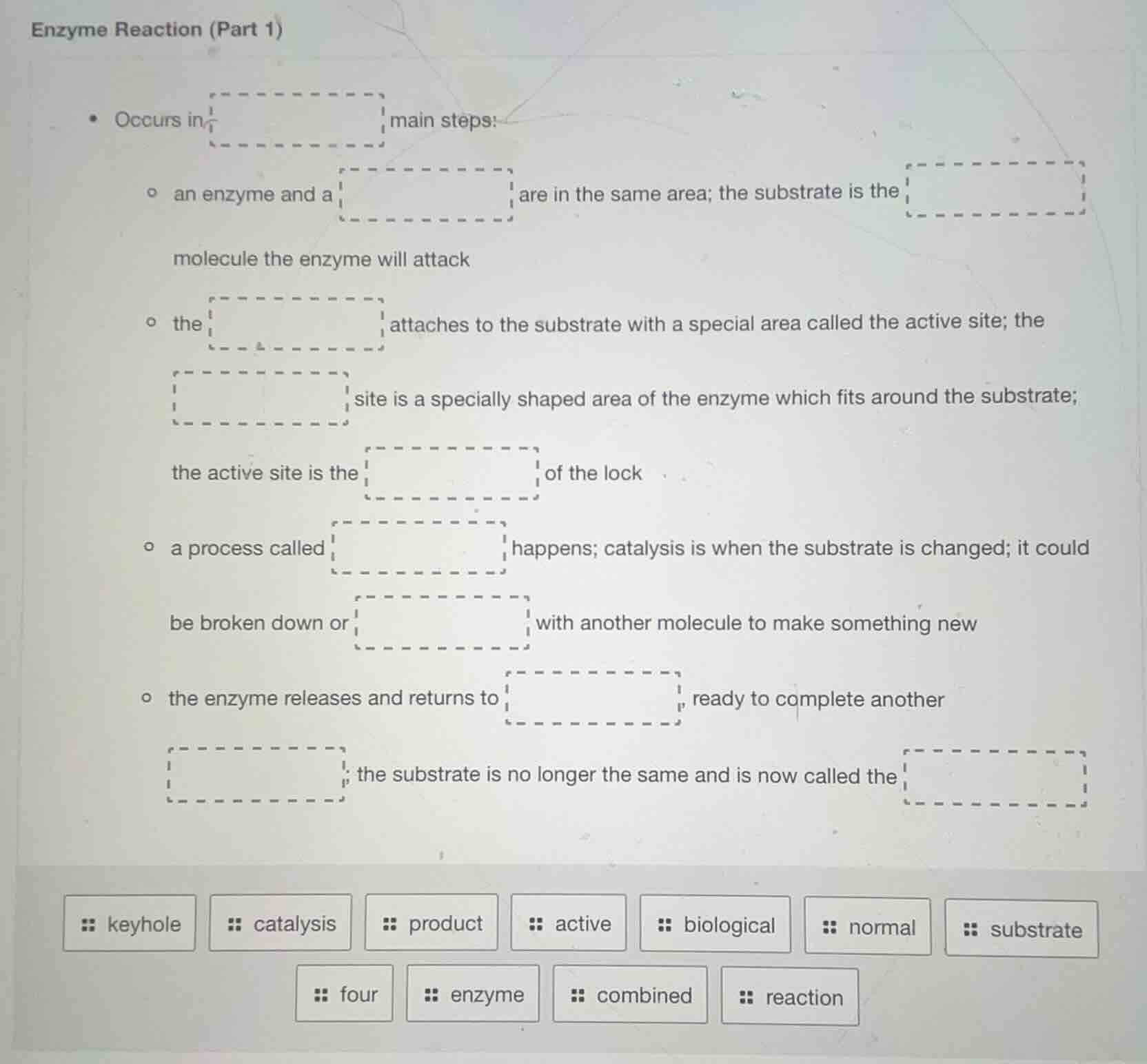
- occurs in \boxed{} main steps:
- an enzyme and a \boxed{} are in the same area; the substrate is the \boxed{} molecule the enzyme will attack
- the \boxed{} attaches to the substrate with a special area called the active site; the \boxed{} site is a specially shaped area of the enzyme which fits around the substrate; the active site is the \boxed{} of the lock
- a process called \boxed{} happens; catalysis is when the substrate is changed; it could be broken down or \boxed{} with another molecule to make something new
- the enzyme releases and returns to \boxed{}, ready to complete another \boxed{}; the substrate is no longer the same and is now called the \boxed{}
options: keyhole, catalysis, product, active, biological, normal, substrate, four, enzyme, combined, reaction
Brief Explanations
To solve this fill - in - the - blanks about enzyme reactions, we use our knowledge of enzyme - substrate interactions and the steps of an enzyme - catalyzed reaction:
- The first blank: Enzyme reactions occur in a certain number of main steps. From the context and the word bank, "four" is the correct number, so "Occurs in \(\boldsymbol{four}\) main steps".
- The second blank: In the first sub - step, an enzyme and a "substrate" are in the same area. The substrate is the molecule the enzyme acts on, so "an enzyme and a \(\boldsymbol{substrate}\) are in the same area".
- The third blank: The "enzyme" attaches to the substrate at the active site. So "the \(\boldsymbol{enzyme}\) attaches to the substrate with a special area called the active site".
- The fourth blank: The "active" site is the specially shaped area of the enzyme that fits the substrate. So "the \(\boldsymbol{active}\) site is a specially shaped area of the enzyme which fits around the substrate".
- The fifth blank: The active site is like the "keyhole" of a lock (lock - and - key model of enzyme action). So "the active site is the \(\boldsymbol{keyhole}\) of the lock".
- The sixth blank: The process where the substrate is changed is "catalysis". So "a process called \(\boldsymbol{catalysis}\) happens".
- The seventh blank: The substrate can be broken down or "combined" with another molecule to form a new substance. So "it could be broken down or \(\boldsymbol{combined}\) with another molecule to make something new".
- The eighth blank: After the reaction, the enzyme releases and returns to its "normal" state to participate in another reaction. So "the enzyme releases and returns to \(\boldsymbol{normal}\)".
- The ninth blank: The enzyme is ready to complete another "reaction". So "ready to complete another \(\boldsymbol{reaction}\)".
- The tenth blank: The substrate, after being changed, is now called the "product". So "the substrate is no longer the same and is now called the \(\boldsymbol{product}\)". Also, the overall context of enzyme reactions is "biological" in nature, so "Occurs in four main steps (biological context)".

Snap & solve any problem in the app
Get step-by-step solutions on Sovi AI
Photo-based solutions with guided steps
Explore more problems and detailed explanations
- Occurs in \(\boldsymbol{four}\) main steps:
- an enzyme and a \(\boldsymbol{substrate}\) are in the same area; the substrate is the molecule the enzyme will attack
- the \(\boldsymbol{enzyme}\) attaches to the substrate with a special area called the active site; the \(\boldsymbol{active}\) site is a specially shaped area of the enzyme which fits around the substrate; the active site is the \(\boldsymbol{keyhole}\) of the lock
- a process called \(\boldsymbol{catalysis}\) happens; catalysis is when the substrate is changed; it could be broken down or \(\boldsymbol{combined}\) with another molecule to make something new
- the enzyme releases and returns to \(\boldsymbol{normal}\), ready to complete another \(\boldsymbol{reaction}\); the substrate is no longer the same and is now called the \(\boldsymbol{product}\) (overall in a \(\boldsymbol{biological}\) context)