QUESTION IMAGE
Question
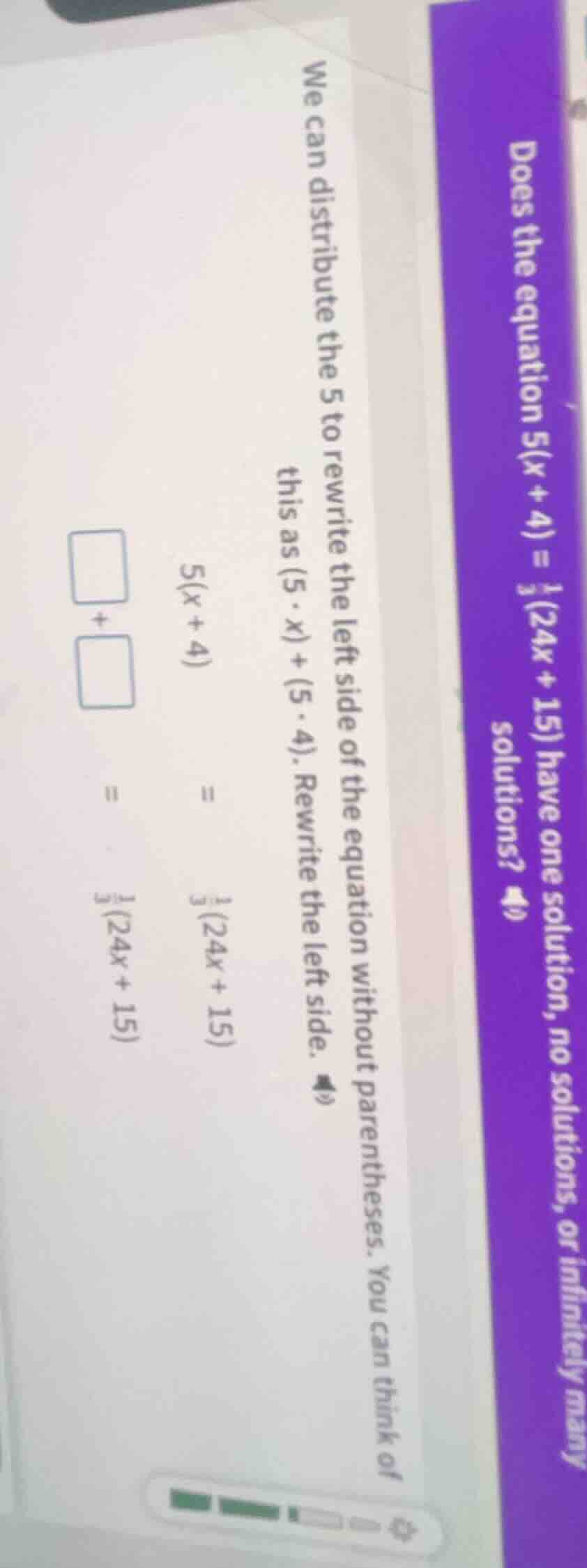
does the equation 5(x + 4) = \frac{1}{3}(24x + 15) have one solution, no solutions, or infinitely many solutions?
we can distribute the 5 to rewrite the left side of the equation without parentheses. you can think of this as (5 \cdot x) + (5 \cdot 4). rewrite the left side.
5(x + 4)
\square + \square
=
\frac{1}{3}(24x + 15)
=
\frac{1}{3}(24x + 15)
Step1: Distribute 5 on left side
$5(x+4) = 5x + 20$
Step2: Distribute $\frac{1}{3}$ on right side
$\frac{1}{3}(24x+15) = 8x + 5$
Step3: Set equal, solve for x
$5x + 20 = 8x + 5$
$20 - 5 = 8x - 5x$
$15 = 3x$
$x = \frac{15}{3} = 5$

Snap & solve any problem in the app
Get step-by-step solutions on Sovi AI
Photo-based solutions with guided steps
Explore more problems and detailed explanations
First, the expanded left side is $\boldsymbol{5x + 20}$.
The equation has one solution, which is $\boldsymbol{x=5}$.