QUESTION IMAGE
Question
equations, inequalities, model
question 1, 5.3.1
part 2 of 3
hw score: 8.33%, 1 of 12 points
points: 0 of 1
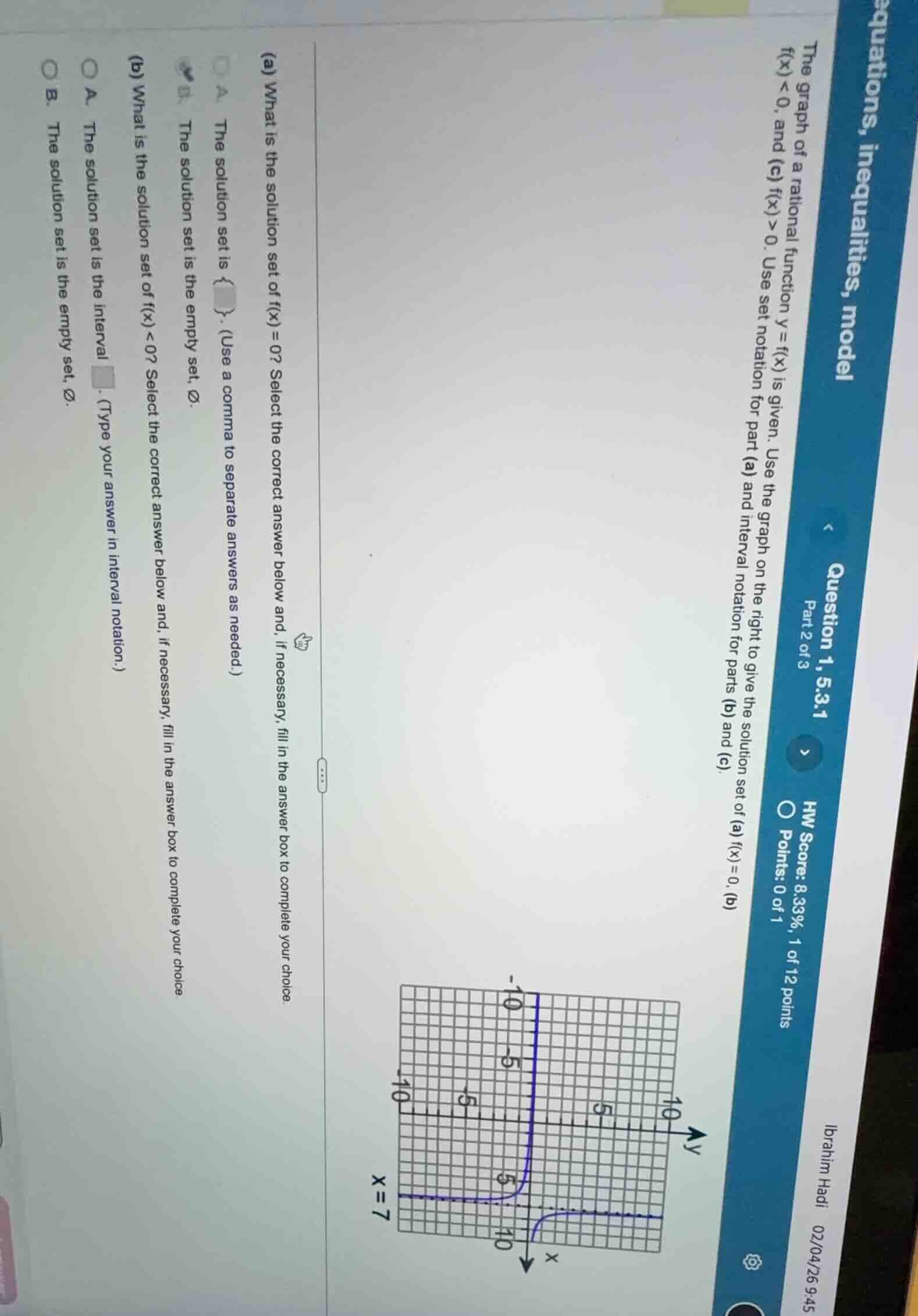
the graph of a rational function ( y = f(x) ) is given. use the graph on the right to give the solution set of (a) ( f(x) = 0 ), (b) ( f(x) < 0 ), and (c) ( f(x) > 0 ). use set notation for part (a) and interval notation for parts (b) and (c).
(a) what is the solution set of ( f(x) = 0 )? select the correct answer below and, if necessary, fill in the answer box to complete your choice.
a the solution set is { }. (use a comma to separate answers as needed.)
b the solution set is the empty set, ( varnothing ).
(b) what is the solution set of ( f(x) < 0 )? select the correct answer below and, if necessary, fill in the answer box to complete your choice.
a the solution set is the interval. (type your answer in interval notation.)
b the solution set is the empty set, ( varnothing ).
To solve the problem, we analyze the graph of the rational function \( y = f(x) \):
Part (a): Solution set of \( f(x) = 0 \)
The solution to \( f(x) = 0 \) occurs where the graph intersects the \( x \)-axis. From the graph, we observe that the function does not intersect the \( x \)-axis (there are no \( x \)-intercepts). Thus, the solution set is the empty set.
Part (b): Solution set of \( f(x) < 0 \)
We look for the intervals where the graph of \( f(x) \) is below the \( x \)-axis (where \( y < 0 \)). From the graph, we see that the function is below the \( x \)-axis for \( x > 7 \). In interval notation, this is \( (7, \infty) \).
Part (c): Solution set of \( f(x) > 0 \)
We look for the intervals where the graph of \( f(x) \) is above the \( x \)-axis (where \( y > 0 \)). From the graph, we see that the function is above the \( x \)-axis for \( x < 7 \) (excluding any vertical asymptotes or holes, but the vertical asymptote is at \( x = 7 \), and the graph is above the \( x \)-axis to the left of \( x = 7 \)). In interval notation, this is \( (-\infty, 7) \).
Final Answers:
(a) The solution set of \( f(x) = 0 \) is \( \boxed{\varnothing} \) (the empty set).
(b) The solution set of \( f(x) < 0 \) is \( \boxed{(7, \infty)} \).
(c) The solution set of \( f(x) > 0 \) is \( \boxed{(-\infty, 7)} \).

Snap & solve any problem in the app
Get step-by-step solutions on Sovi AI
Photo-based solutions with guided steps
Explore more problems and detailed explanations
To solve the problem, we analyze the graph of the rational function \( y = f(x) \):
Part (a): Solution set of \( f(x) = 0 \)
The solution to \( f(x) = 0 \) occurs where the graph intersects the \( x \)-axis. From the graph, we observe that the function does not intersect the \( x \)-axis (there are no \( x \)-intercepts). Thus, the solution set is the empty set.
Part (b): Solution set of \( f(x) < 0 \)
We look for the intervals where the graph of \( f(x) \) is below the \( x \)-axis (where \( y < 0 \)). From the graph, we see that the function is below the \( x \)-axis for \( x > 7 \). In interval notation, this is \( (7, \infty) \).
Part (c): Solution set of \( f(x) > 0 \)
We look for the intervals where the graph of \( f(x) \) is above the \( x \)-axis (where \( y > 0 \)). From the graph, we see that the function is above the \( x \)-axis for \( x < 7 \) (excluding any vertical asymptotes or holes, but the vertical asymptote is at \( x = 7 \), and the graph is above the \( x \)-axis to the left of \( x = 7 \)). In interval notation, this is \( (-\infty, 7) \).
Final Answers:
(a) The solution set of \( f(x) = 0 \) is \( \boxed{\varnothing} \) (the empty set).
(b) The solution set of \( f(x) < 0 \) is \( \boxed{(7, \infty)} \).
(c) The solution set of \( f(x) > 0 \) is \( \boxed{(-\infty, 7)} \).