QUESTION IMAGE
Question
equations and solutions
expressions and number sentences
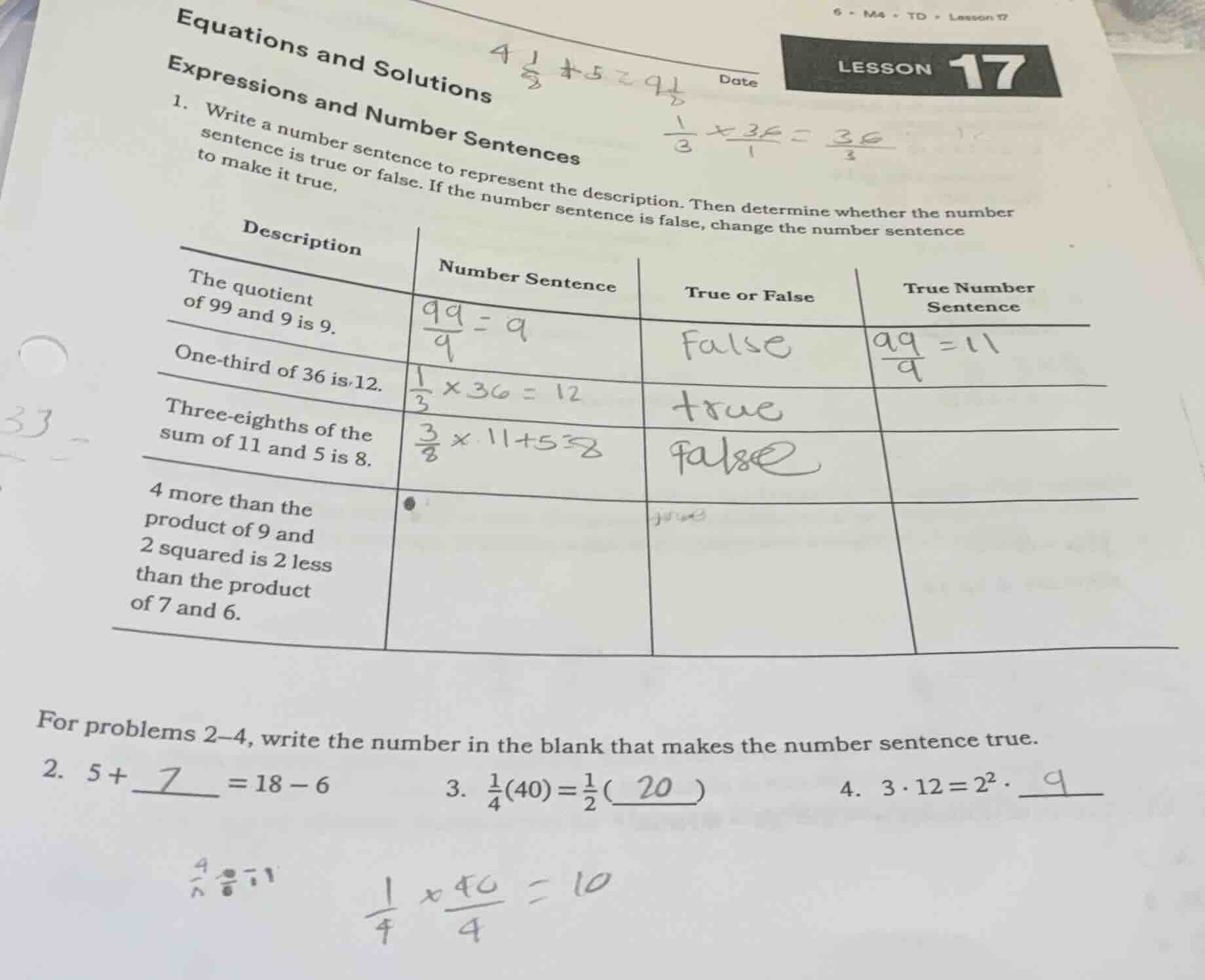
- write a number sentence to represent the description. then determine whether the number sentence is true or false. if the number sentence is false, change the number sentence to make it true.
| description | number sentence | true or false | true number sentence |
|---|---|---|---|
| one - third of 36 is 12. | \\(\frac{1}{3}\times36 = 12\\) | true | |
| three - eighths of the sum of 11 and 5 is 8. | \\(\frac{3}{8}\times11 + 5 = 8\\) | false | |
| 4 more than the product of 9 and 2 squared is 2 less than the product of 7 and 6. |
for problems 2–4, write the number in the blank that makes the number sentence true.
- \\(5 + \underline{7}=18 - 6\\)
- \\(\frac{1}{4}(40)=\frac{1}{2}(\underline{20})\\)
- \\(3\cdot12 = 2^{2}\cdot\underline{9}\\)
Step1: Fix third row number sentence
First, calculate the sum of 11 and 5, then multiply by $\frac{3}{8}$.
Number sentence: $\frac{3}{8} \times (11+5) = 8$
Step2: Verify third row truth value
Calculate left side: $\frac{3}{8} \times 16 = 6$. $6
eq 8$, so false.
True number sentence: $\frac{3}{8} \times (11+5) = 6$
Step3: Write fourth row number sentence
Translate description to math: $9 \times 2^2 + 4 = (7 \times 6) - 2$
Step4: Verify fourth row truth value
Calculate left: $9 \times 4 + 4 = 40$. Calculate right: $42 - 2 = 40$. $40=40$, so true.
Step5: Solve problem 2
Simplify right side: $18-6=12$. Find missing number: $12-5=7$
Step6: Solve problem 3
Calculate left side: $\frac{1}{4} \times 40 = 10$. Find missing number: $10 \div \frac{1}{2} = 20$
Step7: Solve problem 4
Calculate left side: $3 \times 12 = 36$. Calculate $2^2=4$. Find missing number: $36 \div 4 = 9$

Snap & solve any problem in the app
Get step-by-step solutions on Sovi AI
Photo-based solutions with guided steps
Explore more problems and detailed explanations
Completed Table:
| Description | Number Sentence | True or False | True Number Sentence |
|---|---|---|---|
| One-third of 36 is 12. | $\frac{1}{3} \times 36=12$ | True | (no change needed) |
| Three-eighths of the sum of 11 and 5 is 8. | $\frac{3}{8} \times (11+5)=8$ | False | $\frac{3}{8} \times (11+5)=6$ |
| 4 more than the product of 9 and 2 squared is 2 less than the product of 7 and 6. | $9 \times 2^2 + 4 = (7 \times 6) - 2$ | True | (no change needed) |
Problems 2-4:
- $5 + \boldsymbol{7} = 18 - 6$
- $\frac{1}{4}(40)=\frac{1}{2}(\boldsymbol{20})$
- $3 \cdot 12 = 2^2 \cdot \boldsymbol{9}$