QUESTION IMAGE
Question
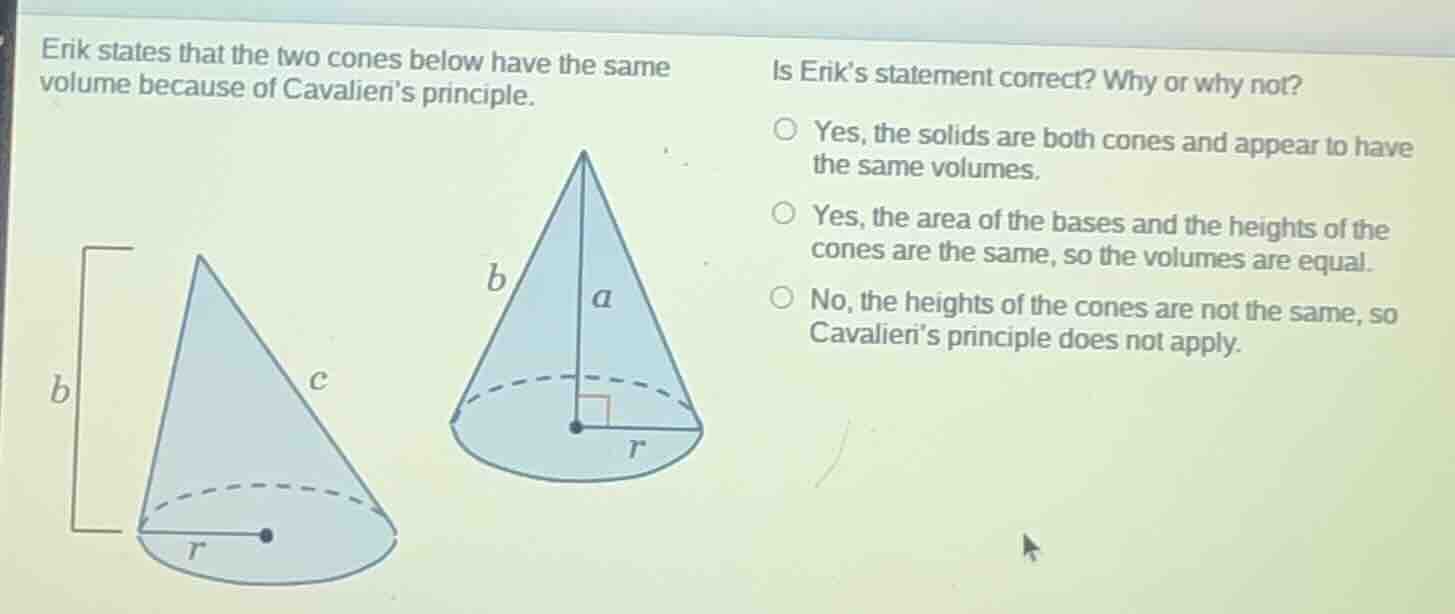
erik states that the two cones below have the same volume because of cavalien’s principle. is erik’s statement correct? why or why not? yes, the solids are both cones and appear to have the same volumes. yes, the area of the bases and the heights of the cones are the same, so the volumes are equal. no, the heights of the cones are not the same, so cavalieri’s principle does not apply.
Step1: Recall Cavalieri's Principle
Cavalieri's principle requires that for two solids between parallel planes, the cross-sectional areas at every height are equal, or equivalently, the solids have equal height and equal corresponding cross-sectional areas. For cones, volume depends on base area and perpendicular height: $V=\frac{1}{3}\pi r^2 h$.
Step2: Analyze cone dimensions
Left cone: perpendicular height = $b$, base radius $r$. Right cone: perpendicular height = $a$, base radius $r$. The slant heights ($c$ and $b$ for the right cone) do not affect volume. The perpendicular heights $a
eq b$, so the heights are not equal.
Step3: Evaluate Erik's claim
Erik invokes Cavalieri's principle, but the principle does not apply here because the perpendicular heights of the two cones are not the same.

Snap & solve any problem in the app
Get step-by-step solutions on Sovi AI
Photo-based solutions with guided steps
Explore more problems and detailed explanations
No, the heights of the cones are not the same, so Cavalieri's principle does not apply.