QUESTION IMAGE
Question
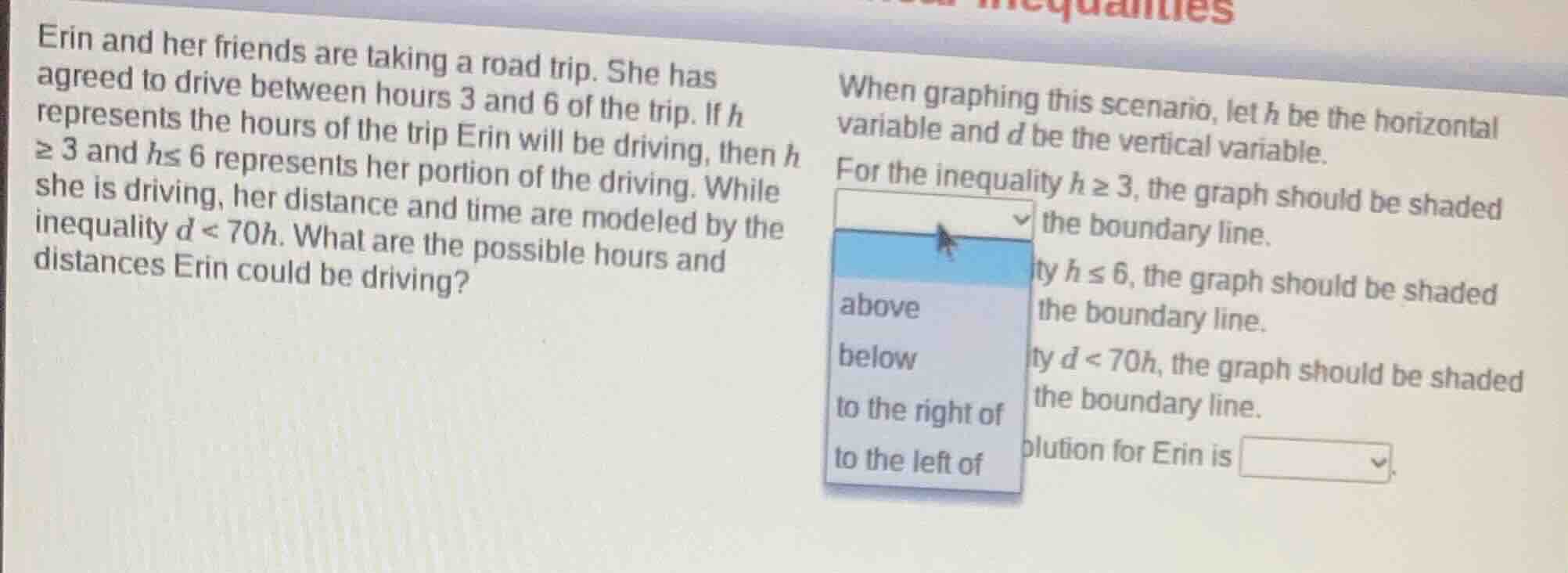
erin and her friends are taking a road trip. she has agreed to drive between hours 3 and 6 of the trip. if h represents the hours of the trip erin will be driving, then h ≥ 3 and h ≤ 6 represents her portion of the driving. while she is driving, her distance and time are modeled by the inequality d < 70h. what are the possible hours and distances erin could be driving? when graphing this scenario, let h be the horizontal variable and d be the vertical variable. for the inequality h ≥ 3, the graph should be shaded dropdown with options: above, below, to the right of, to the left of the boundary line. for inequality h ≤ 6, the graph should be shaded not fully visible the boundary line. for inequality d < 70h, the graph should be shaded not fully visible the boundary line. the solution for erin is dropdown.
Step1: Analyze $h\geq3$ (horizontal axis)
For a horizontal variable $h$, $h\geq3$ means values greater than 3 lie to the right of the vertical boundary line $h=3$. So we shade to the right of this line.
Step2: Analyze $h\leq6$ (horizontal axis)
For $h\leq6$, values less than 6 lie to the left of the vertical boundary line $h=6$. So we shade to the left of this line.
Step3: Analyze $d<70h$ (vertical axis)
For vertical variable $d$, $d<70h$ means values of $d$ that are smaller than the line $d=70h$. So we shade below this boundary line.
Step4: Combine the regions
The valid region is where all three inequalities overlap: $3\leq h\leq6$ and $0< d<70h$ (distance can't be negative).

Snap & solve any problem in the app
Get step-by-step solutions on Sovi AI
Photo-based solutions with guided steps
Explore more problems and detailed explanations
- For $h\geq3$: to the right of
- For $h\leq6$: to the left of
- For $d<70h$: below
- Solution for Erin: All pairs $(h,d)$ where $3\leq h\leq6$ and $0< d<70h$