QUESTION IMAGE
Question
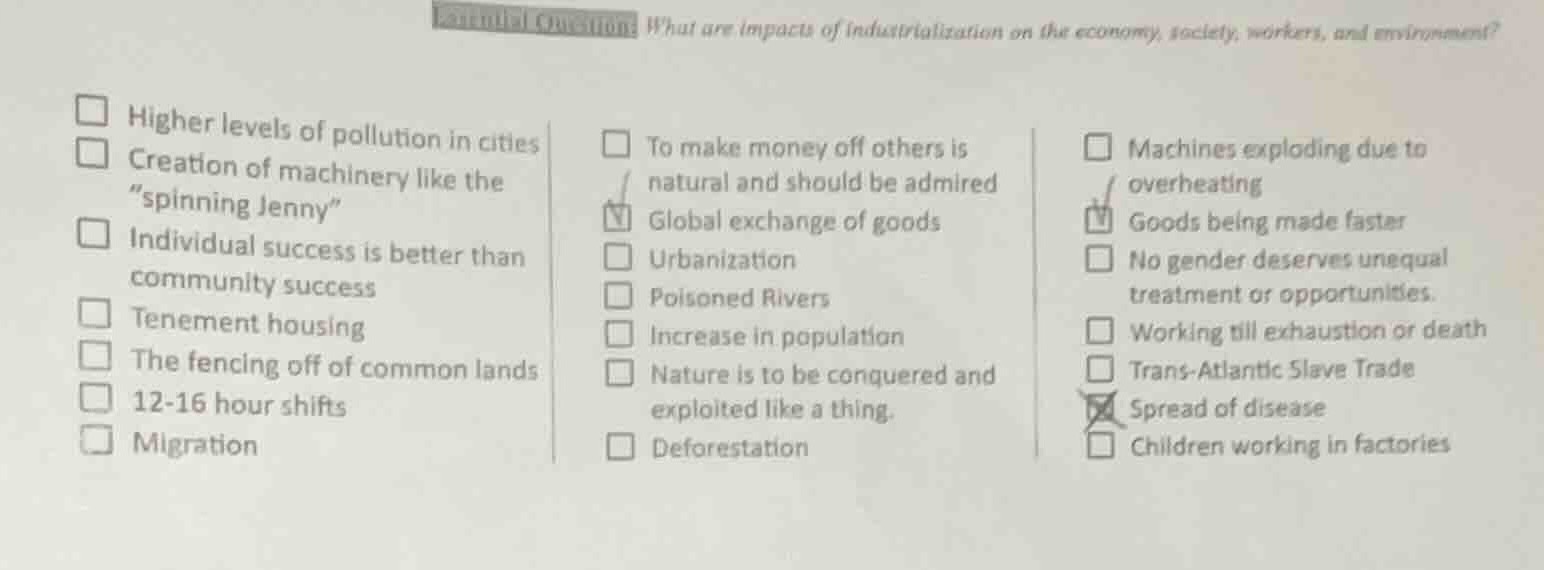
essential question: what are impacts of industrialization on the economy, society, workers, and environment? higher levels of pollution in cities creation of machinery like the \spinning jenny\ individual success is better than community success tenement housing the fencing off of common lands 12 - 16 hour shifts migration to make money off others is natural and should be admired global exchange of goods urbanization poisoned rivers increase in population nature is to be conquered and exploited like a thing. deforestation machines exploding due to overheating goods being made faster no gender deserves unequal treatment or opportunities. working till exhaustion or death trans - atlantic slave trade spread of disease children working in factories
To determine the impacts of industrialization on the economy, society, workers, and environment, we analyze each option:
Economic Impacts:
- Creation of machinery (e.g., Spinning Jenny): Introduced new production methods, boosting manufacturing.
- Global exchange of goods: Industrialization enabled mass production, fueling international trade.
- Goods being made faster: Mechanization increased production speed and efficiency.
Social Impacts:
- Urbanization: People moved to cities for factory jobs, transforming settlements.
- Migration: Workers migrated (domestically/internationally) for industrial opportunities.
- Tenement housing: Rapid urban growth led to overcrowded, unsanitary living conditions.
- Increase in population: Improved access to goods (e.g., food) and medical advancements (later) supported population growth.
- Spread of disease: Overcrowded cities and poor sanitation facilitated disease outbreaks.
- Children working in factories: Child labor was exploited to meet industrial labor demands.
- 12 - 16 hour shifts: Workers faced grueling hours due to industrial production pressures.
- Working till exhaustion or death: Harsh working conditions led to extreme worker exploitation.
Environmental Impacts:
- Higher levels of pollution in cities: Factories and coal - burning released pollutants.
- Poisoned Rivers: Industrial waste contaminated water sources.
- Deforestation: Resources (e.g., wood for fuel/construction) were overexploited.
- Machines exploding due to overheating: Industrial machinery risks (safety/environmental if toxic materials released).
Ideological/Cultural Impacts (Less Direct, but Related):
- Individual success > community success: Industrial capitalism emphasized individual achievement.
- Nature is to be conquered/exploited: Industrial mindset prioritized resource extraction over environmental stewardship.
- The fencing off of common lands (Enclosure Movement): Pre - industrial communal lands were privatized for industrial development (e.g., sheep farming for textiles).
Options like “To make money off others…admired” reflect capitalist ideology (not a direct impact), and “Trans - Atlantic Slave Trade” predated industrialization (or was less directly tied to industrialization’s core impacts). “No gender deserves unequal treatment” relates to social reform (a response to industrialization’s gender inequities, not a direct impact).
Final Answer (Selecting Correct Impacts):
- Economic: Creation of machinery like the “spinning Jenny”, Global exchange of goods, Goods being made faster
- Social: Urbanization, Migration, Tenement housing, Increase in population, Spread of disease, Children working in factories, 12 - 16 hour shifts, Working till exhaustion or death
- Environmental: Higher levels of pollution in cities, Poisoned Rivers, Deforestation, Machines exploding due to overheating
- Ideological/Societal Values: Individual success is better than community success, Nature is to be conquered and exploited like a thing, The fencing off of common lands
(Note: The checkmarks in the original image likely indicate pre - selected options, but the above analysis identifies all valid impacts of industrialization across the four domains.)

Snap & solve any problem in the app
Get step-by-step solutions on Sovi AI
Photo-based solutions with guided steps
Explore more problems and detailed explanations
To determine the impacts of industrialization on the economy, society, workers, and environment, we analyze each option:
Economic Impacts:
- Creation of machinery (e.g., Spinning Jenny): Introduced new production methods, boosting manufacturing.
- Global exchange of goods: Industrialization enabled mass production, fueling international trade.
- Goods being made faster: Mechanization increased production speed and efficiency.
Social Impacts:
- Urbanization: People moved to cities for factory jobs, transforming settlements.
- Migration: Workers migrated (domestically/internationally) for industrial opportunities.
- Tenement housing: Rapid urban growth led to overcrowded, unsanitary living conditions.
- Increase in population: Improved access to goods (e.g., food) and medical advancements (later) supported population growth.
- Spread of disease: Overcrowded cities and poor sanitation facilitated disease outbreaks.
- Children working in factories: Child labor was exploited to meet industrial labor demands.
- 12 - 16 hour shifts: Workers faced grueling hours due to industrial production pressures.
- Working till exhaustion or death: Harsh working conditions led to extreme worker exploitation.
Environmental Impacts:
- Higher levels of pollution in cities: Factories and coal - burning released pollutants.
- Poisoned Rivers: Industrial waste contaminated water sources.
- Deforestation: Resources (e.g., wood for fuel/construction) were overexploited.
- Machines exploding due to overheating: Industrial machinery risks (safety/environmental if toxic materials released).
Ideological/Cultural Impacts (Less Direct, but Related):
- Individual success > community success: Industrial capitalism emphasized individual achievement.
- Nature is to be conquered/exploited: Industrial mindset prioritized resource extraction over environmental stewardship.
- The fencing off of common lands (Enclosure Movement): Pre - industrial communal lands were privatized for industrial development (e.g., sheep farming for textiles).
Options like “To make money off others…admired” reflect capitalist ideology (not a direct impact), and “Trans - Atlantic Slave Trade” predated industrialization (or was less directly tied to industrialization’s core impacts). “No gender deserves unequal treatment” relates to social reform (a response to industrialization’s gender inequities, not a direct impact).
Final Answer (Selecting Correct Impacts):
- Economic: Creation of machinery like the “spinning Jenny”, Global exchange of goods, Goods being made faster
- Social: Urbanization, Migration, Tenement housing, Increase in population, Spread of disease, Children working in factories, 12 - 16 hour shifts, Working till exhaustion or death
- Environmental: Higher levels of pollution in cities, Poisoned Rivers, Deforestation, Machines exploding due to overheating
- Ideological/Societal Values: Individual success is better than community success, Nature is to be conquered and exploited like a thing, The fencing off of common lands
(Note: The checkmarks in the original image likely indicate pre - selected options, but the above analysis identifies all valid impacts of industrialization across the four domains.)