QUESTION IMAGE
Question
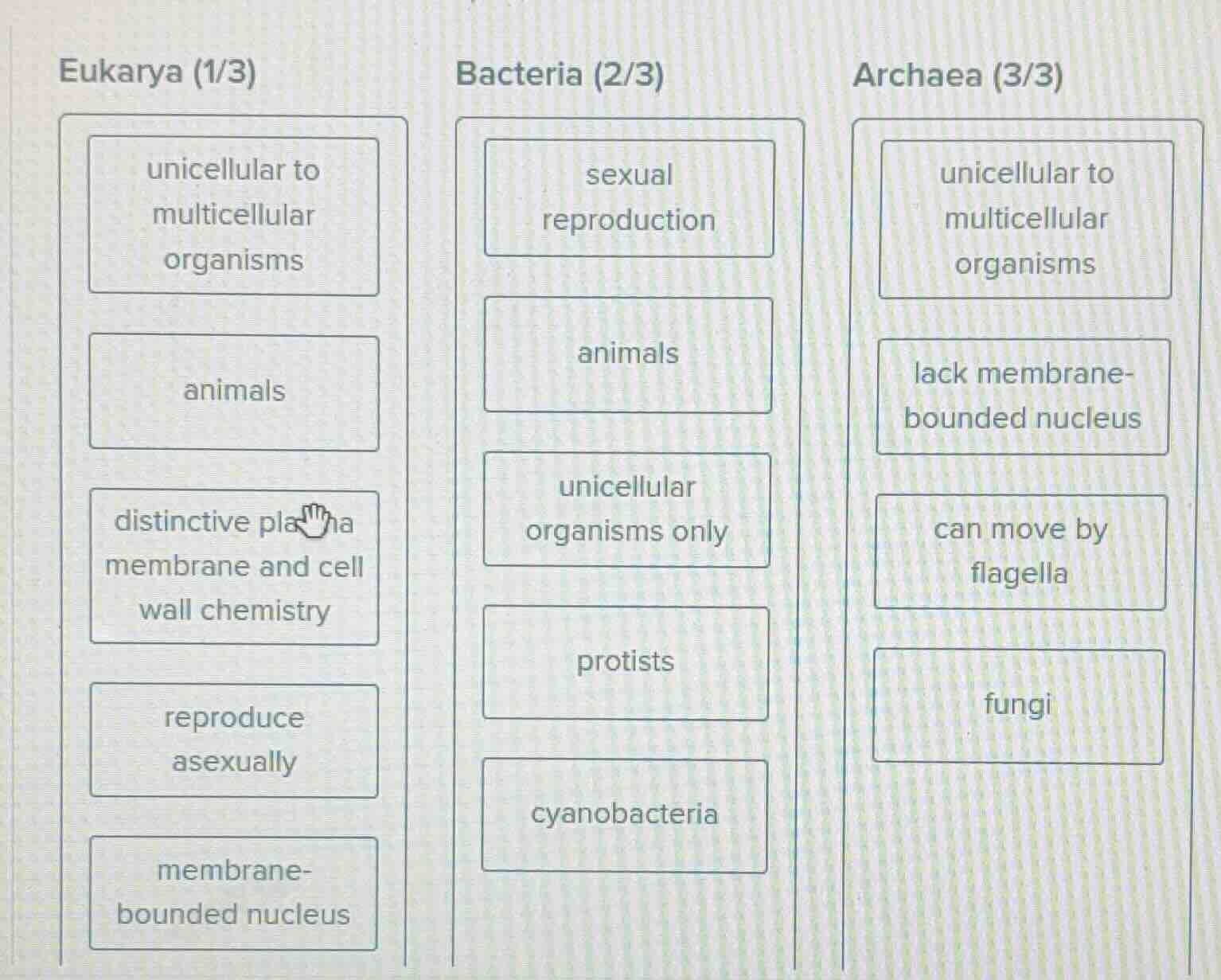
eukarya (1/3)
unicellular to multicellular organisms
animals
distinctive plasma membrane and cell wall chemistry
reproduce asexually
membrane-bounded nucleus
bacteria (2/3)
sexual reproduction
animals
unicellular organisms only
protists
cyanobacteria
archaea (3/3)
unicellular to multicellular organisms
lack membrane-bounded nucleus
can move by flagella
fungi
Brief Explanations
This task involves sorting the given traits to their correct domains (Eukarya, Bacteria, Archaea) based on biological characteristics:
- Eukarya: Defined by having a membrane-bounded nucleus, includes unicellular (protists) to multicellular (animals, fungi) organisms, can reproduce sexually or asexually.
- Bacteria: Are exclusively unicellular prokaryotes (no membrane-bounded nucleus), include groups like cyanobacteria, reproduce asexually (sexual reproduction does not occur here), have unique plasma membrane/cell wall chemistry.
- Archaea: Are unicellular prokaryotes (no membrane-bounded nucleus), have distinctive plasma membrane/cell wall chemistry, some use flagella for movement, are not animals/fungi/protists.

Snap & solve any problem in the app
Get step-by-step solutions on Sovi AI
Photo-based solutions with guided steps
Explore more problems and detailed explanations
Correctly Sorted Traits:
Eukarya (1/3)
- unicellular to multicellular organisms
- animals
- reproduce asexually
- membrane-bounded nucleus
- protists
- fungi
Bacteria (2/3)
- unicellular organisms only
- cyanobacteria
- distinctive plasma membrane and cell wall chemistry
Archaea (3/3)
- lack membrane-bounded nucleus
- can move by flagella
- distinctive plasma membrane and cell wall chemistry