QUESTION IMAGE
Question
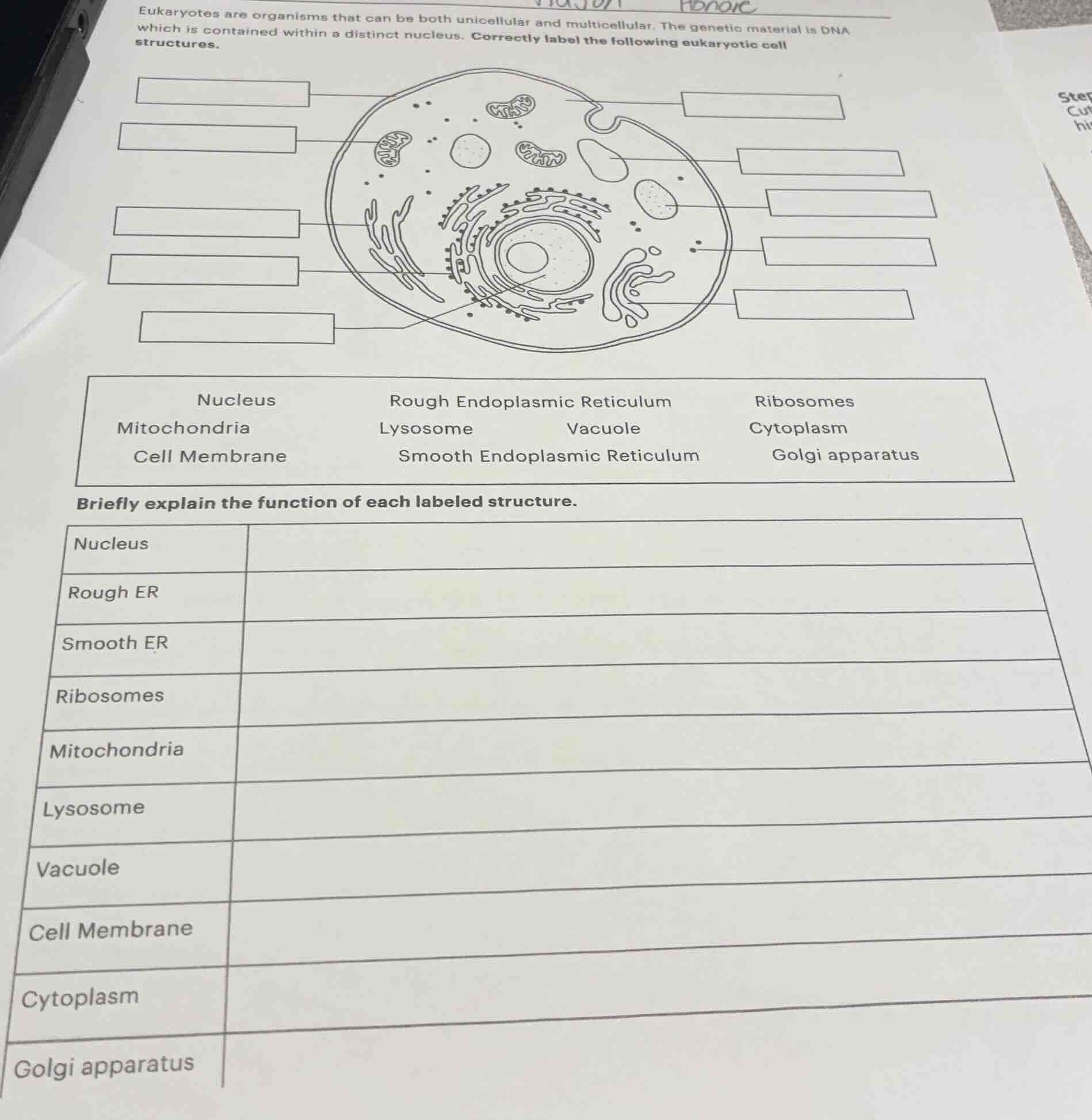
eukaryotes are organisms that can be both unicellular and multicellular. the genetic material is dna which is contained within a distinct nucleus. correctly label the following eukaryotic cell structures.
briefly explain the function of each labeled structure.
nucleus
rough er
smooth er
ribosomes
mitochondria
lysosome
vacuole
cell membrane
cytoplasm
golgi apparatus
Brief Explanations
First, the cell diagram is labeled by matching each structure to its identifier, then each structure's core function is summarized concisely.
- Top-left box (outer curved structure): Matches the cell's outer boundary, the Cell Membrane.
- Second left box (oval, folded structures): Matches the energy-producing Mitochondria.
- Third left box (folded membrane with dots): Matches the protein-making Rough Endoplasmic Reticulum.
- Fourth left box (folded membrane without dots): Matches the lipid-making Smooth Endoplasmic Reticulum.
- Bottom-left box (central, large structure): Matches the genetic control center, the Nucleus.
- Top-right box (outer indent): Matches the flexible outer Cell Membrane (same structure, different marker).
- Second right box (small, round, dark structure): Matches the digestive Lysosome.
- Third right box (large, round, light structure): Matches the storage Vacuole.
- Fourth right box (tiny dots): Matches the protein-building Ribosomes.
- Bottom-right box (stacked, curved membranes): Matches the packaging Golgi apparatus.
Then, each structure's function is defined by its core cellular role:
- Nucleus: Stores and regulates genetic material, controls cell activities.
- Rough ER: Has ribosomes attached; synthesizes and modifies proteins.
- Smooth ER: Synthesizes lipids, detoxifies substances, stores calcium.
- Ribosomes: Links amino acids to build proteins (protein synthesis).
- Mitochondria: Breaks down nutrients to produce ATP (cell energy).
- Lysosome: Contains digestive enzymes to break down waste and invaders.
- Vacuole: Stores water, nutrients, and waste products; maintains cell turgor.
- Cell Membrane: Controls movement of substances in and out of the cell.
- Cytoplasm: Gel-like fluid that fills the cell, suspends organelles, and supports cell functions.
- Golgi apparatus: Modifies, sorts, and packages proteins/lipids for transport.

Snap & solve any problem in the app
Get step-by-step solutions on Sovi AI
Photo-based solutions with guided steps
Explore more problems and detailed explanations
Labeled Cell Diagram (from top-left to bottom-left, then top-right to bottom-right):
- Cell Membrane
- Mitochondria
- Rough Endoplasmic Reticulum
- Smooth Endoplasmic Reticulum
- Nucleus
- Cell Membrane
- Lysosome
- Vacuole
- Ribosomes
- Golgi apparatus
Structure Functions:
| Structure | Function |
|---|---|
| Rough ER | Makes/modifies proteins (has ribosomes) |
| Smooth ER | Makes lipids, detoxifies, stores calcium |
| Ribosomes | Synthesizes proteins from amino acids |
| Mitochondria | Produces ATP (cellular energy) via respiration |
| Lysosome | Breaks down waste, old organelles, and foreign invaders |
| Vacuole | Stores water, nutrients, and cellular waste; maintains cell structure |
| Cell Membrane | Regulates movement of materials in/out of cell |
| Cytoplasm | Suspends organelles, facilitates cellular chemical reactions |
| Golgi apparatus | Modifies, sorts, and packages molecules for transport out of the cell |