QUESTION IMAGE
Question
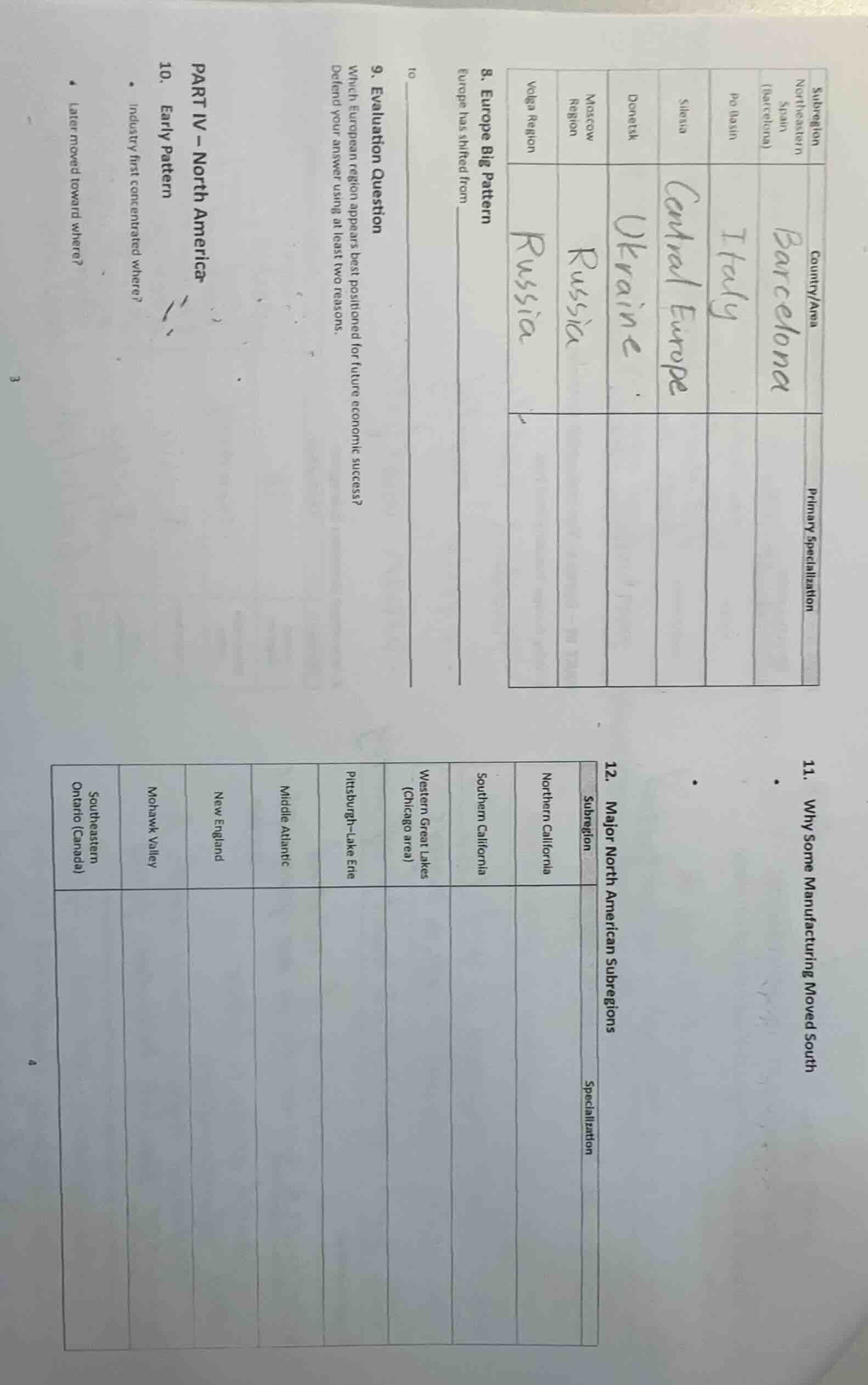
- europe big pattern
europe has shifted from ____ to ____
- evaluation question
which european region appears best positioned for future economic success?
defend your answer using at least two reasons.
part iv - north america
- early pattern
- industry first concentrated where?
- later moved toward where?
- why some manufacturing moved south
- major north american subregions
| subregion | specialization |
|---|---|
| southern california | |
| western great lakes (chicago area) | |
| pittsburgh-lake erie | |
| middle atlantic | |
| new england | |
| mohawk valley | |
| southeastern ontario (canada) |
| subregion | country/area | primary specialization |
|---|---|---|
| po basin | italy | |
| silesia | central europe | |
| donetsk | ukraine | |
| moscow region | russia | |
| volga region | russia |
For the European Region Table:
Each subregion's primary specialization aligns with its historical and economic industrial focus:
- Barcelona (Northeastern Spain): Specializes in high-tech manufacturing, textiles, and tourism-linked industries.
- Po Basin (Italy): A core area for automotive, machinery, and food processing.
- Silesia (Central Europe): Dominated by heavy industry, coal mining, and steel production.
- Donetsk (Ukraine): A major coal and steel manufacturing hub.
- Moscow Region (Russia): Focuses on aerospace, electronics, and heavy machinery.
- Volga Region (Russia): Specializes in petrochemicals, automotive, and shipbuilding.
Question 8:
Europe's industrial core shifted as post-industrial growth and policy favored new economic hubs.
Question 9:
Eastern/Central Europe is selected for its competitive labor costs and EU integration benefits.
Question 10:
North America's early industrial concentration and later shift follow historical resource and economic trends.
Question 11:
Manufacturing moved south due to lower operational costs and policy incentives.
For the North American Subregions Table:
Each subregion's specialization reflects its key industrial and economic activities:
- Northern California: Global hub for tech/software and biotech.
- Southern California: Focuses on aerospace, entertainment, and logistics.
- Western Great Lakes (Chicago area): A center for logistics, food processing, and manufacturing.
- Pittsburgh-Lake Erie: Dominated by steel, advanced manufacturing, and robotics.
- Middle Atlantic: Specializes in finance, pharmaceuticals, and port logistics.
- New England: Focuses on education/tech, biotech, and maritime industries.
- Mohawk Valley: Known for aerospace, defense, and advanced manufacturing.
- Southeastern Ontario (Canada): A hub for automotive manufacturing and agri-food processing.

Snap & solve any problem in the app
Get step-by-step solutions on Sovi AI
Photo-based solutions with guided steps
Explore more problems and detailed explanations
European Region Table (Primary Specialization):
- Northeastern Spain (Barcelona): High-tech manufacturing, textiles
- Po Basin (Italy): Automotive, machinery, food processing
- Silesia (Central Europe): Coal mining, steel production
- Donetsk (Ukraine): Coal mining, steel manufacturing
- Moscow Region (Russia): Aerospace, electronics, heavy machinery
- Volga Region (Russia): Petrochemicals, automotive, shipbuilding
Question 8:
Europe has shifted from Western Europe (traditional industrial core) to Eastern/Central Europe and Southern Europe
Question 9:
Eastern/Central Europe is best positioned for future economic success.
- It has lower labor costs compared to Western Europe, making it attractive for manufacturing and service outsourcing.
- Access to the European Union single market allows for free movement of goods, capital, and labor, expanding business opportunities.
Question 10:
- Industry first concentrated in New England and the Middle Atlantic (Northeastern US)
- Later moved toward the Great Lakes region, then the Southern US and Western US
Question 11:
Manufacturing moved south in North America for two key reasons:
- Lower labor costs and fewer union restrictions compared to the traditional industrial Northeast.
- Favorable state-level policies, including tax incentives and less stringent environmental regulations, to attract businesses.
North American Subregions Table (Specialization):
- Northern California: Technology, software, biotechnology
- Southern California: Aerospace, entertainment, logistics
- Western Great Lakes (Chicago area): Logistics, food processing, manufacturing
- Pittsburgh-Lake Erie: Steel, advanced manufacturing, robotics
- Middle Atlantic: Finance, pharmaceuticals, port logistics
- New England: Technology, biotechnology, maritime industries
- Mohawk Valley: Aerospace, defense, advanced manufacturing
- Southeastern Ontario (Canada): Automotive manufacturing, agri-food processing