QUESTION IMAGE
Question
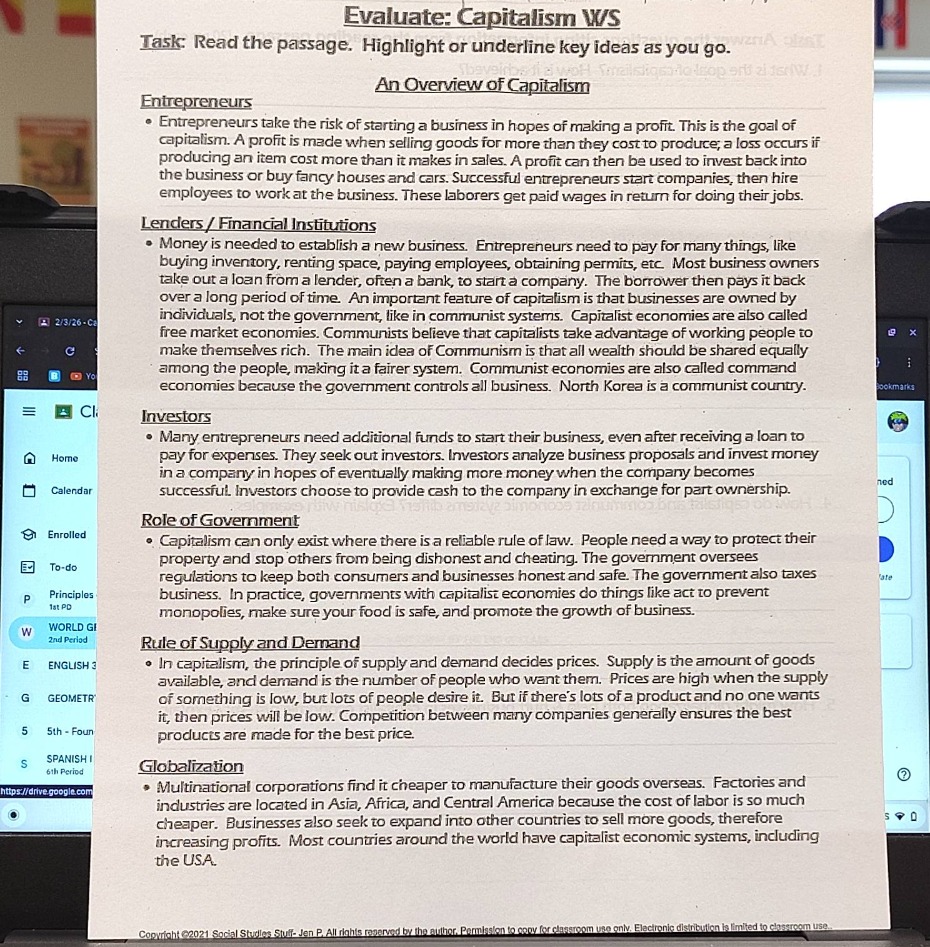
evaluate: capitalism ws
task: read the passage. highlight or underline key ideas as you go.
an overview of capitalism
entrepreneurs
- entrepreneurs take the risk of starting a business in hopes of making a profit. this is the goal of capitalism: a profit is made when selling goods for more than they cost to produce; a loss occurs if producing an item cost more than it makes in sales. a profit can then be used to invest back into the business or buy fancy houses and cars. successful entrepreneurs start companies, then hire employees to work at the business. these laborers get paid wages in return for doing their jobs.
lenders / financial institutions
- money is needed to establish a new business. entrepreneurs need to pay for many things, like buying inventory, renting space, paying employees, obtaining permits, etc. most business owners take out a loan from a lender, often a bank, to start a company. the borrower then pays it back over a long period of time. an important feature of capitalism is that businesses are owned by individuals, not the government, like in communist systems. capitalist economies are also called free market economies. communists believe that capitalists take advantage of working people to make themselves rich. the main idea of communism is that all wealth should be shared equally among the people, making it a fairer system. communist economies are also called command economies because the government controls all business. north korea is a communist country.
investors
- many entrepreneurs need additional funds to start their business, even after receiving a loan to pay for expenses. they seek out investors. investors analyze business proposals and invest money in a company in hopes of eventually making more money when the company becomes successful. investors choose to provide cash to the company in exchange for part ownership.
role of government
- capitalism can only exist where there is a reliable rule of law. people need a way to protect their property and stop others from being dishonest and cheating. the government oversees regulations to keep both consumers and businesses honest and safe. the government also taxes business. in practice, governments with capitalist economies do things like act to prevent monopolies, make sure your food is safe, and promote the growth of business.
rule of supply and demand
- in capitalism, the principle of supply and demand decides prices. supply is the amount of goods available, and demand is the number of people who want them. prices are high when the supply of something is low, but lots of people desire it. but if there’s lots of a product and no one wants it, then prices will be low. competition between many companies generally ensures the best products are made for the best price.
globalization
- multinational corporations find it cheaper to manufacture their goods overseas. factories and industries are located in asia, africa, and central america because the cost of labor is so much cheaper. businesses also seek to expand into other countries to sell more goods, therefore increasing profits. most countries around the world have capitalist economic systems, including the usa.
copyright ©2021 social studies stuff- jen p. all rights reserved by the author. permission to copy for classroom use only. electronic distribution is limited to classroom use.
Since the problem is to evaluate the passage on capitalism and the task involves reading and highlighting key ideas, and the content is related to economic systems (capitalism vs communism, role of government, supply and demand in capitalism), the relevant subfield under Business is Economics (as it deals with economic systems, entrepreneurship, supply - demand, etc.). But since the task is more of a reading comprehension - style evaluation related to economic concepts, and if we consider the solution format, as there are no calculations, we use the Answer - Explanation Format.
The passage provides an overview of capitalism, covering aspects like entrepreneurs (risk - taking for profit, hiring labor), lenders/financial institutions (providing loans for business start - up, difference from communist systems), investors (providing additional funds for equity), role of government (rule of law, regulations, taxation, anti - monopoly, safety, business growth), supply and demand (price determination, competition), and globalization (offshore manufacturing for cost - cutting, international expansion for profit). Key ideas to highlight would include the profit motive of entrepreneurs, the role of lenders/investors in funding, the contrast with communism (private vs government ownership, free market vs command economy), the government's role in capitalism (rule of law, regulation, taxation, etc.), the supply - demand principle, and globalization's impact on capitalist businesses.

Snap & solve any problem in the app
Get step-by-step solutions on Sovi AI
Photo-based solutions with guided steps
Explore more problems and detailed explanations
To evaluate the passage, key ideas to highlight are:
- Entrepreneurs: Take business risks for profit, hire workers.
- Lenders/Financial Institutions: Provide loans for business start - up; capitalism has private ownership (vs communist government ownership), free market (vs command economy).
- Investors: Provide additional funds for equity in successful businesses.
- Role of Government: Ensure rule of law, regulate (consumer/business safety), tax, prevent monopolies, promote business growth.
- Rule of Supply and Demand: Determines prices; competition ensures good prices.
- Globalization: Multinationals manufacture offshore (cheaper labor) and expand internationally for profit.