QUESTION IMAGE
Question
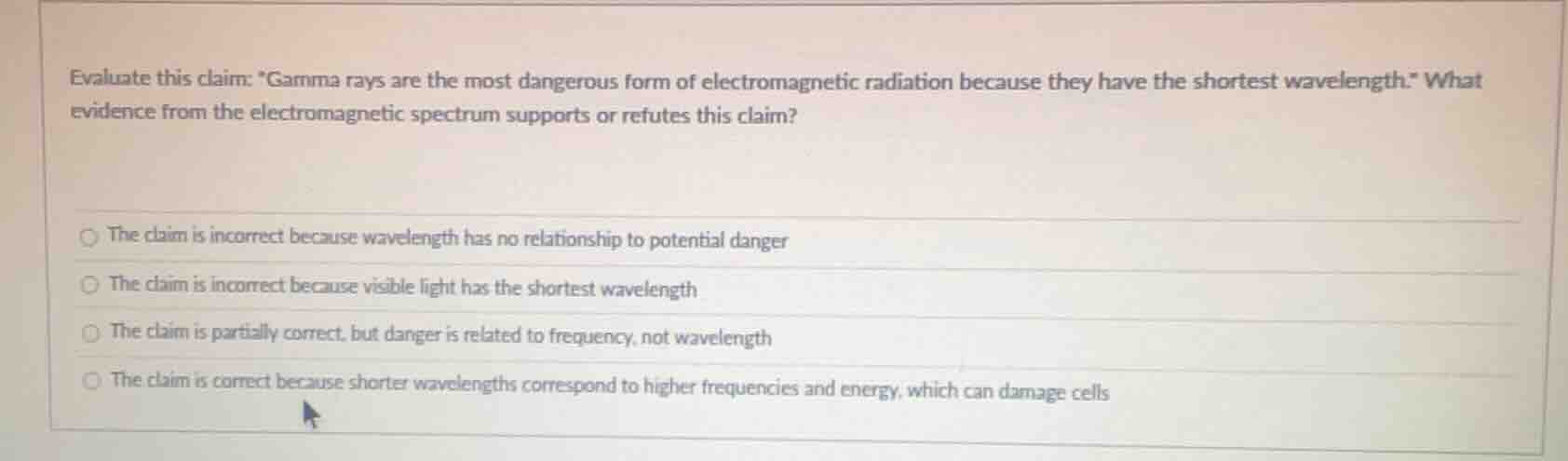
evaluate this claim: “gamma rays are the most dangerous form of electromagnetic radiation because they have the shortest wavelength.” what evidence from the electromagnetic spectrum supports or refutes this claim?
the claim is incorrect because wavelength has no relationship to potential danger
the claim is incorrect because visible light has the shortest wavelength
the claim is partially correct, but danger is related to frequency, not wavelength
the claim is correct because shorter wavelengths correspond to higher frequencies and energy, which can damage cells
- Analyze the relationship between electromagnetic radiation properties: The energy of electromagnetic radiation is related to wavelength ($\lambda$) and frequency ($f$) by $E = hf=\frac{hc}{\lambda}$ (where $h$ is Planck's constant, $c$ is the speed of light). Shorter wavelengths mean higher frequency and higher energy. Gamma rays have very short wavelengths, so high energy, which can damage cells (e.g., ionizing radiation effects).
- Evaluate each option:
- First option: Wavelength is related to energy (and thus danger), so incorrect.
- Second option: Visible light does not have the shortest wavelength (gamma, X - rays have shorter), so incorrect.
- Third option: Frequency and wavelength are related ($c = f\lambda$), so danger is related to both (since they are inversely related for a given wave speed in a medium), so this is incorrect.
- Fourth option: Gamma rays have short wavelengths, so high frequency and energy, which can damage cells. So the claim is correct for this reason.

Snap & solve any problem in the app
Get step-by-step solutions on Sovi AI
Photo-based solutions with guided steps
Explore more problems and detailed explanations
The claim is correct because shorter wavelengths correspond to higher frequencies and energy, which can damage cells