QUESTION IMAGE
Question
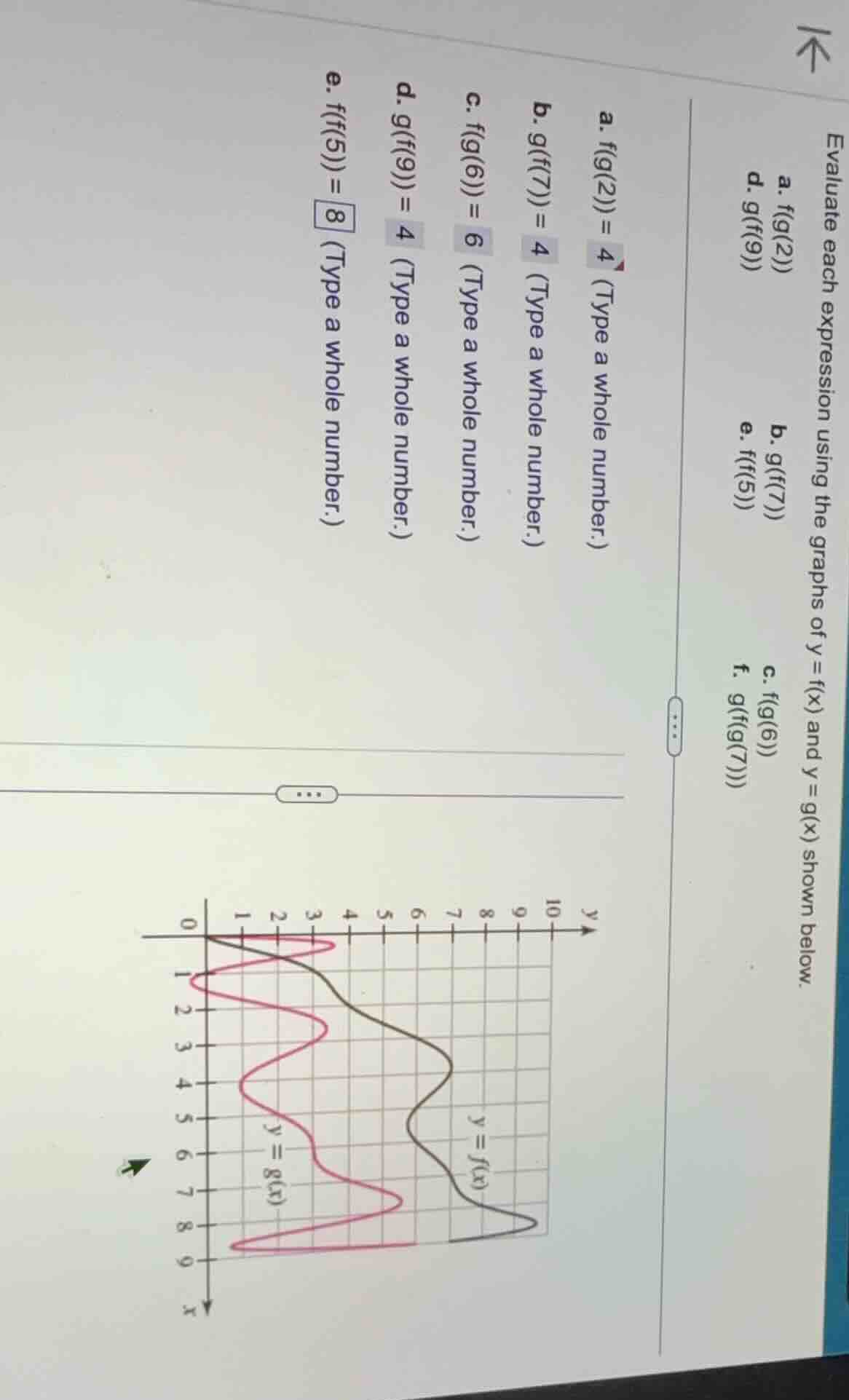
evaluate each expression using the graphs of ( y = f(x) ) and ( y = g(x) ) shown below.
a. ( f(g(2)) )
b. ( g(f(7)) )
c. ( f(g(6)) )
d. ( g(f(9)) )
e. ( f(f(5)) )
f. ( g(f(9(7))) ) note: likely a typo, maybe ( g(f(7)) ) or similar
for each part, type a whole number.
a. ( f(g(2)) = 4 )
b. ( g(f(7)) = 4 )
c. ( f(g(6)) = 6 )
d. ( g(f(9)) = 4 )
e. ( f(f(5)) = 8 )
To solve these composite function problems, we analyze each part by first evaluating the inner function using the given graphs of \( y = f(x) \) and \( y = g(x) \), then using that result as the input for the outer function.
Part a: \( f(g(2)) \)
Step 1: Find \( g(2) \)
From the graph of \( y = g(x) \) (red curve), when \( x = 2 \), \( g(2) = 2 \) (since the red curve passes through \( (2, 2) \)).
Step 2: Find \( f(g(2)) = f(2) \)
From the graph of \( y = f(x) \) (black curve), when \( x = 2 \), \( f(2) = 4 \) (since the black curve passes through \( (2, 4) \)).

Snap & solve any problem in the app
Get step-by-step solutions on Sovi AI
Photo-based solutions with guided steps
Explore more problems and detailed explanations
\( 4 \)
Part b: \( g(f(7)) \)
Step 1: Find \( f(7) \)
From the graph of \( y = f(x) \) (black curve), when \( x = 7 \), \( f(7) = 4 \) (since the black curve passes through \( (7, 4) \)).
Step 2: Find \( g(f(7)) = g(4) \)
From the graph of \( y = g(x) \) (red curve), when \( x = 4 \), \( g(4) = 4 \) (since the red curve passes through \( (4, 4) \)).