QUESTION IMAGE
Question
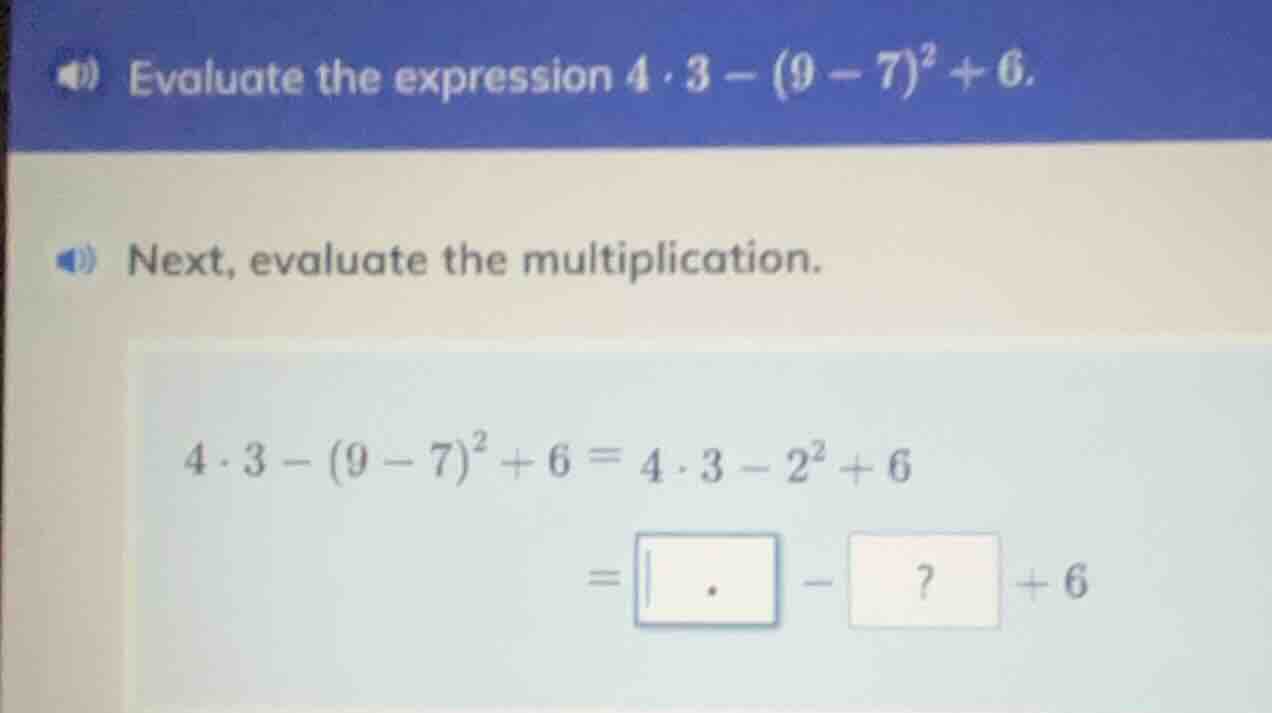
evaluate the expression $4 \cdot 3 - (9 - 7)^2 + 6$. next, evaluate the multiplication. $4 \cdot 3 - (9 - 7)^2 + 6 = 4 \cdot 3 - 2^2 + 6 = \square \cdot \square - \square + 6$
Step1: Evaluate multiplication (4·3)
First, calculate the multiplication \(4 \cdot 3\). By the basic multiplication operation, \(4 \times 3 = 12\). Then, evaluate the exponent \(2^2\). By the definition of exponentiation, \(2^2 = 4\). So the expression becomes \(12 - 4 + 6\) at this step (but for the blanks, we just need the result of multiplication and the exponent result). Wait, the problem is about filling the blanks: the first blank is the multiplication \(4 \cdot 3\) result, and the second blank is \(2^2\) result. Wait, no, the current step is "evaluate the multiplication" and then the exponent? Wait, the expression after simplifying the parentheses is \(4 \cdot 3 - 2^2 + 6\). Now, evaluating the multiplication: \(4 \cdot 3 = 12\), and evaluating the exponent \(2^2 = 4\). So the blanks should be 12 (for the multiplication part) and 4 (for the exponent part). Wait, the first blank is \(4 \cdot 3\) which is 12, and the second blank is \(2^2\) which is 4. Let's check:
Original step: \(4 \cdot 3 - (9 - 7)^2 + 6 = 4 \cdot 3 - 2^2 + 6\)
Then, "evaluate the multiplication" (4·3) gives 12, and evaluate the exponent (2²) gives 4. So the next line is \(12 - 4 + 6\). So the first blank (the multiplication result) is 12, and the second blank (the exponent result) is 4. Wait, the first box is "□ · □" but no, wait the first box is "□ · □" but actually, the first box is the result of \(4 \cdot 3\), which is 12? Wait, no, the first box is written as "□ · □" but that's a typo? Wait, no, looking at the image: the first box is "□ · □" but actually, after evaluating the multiplication, \(4 \cdot 3 = 12\), so the first box is 12 (but the format is "□ · □" which is confusing). Wait, no, maybe the first box is the multiplication part, so \(4 \cdot 3 = 12\), so the first box is 12 (but the dot is there, maybe it's a mistake, and the first box is 12, and the second box is \(2^2 = 4\). Let's confirm:
The expression after parentheses: \(4 \cdot 3 - 2^2 + 6\)
Now, evaluate the multiplication: \(4 \cdot 3 = 12\), so replace \(4 \cdot 3\) with 12. Then evaluate the exponent: \(2^2 = 4\), so replace \(2^2\) with 4. So the next line is \(12 - 4 + 6\). Therefore, the first blank (the multiplication result) is 12 (so the first box is 12, with the dot, maybe it's a formatting error, and the first box is 12, and the second box is 4.
Step1: Evaluate \(4 \cdot 3\)
\(4 \cdot 3 = 12\)
Step2: Evaluate \(2^2\)
\(2^2 = 4\)
So the first blank (multiplication) is 12, the second blank (exponent) is 4.

Snap & solve any problem in the app
Get step-by-step solutions on Sovi AI
Photo-based solutions with guided steps
Explore more problems and detailed explanations
The first blank (multiplication result) is 12, the second blank (exponent result) is 4. So the filled line is \(12 - 4 + 6\). So the first box is 12 (for \(4 \cdot 3\)) and the second box is 4 (for \(2^2\)).