QUESTION IMAGE
Question
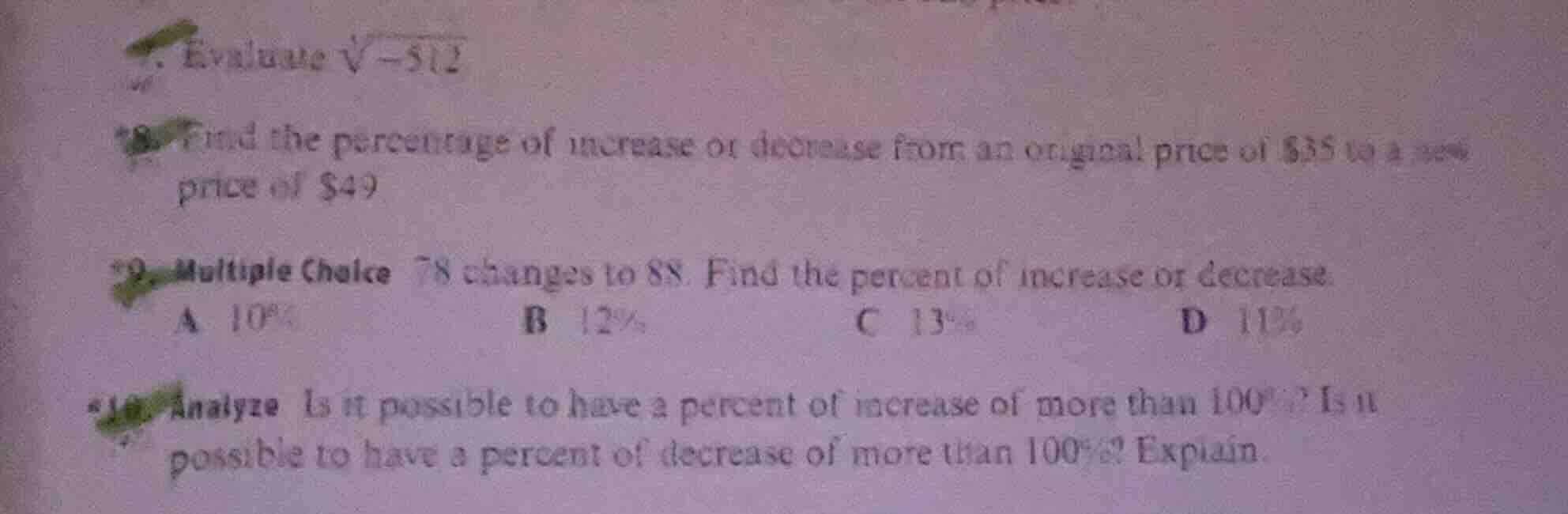
- evaluate \\(sqrt3{-512}\\)
*8. find the percentage of increase or decrease from an original price of $35 to a new price of $49
*9. multiple choice 78 changes to 88. find the percent of increase or decrease.
a 10% b 12% c 13% d 11%
*10. analyze is it possible to have a percent of increase of more than 100%? is it possible to have a percent of decrease of more than 100%? explain.
Question 7: Evaluate $\sqrt[3]{-512}$
Step 1: Recall the cube root property
We know that for any real number \( a \), \(\sqrt[3]{-a}=-\sqrt[3]{a}\). So we can rewrite \(\sqrt[3]{-512}\) as \(-\sqrt[3]{512}\).
Step 2: Find the cube root of 512
We need to find a number \( x \) such that \( x^3 = 512 \). We know that \( 8\times8\times8 = 8^3=512 \). So \(\sqrt[3]{512} = 8\).
Step 3: Combine the results
Since \(\sqrt[3]{-512}=-\sqrt[3]{512}\) and \(\sqrt[3]{512} = 8\), then \(\sqrt[3]{-512}=-8\).
Step 1: Determine if it's an increase or decrease
Since the new price (\$49) is greater than the original price (\$35), it's a percentage increase.
Step 2: Calculate the amount of increase
The amount of increase is \( \text{New Price}-\text{Original Price} = 49 - 35=\$14 \).
Step 3: Use the percentage increase formula
The formula for percentage increase is \( \text{Percentage Increase}=\frac{\text{Amount of Increase}}{\text{Original Price}}\times100\% \). Substituting the values, we get \( \frac{14}{35}\times100\% \).
Step 4: Simplify the fraction
\( \frac{14}{35}=\frac{2}{5} \) (dividing numerator and denominator by 7). Then \( \frac{2}{5}\times100\% = 40\% \).
Step 1: Determine if it's an increase or decrease
Since 88 > 78, it's a percentage increase.
Step 2: Calculate the amount of increase
The amount of increase is \( 88 - 78 = 10 \).
Step 3: Use the percentage increase formula
The formula for percentage increase is \( \text{Percentage Increase}=\frac{\text{Amount of Increase}}{\text{Original Amount}}\times100\% \). Here, the original amount is 78, so we have \( \frac{10}{78}\times100\% \approx 12.82\% \approx 13\% \)? Wait, no, wait: Wait, 88 - 78 = 10? Wait, 88 - 78 = 10? Wait, 78 + 10 = 88? No, 78+10=88? 78+10=88? 78+10=88, yes. Wait, but \( \frac{10}{78}\times100\% \approx 12.82\% \), which is approximately 13%? Wait, no, the options are A.10%, B.12%, C.13%, D.11%. Wait, maybe I made a mistake. Wait, 78 to 88: 88 - 78 = 10. Then \( \frac{10}{78}\times100=\frac{1000}{78}\approx12.82\%\approx13\% \)? But let's check again. Wait, maybe the original number is 78, new is 88. So \( \frac{88 - 78}{78}\times100=\frac{10}{78}\times100\approx12.82\%\), which is closest to 13%? But wait, maybe I miscalculated. Wait, 78 1.12 = 78 + 780.12 = 78 + 9.36 = 87.36, 781.13=78+780.13=78+10.14=88.14, which is close to 88. So the closest is 13%? Wait, but the options have C as 13%. Wait, but let's do the calculation properly. \( \frac{10}{78}=\frac{5}{39}\approx0.1282 \), so 12.82% which is approximately 13% (option C) or 12%? Wait, 12% of 78 is 0.12*78=9.36, 78+9.36=87.36. 13% of 78 is 10.14, 78+10.14=88.14. The difference between 88 and 78 is 10, which is closer to 10.14 (13%) than 9.36 (12%). So the answer is C.

Snap & solve any problem in the app
Get step-by-step solutions on Sovi AI
Photo-based solutions with guided steps
Explore more problems and detailed explanations
\(-8\)