QUESTION IMAGE
Question
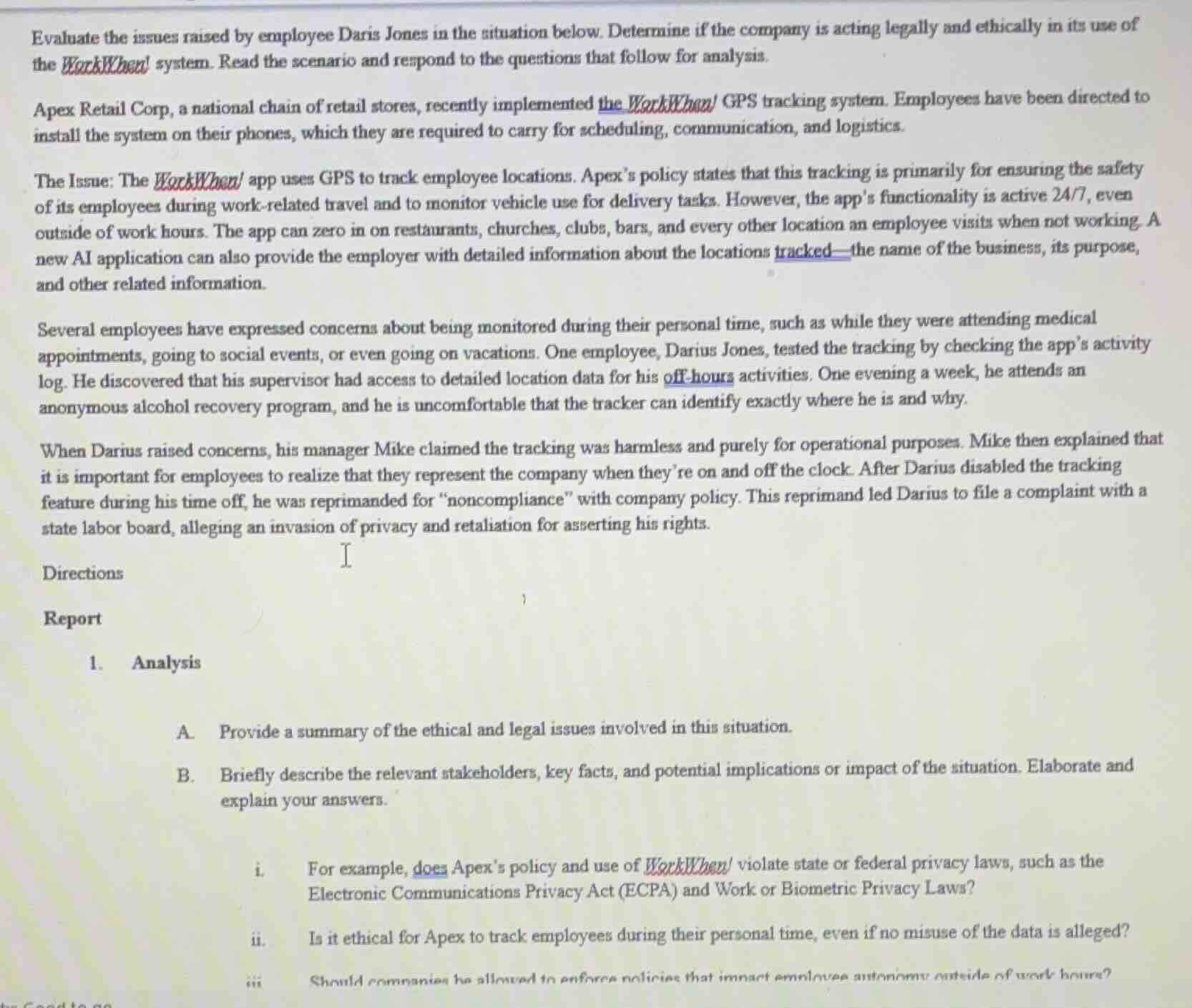
evaluate the issues raised by employee daris jones in the situation below. determine if the company is acting legally and ethically in its use of the workwhen! system. read the scenario and respond to the questions that follow for analysis.
apex retail corp, a national chain of retail stores, recently implemented the workwhen! gps tracking system. employees have been directed to install the system on their phones, which they are required to carry for scheduling, communication, and logistics.
the issue: the workwhen! app uses gps to track employee locations. apex’s policy states that this tracking is primarily for ensuring the safety of its employees during work - related travel and to monitor vehicle use for delivery tasks. however, the app’s functionality is active 24/7, even outside of work hours. the app can zero in on restaurants, churches, clubs, bars, and every other location an employee visits when not working. a new ai application can also provide the employer with detailed information about the locations tracked—the name of the business, its purpose, and other related information.
several employees have expressed concerns about being monitored during their personal time, such as while they were attending medical appointments, going to social events, or even going on vacations. one employee, darius jones, tested the tracking by checking the app’s activity log. he discovered that his supervisor had access to detailed location data for his off - hours activities. one evening a week, he attends an anonymous alcohol recovery program, and he is uncomfortable that the tracker can identify exactly where he is and why.
when darius raised concerns, his manager mike claimed the tracking was harmless and purely for operational purposes. mike then explained that it is important for employees to realize that they represent the company when they’re on and off the clock. after darius disabled the tracking feature during his time off, he was reprimanded for “noncompliance” with company policy. this reprimand led darius to file a complaint with a state labor board, alleging an invasion of privacy and retaliation for asserting his rights.
directions
report
- analysis
a. provide a summary of the ethical and legal issues involved in this situation.
b. briefly describe the relevant stakeholders, key facts, and potential implications or impact of the situation. elaborate and explain your answers.
i. for example, does apex’s policy and use of workwhen! violate state or federal privacy laws, such as the electronic communications privacy act (ecpa) and work or biometric privacy laws?
ii. is it ethical for apex to track employees during their personal time, even if no misuse of the data is alleged?
iii. should companies be allowed to enforce policies that impact employee autonomy outside of work hours?
1A. Summary of Ethical and Legal Issues
- Legal Issues: Apex’s 24/7 GPS tracking via WorkWhen may violate privacy laws (e.g., ECPA, state biometric/privacy laws) by monitoring employees’ off - duty locations without valid work - related justification. Reprimanding Darius for disabling off - hour tracking could be retaliation, which is illegal under labor laws.
- Ethical Issues: Tracking employees during personal time (e.g., medical appointments, recovery programs) invades privacy, undermines employee autonomy, and shows a lack of respect for employees’ personal lives. The company’s claim of “representing the company off - clock” is an unethical overreach.
- Relevant Laws: The Electronic Communications Privacy Act (ECPA) restricts unauthorized monitoring of electronic communications (including location data from work - required devices if used for personal purposes). State biometric/privacy laws may also apply. Apex tracks employees 24/7, including off - work hours, which is not related to work - safety or vehicle - use (their stated purposes) for off - duty time. So, it likely violates these laws as the tracking is not limited to work - related needs.
- Key Facts: Tracking is active 24/7, monitors off - duty locations (e.g., recovery programs, medical appointments), and the stated purpose (safety, vehicle use) does not justify off - duty tracking.
- Implications: Legal action (e.g., Darius’ labor board complaint, class - action suits), fines, and damage to the company’s reputation.
- Ethical Framework: Using deontological ethics (duty - based), the company has a duty to respect employee privacy. Consequentialist ethics (outcome - based) shows negative outcomes like employee distress, reduced trust, and turnover. Even without data misuse, the act of tracking personal time is unethical as it invades privacy, undermines autonomy, and creates a surveillance - based work environment.
- Key Facts: Employees are tracked during personal activities (e.g., recovery programs, social events), and the company claims off - clock representation as a justification (which is an overreach).
- Implications: Reduced employee morale, increased turnover, damaged employer - employee relationship, and negative public perception.

Snap & solve any problem in the app
Get step-by-step solutions on Sovi AI
Photo-based solutions with guided steps
Explore more problems and detailed explanations
- Legal: Potential violations of privacy laws (ECPA, state privacy/biometric laws) due to 24/7 tracking. Retaliation against Darius for asserting privacy rights may violate labor laws.
- Ethical: Unethical invasion of privacy during personal time, undermining employee autonomy, and overreaching by claiming off - clock representation.