QUESTION IMAGE
Question
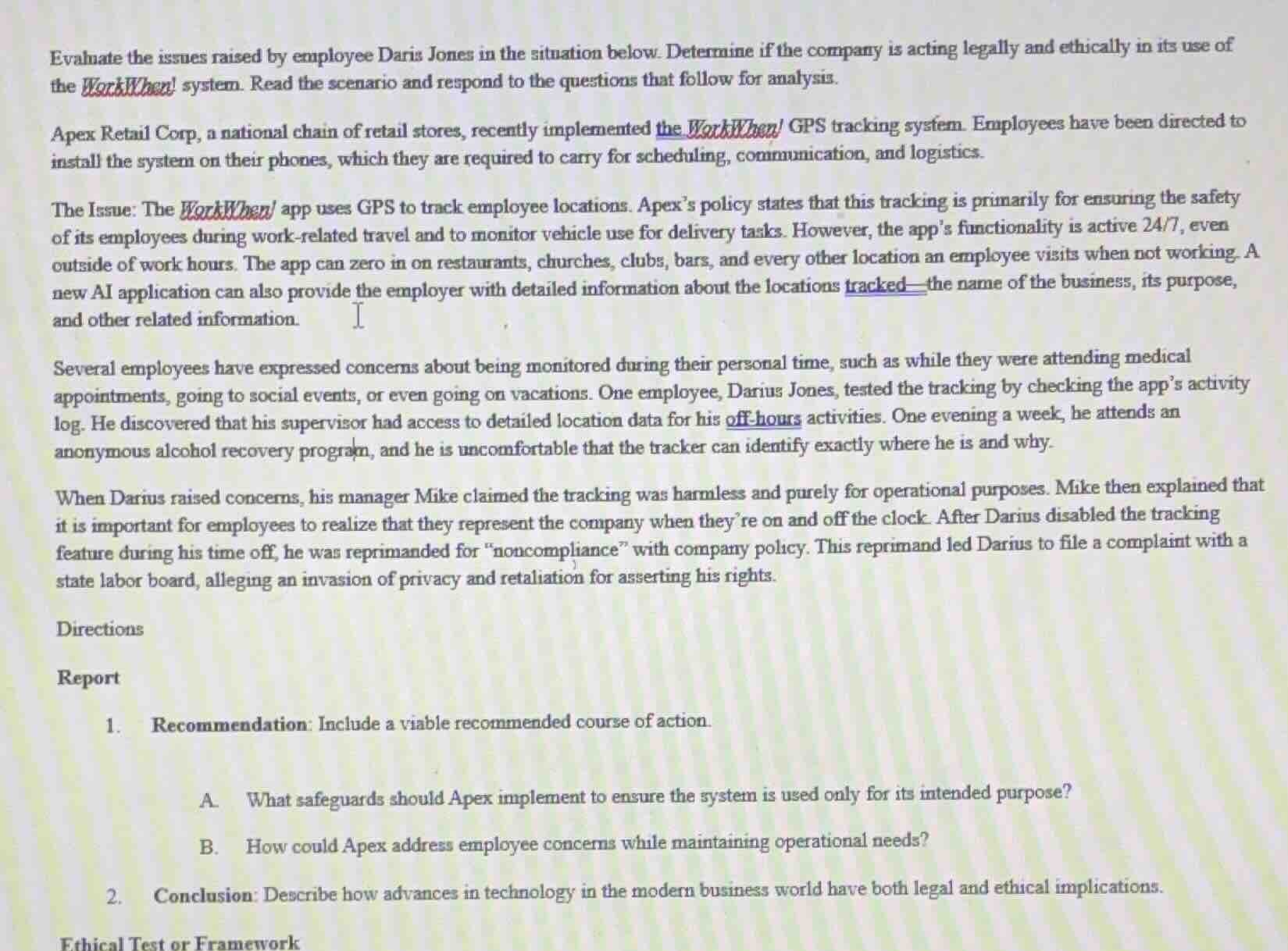
evaluate the issues raised by employee darius jones in the situation below. determine if the company is acting legally and ethically in its use of the workwhen! system. read the scenario and respond to the questions that follow for analysis. apex retail corp, a national chain of retail stores, recently implemented the workwhen! gps tracking system. employees have been directed to install the system on their phones, which they are required to carry for scheduling, communication, and logistics. the issue: the workwhen! app uses gps to track employee locations. apex’s policy states that this tracking is primarily for ensuring the safety of its employees during work - related travel and to monitor vehicle use for delivery tasks. however, the app’s functionality is active 24/7, even outside of work hours. the app can zero in on restaurants, churches, clubs, bars, and every other location an employee visits when not working. a new ai application can also provide the employer with detailed information about the locations tracked—the name of the business, its purpose, and other related information. several employees have expressed concerns about being monitored during their personal time, such as while they were attending medical appointments, going to social events, or even going on vacations. one employee, darius jones, tested the tracking by checking the app’s activity log. he discovered that his supervisor had access to detailed location data for his off - hours activities. one evening a week, he attends an anonymous alcohol recovery program, and he is uncomfortable that the tracker can identify exactly where he is and why. when darius raised concerns, his manager mike claimed the tracking was harmless and purely for operational purposes. mike then explained that it is important for employees to realize that they represent the company when they’re on and off the clock. after darius disabled the tracking feature during his time off, he was reprimanded for “noncompliance” with company policy. this reprimand led darius to file a complaint with a state labor board, alleging an invasion of privacy and retaliation for asserting his rights. directions report 1. recommendation: include a viable recommended course of action. a. what safeguards should apex implement to ensure the system is used only for its intended purpose? b. how could apex address employee concerns while maintaining operational needs? 2. conclusion: describe how advances in technology in the modern business world have both legal and ethical implications. ethical test or framework
1. Recommendation
A. What safeguards should Apex implement to ensure the system is used only for its intended purpose?
To ensure the WorkWhen! system is used for its intended purpose (employee safety during work - related travel and vehicle use for delivery tasks), Apex can take the following steps:
- Time - based Restrictions: Program the app to be active only during official work hours and during approved work - related travel time outside of work hours (e.g., if an employee has to travel to a work event outside of regular hours). This can be done by setting up a schedule in the app's backend where the GPS tracking is automatically disabled during non - work and non - approved travel times.
- Role - based Access: Limit access to location data. Only relevant personnel, such as logistics managers for delivery - related tracking and safety officers for employee safety during work travel, should be able to access the location data. Supervisors who do not have a direct role in these areas should not have access. This can be implemented through a user - access management system in the app's backend.
- Data Anonymization for Non - Operational Use: For any data that is collected (for example, if there is a need to analyze overall patterns of employee travel for operational improvement), anonymize the data so that individual employees cannot be identified. This way, the data can be used for legitimate business purposes without invading employee privacy.
- Audit Trails: Implement a system to audit who accesses the location data, when, and for what purpose. This will act as a deterrent against unauthorized access and also help in identifying any misuse of the system.
- Transparent Communication: Hold company - wide meetings or send detailed communications explaining the exact purpose of the tracking (safety during work travel, vehicle use for deliveries), how the data is used, and who has access. Share the safeguards (like the ones mentioned above) that are being put in place to protect employee privacy.
- Employee Feedback Mechanism: Set up a system where employees can provide feedback about the tracking system. This can be an anonymous survey or a dedicated email address. Use this feedback to make improvements to the system and address concerns in a timely manner.
- Alternative Communication and Scheduling Tools: For non - tracking related tasks like scheduling and communication, provide alternative apps or methods that do not require GPS tracking. This way, employees can fulfill their work - related communication and scheduling needs without having to be tracked at all times.
- Privacy Training: Conduct training sessions for employees about privacy laws, the company's commitment to protecting their privacy, and how the tracking system aligns with legal and ethical standards.
Legal Implications:
- Privacy Laws: Technologies like GPS tracking apps are subject to privacy laws such as the General Data Protection Regulation (GDPR) in Europe or state - level privacy laws in the US (e.g., California Consumer Privacy Act). If a company misuses such technology (e.g., tracking employees during personal time without proper authorization), it can face legal action, including fines and lawsuits. For example, in the case of Apex, if they are found to be violating employee privacy rights through the WorkWhen! app, they could be sued by employees or face penalties from regulatory bodies.
- Employment Laws: There are laws related to employee rights and employer - employee relationships. Retaliating against an employee (like reprimanding Darius for disabling the tracking during off - hours) for asserting their privacy rights can be a violation of employment laws, leading to legal consequences such as having to reinstate the employee, pay damages, or face penalties from labor boards.
Ethical Implications:
- Employee Privacy: Ethically, employees have a right to privacy in their personal lives. Using technology to track them 24/7, even during personal time, invades this privacy. It can lead to a breakdown of trust between the employer and employees. For example, Darius feels uncomfortable because his supervisor can track his off - hours activities, including his attendance at an alcohol recovery program.
- Employee Well - being: Constant tracking can cause stress and anxiety among employees. They may feel like they are always being watched, which can negatively impact their mental health and job satisfaction. This can also lead to a decrease in employee productivity and morale in the long run.
- Corporate Responsibility: Ethically, companies have a responsibility to use technology in a way that respects the rights and dignity of their employees. Misusing technology for unnecessary surveillance goes against this responsibility and can damage the company's reputation in the eyes of employees, customers, and the general public.
In summary, while technological advances like GPS tracking apps offer benefits for business operations (e.g., improved logistics, employee safety), they also bring with them legal risks if not used in compliance with privacy and employment laws, and ethical dilemmas related to employee privacy, well - being, and corporate responsibility.

Snap & solve any problem in the app
Get step-by-step solutions on Sovi AI
Photo-based solutions with guided steps
Explore more problems and detailed explanations
Apex can implement the following safeguards:
- Time - based Restrictions: Disable GPS tracking during non - work and non - approved work - related travel hours via the app's backend scheduling.
- Role - based Access: Limit location data access to only relevant personnel (e.g., logistics managers, safety officers) through a user - access management system.
- Data Anonymization: Anonymize data used for non - operational analysis to protect employee identity.
- Audit Trails: Create a system to record who accesses location data, when, and for what purpose to detect and prevent misuse.